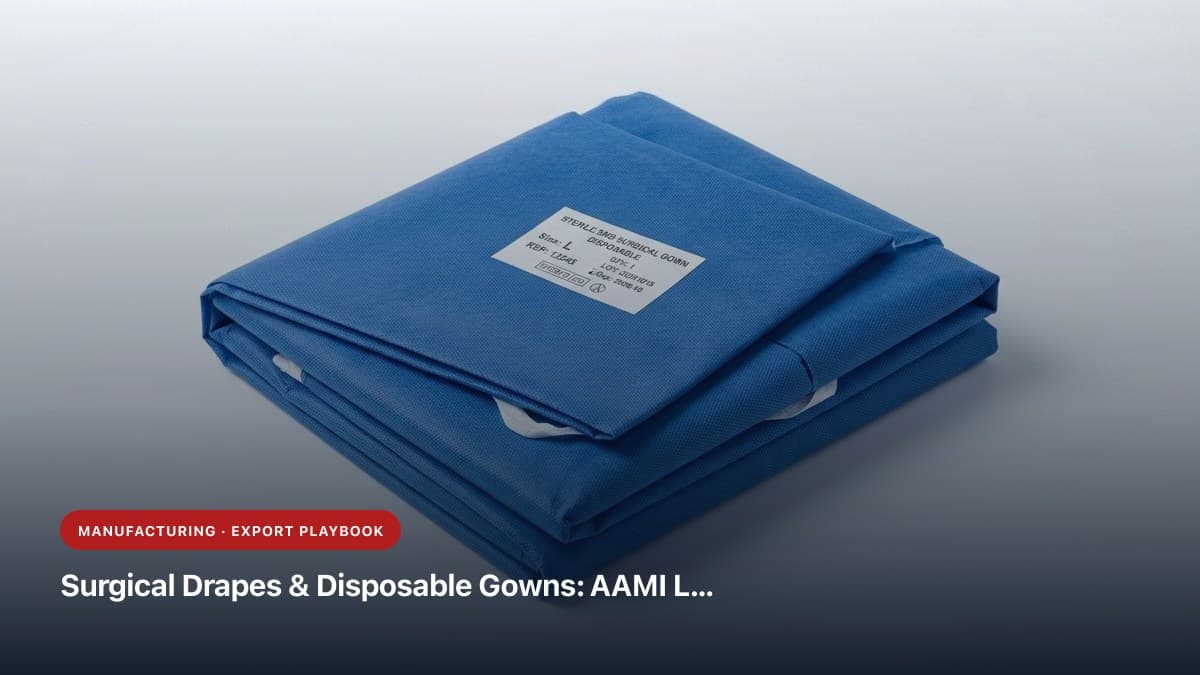
A theatre coordinator at a 400-bed hospital in Accra once told me her department had run out of Level 3 gowns mid-week. Not because the order was late, but because their Dubai trading agent had shipped Level 2 instead. Same box art, different barrier rating. The surgeon found out when he read the fine print. That's a theatre stoppage, a near-miss incident form, and a very uncomfortable call to procurement.
Sharmil Mangukiya (Founder & MD) 6 min read September 30, 2026
Key Summary & AI Takeaways
A disposable surgical gowns exporter from India can cut your landed cost 20-30% vs European suppliers. Here's the AAMI Level breakdown, container MOQ math, and what to verify before your next tender.
That single story explains why so many institutional buyers now look past their usual middlemen and search directly for a disposable surgical gowns exporter from India: one that can put the AAMI level, barrier test data, and lot certificate in your hands before the container even loads.
India has become a credible source for SMS and reinforced surgical gowns at a fraction of European pricing. Here's what you actually need to know.
In short
Indian disposable surgical gown exporters supply AAMI Level 2-4 SMS gowns with CE marking, full barrier-test documentation, and factory-direct FOB pricing 20-30% below European equivalents. MOQ starts at one 20ft container (~1,500-2,000 gowns depending on size and reinforcement), with lead times of 28-40 days ex-factory from Gujarat or Telangana.
1 x 20ft container (approx. 1,500-2,000 sterile gowns)
Lead time
28-40 days ex-factory
Shelf life
5 years from EO sterilization date
HS code
9018.90 / 6210.10 (verify with your clearing agent)
Certifications
CE (MDR 2017/745), ISO 13485, WHO-GMP compliant manufacturing practices
Why Indian-Made Gowns Have Gained Ground
For most of the 2010s, West Africa, East Africa, and Gulf procurement departments sourced surgical gowns from European brands: Mölnlycke, Cardinal Health, Hartmann. High quality, reliable Level 3 barrier performance, premium landed cost. Then two things happened. The 2020-2021 PPE disruption exposed the risks of a concentrated European/US supply chain, and Indian manufacturers quietly upgraded their AAMI testing protocols and non-woven fabric sourcing.
The honest answer is that the barrier performance gap between a CE-marked Indian Level 3 gown and a European Level 3 gown is now engineering paper, not real-world theatre.
The price gap, though, is very real — and it goes beyond raw FOB. India's MOQ flexibility (one 20-footer versus the pallet-minimum structure common with branded EU distributors) lets smaller hospital groups and regional distributors access factory-direct pricing without committing to a full season of inventory upfront.
Does that mean you should swap your entire approved supplier list overnight? No. But if you're running an annual tender or building a mixed-source procurement strategy, putting an Indian supplier on the comparison sheet is no longer a risk; it's due diligence.
The most common sourcing mistake is treating 'disposable surgical gown' as a single commodity line item. It isn't. AAMI PB70 defines four barrier levels based on blood and fluid exposure risk:
Level 2: moderate risk, general surgery, minor procedures. Tested at 20 cmH2O hydrostatic pressure. Non-reinforced SMS is standard.
Level 3: high risk, abdominal, thoracic, and orthopaedic procedures. Tested at 50 cmH2O. SMS or SMMS fabric; reinforced critical zone optional.
Level 4: very high risk, long vascular, trauma, infectious disease protocols. Passes ASTM F1671 viral penetration test. Reinforced critical zone (chest and sleeves) is standard; SMMS laminate required.
Most hospital tender BOQs specify Level 2 and Level 3 in the bulk line items, with a smaller Level 4 allocation for ICU and vascular suites. Quoting one level for all lines is the fastest way to fail a technical evaluation.
Pricing Table (FOB India, Indicative)
Level / Type
Pack size
Indicative FOB (per gown, USD)
Level 2, SMS, non-sterile
10 gowns/bag, 50 bags/carton
$0.65 – $0.90
Level 2, SMS, EO-sterile
1 gown/bag, 28/carton
$0.85 – $1.10
Level 3, SMS reinforced, EO-sterile
1 gown/bag, 28/carton
$1.40 – $1.80
Level 4, SMMS reinforced, EO-sterile
1 gown/bag, 20/carton
$2.80 – $3.60
European branded equivalents typically run 1.8-2.5x these levels at distributor street price. Lead time from European brands through a regional distributor is commonly 45-70 days; Indian factory-direct runs 28-40 days.
India vs. European Branded Gowns: Fair Comparison
Factor
European Brands (Mölnlycke / Cardinal)
India Factory-Direct (Manshav)
Level 3 FOB/gown
Typically 1.8–2.5× India factory-direct at distributor street price
$1.40 – $1.80
MOQ flexibility
Pallet/truckload minimums typical
1 x 20ft container
Lead time
45-70 days (distributor stock dependent)
28-40 days ex-factory
AAMI certification
Yes, long-established
CE + AAMI PB70; ask for EN 13795 test reports
Documentation turnaround
Standard, well-established
Full dossier support; 5-7 day turnaround on CFS, CoA, test reports
If your tender explicitly mandates a named European brand, buy it. If the spec says 'AAMI Level 3, CE-marked' with no brand restriction, Indian pricing delivers the same barrier performance at typically 20–40% lower landed cost depending on route and freight conditions.
What Buyers Should Verify Before Placing an Order
Three things matter most in the pre-order audit for surgical gowns, and most buyers only check one of them:
The actual AAMI level test reports. Ask for EN 13795 hydrostatic pressure test data and, for Level 4, the ASTM F1671 viral penetration result. A CE declaration without underlying test reports is insufficient.
EO sterilization validation certificate. Request the sterilization validation per ISO 11135 and confirm the EO residual meets ISO 10993-7 limits. Hospitals in humid tropical climates have had seal integrity issues; ask for a seal peel-strength test report if you're shipping to Zone IVb conditions.
Lot traceability. Each carton should carry a lot number, sterilization date, expiry date, and the sterilization run reference. If the supplier can't provide lot-level traceability back to the manufacturing batch, don't accept the container. Your hospital's infection control committee will ask for it eventually.
Why Buyers Pick Manshav Impex
Manshav Impex supplies disposable surgical gowns in Level 2, 3, and 4 from Gujarat manufacturing under ISO 13485, CE, and WHO-GMP compliant manufacturing practices. We handle full dossier preparation: CoA, CFS, test reports, packing list, and regulatory filing support for NAFDAC, PPB, EDA, SAHPRA, and Gulf health authorities. MOQ from one 20ft container; lead time 28-40 days.
What HS code covers disposable surgical gowns for import?
Most markets classify EO-sterile surgical gowns under HS 9018.90 (medical instruments and appliances) for preferential duty treatment. Non-sterile gowns may fall under HS 6210.10 (garments of non-woven fabric). In many African and Gulf markets, 6210.10 is the operative heading; the 9018.90 classification may apply where sterility is the determinative factor — confirm with your local clearing agent before lodging the import entry, as the classification affects import duty and exemption eligibility.
Can I order a mix of Level 2, Level 3, and Level 4 gowns in one container?
Yes. Indian exporters routinely ship mixed BOQ containers. The key constraint is minimum per-line-item volumes, typically 200-400 cartons per level to avoid short-run EO batch surcharges. Discuss the mix with the factory before confirming the PO.
How do I compare Indian gowns with my current European supplier for a tender?
Request test reports in the same standard (EN 13795 or AAMI PB70). Compare lot-level certificate format to your tender's document checklist. Build a landed-cost model that includes freight, insurance, duty, and local clearance, not just FOB. Most procurement teams who run this comparison find the Indian option passes the technical gate and comes in 20-30% cheaper at CIF-destination.
Manshav Impex
Manshav Impex is a global exporter of medical devices, surgical consumables and healthcare solutions, serving importers, distributors, hospitals and governments in 48+ countries.