Surgical Gowns for GCC Hospital Networks: Navigating the GCC Central Registration System
A Riyadh-based agent forwards a tender document for 400,000 AAMI Level 3 gowns under a NUPCO framework and asks for pricing in eleven days. Two weeks later, a Dubai private hospital group's procurement manager emails asking for a barrier-performance data sheet, a sample batch, and a call with their infection-control lead before they'll even discuss volume. Same region, same product, same six-letter regulator acronym on both desks, and two buyers who evaluate a surgical gown supplier in almost opposite ways.
Sharmil Mangukiya (Founder & MD) 8 min read September 18, 2026
Key Summary & AI Takeaways
A gown that clears Saudi SFDA and sells through NUPCO still needs a separate conversation with a Dubai private hospital buyer. Here's how the GCC's central registration system actually works across both paths.
What the GCC Central Registration System actually is
The Gulf Health Council (GHC), established in 1976 and linked to the GCC's General Secretariat, runs a genuine central registration mechanism covering the six GCC states (UAE, Saudi Arabia, Qatar, Kuwait, Bahrain, Oman) plus Yemen as an associate member. Its Medical Devices and Supplies Registration Committee operates what the industry shorthand calls GCC-DR (GCC Device Registration): a manufacturer submits one technical dossier through the GHC's central platform, a lead reviewer is assigned from a rotating pool of national regulatory authorities, other member-state authorities peer-review the assessment, and an approved device is meant to carry recognition across participating states.
The reality on the ground is more layered than the single-portal pitch suggests. Saudi Arabia's SFDA still runs its own national Medical Devices Marketing Authorization (MDMA) pathway, and most exporters use it as the primary route into the Kingdom rather than waiting on GCC-DR alone. SFDA is also the most active lead reviewer within GCC-DR itself. Bahrain's National Health Regulatory Authority (NHRA), Kuwait's MOH/MMPRRA, Oman's MOH Drug Safety Center, and Qatar's MoPH each maintain their own national registration requirements in parallel. A gown cleared centrally through GHC does not automatically skip a country's local listing or import-permit step. In practice, most exporters register nationally first and treat GCC-DR as the mechanism that shortens the second, third, and fourth country's paperwork, not the first.
MOH tender boards vs. private hospital groups: two different buyers
This is where a lot of new exporters misjudge the region. A Saudi MOH award and a UAE private hospital contract are not the same sales cycle, even though both sit inside the GCC bloc and both eventually reference the same underlying registration.
Saudi Arabia's public hospital and MOH facility supply runs almost entirely through NUPCO (National Unified Procurement Company), a Public Investment Fund-owned entity established in 2009 that centralizes procurement, warehousing, and distribution for government healthcare facilities across the Kingdom. Winning a NUPCO tender means qualifying as a registered supplier, holding valid SFDA marketing authorization, meeting the tender's specified AAMI protection level and quantity, and competing largely on documented compliance and delivered price. The tender board rarely visits your factory before award; it evaluates the dossier.
Private hospital groups in the UAE (Mediclinic Middle East, Aster DM Healthcare, Burjeel Holdings/VPS Healthcare, NMC Healthcare, Emirates Hospital Group) buy differently. Their facilities sit under DHA (Dubai) or DOH Abu Dhabi licensing, but procurement decisions are made by the hospital group's own supply chain and infection-control teams, not a central tender board. They want barrier performance data, fluid-resistance test reports, and often a trial batch before committing volume, and pricing negotiations happen alongside clinical sign-off, not purely on lowest landed cost. A supplier who only has a tender-ready compliance file and no technical data sheet or sample-shipment process will stall at this stage.
Factor
MOH / Government Tender (e.g. Saudi NUPCO)
Private Hospital Group Procurement
Decision maker
Central tender board, document-led
Hospital supply chain + infection-control team
Registration required
National MDMA/registration mandatory before bid
Registration required, but often just table stakes
Evaluation basis
Compliance to spec + price
Barrier data, sample trial, clinical fit + price
Cycle length
Weeks (tender window), then multi-year framework
Months, relationship-driven, often no fixed deadline
Volume pattern
Very high volume, single award
Lower volume per order, repeat purchasing
The gown spec that actually decides the deal
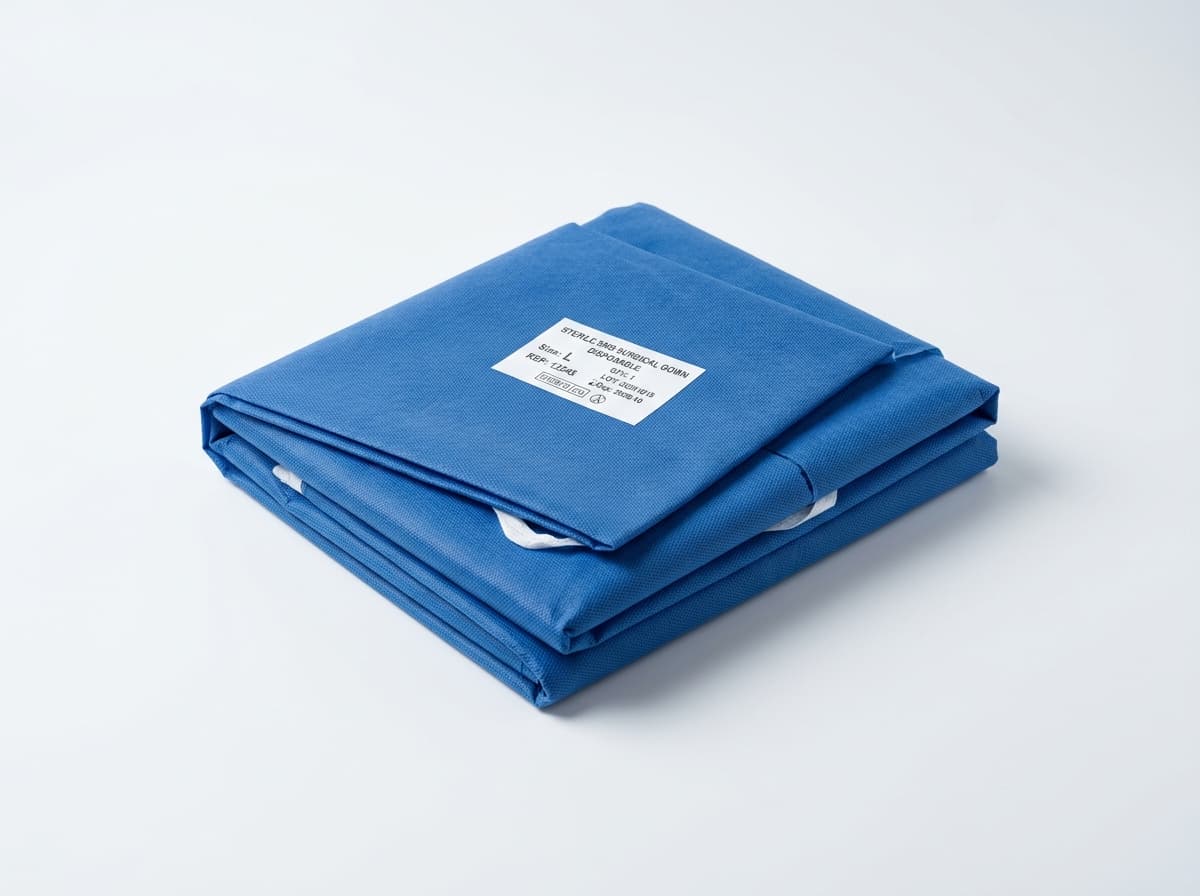
Both buyer types anchor to the same barrier standard, even when they evaluate it differently: AAMI PB70, which grades surgical gowns Level 1 through Level 4 by fluid and microbial barrier performance, from minimal-fluid minor procedures (Level 1) up to high-fluid, high-pressure exposure such as long orthopedic or trauma cases (Level 4). Gulf hospital tenders most commonly specify Level 3 SMS (spunbond-meltblown-spunbond) non-woven gowns for general OR use, with Level 4 reinforced gowns called out specifically for high-fluid specialties. Getting the level wrong on a tender submission is an automatic disqualification, not a negotiation point.
Sterility method matters too: most GCC tenders and private hospitals expect EO (ethylene oxide) or gamma-sterilized gowns with batch-level sterility documentation, not just a clean-room production claim.
Pricing and order volume reality
Indian manufacturers commonly quote disposable SMS surgical gowns to export buyers in the low single-digit dollar range per piece at container volumes, moving up meaningfully for Level 4 reinforced construction, though exact FOB pricing depends on GSM, reinforcement, sterilization method, and current raw-material cost and should always be confirmed against a current quote rather than a published number. MOQs for gowns supplied to Manshav Impex's export customers typically start in the low thousands of pieces for private hospital trial orders and scale into tens of thousands for framework-agreement or tender-linked volumes.
A gown carrying valid national registration plus certifications documentation can support both a NUPCO-style tender submission and a private hospital's technical review, but the sales conversation, sample process, and lead time expectations differ. Check current surgical gown specs and MOQs or request a quote with your target GCC country and buyer type specified.
A practical registration path for exporters
Most exporters serious about the GCC do not wait for GCC-DR alone. The working sequence is: secure national registration in the largest target market first (commonly Saudi SFDA MDMA, given market size), pursue GCC-DR recognition where the lead reviewer relationship already exists, then close remaining national gaps: Bahrain's NHRA in particular runs its own mandatory registration timeline independent of GCC-DR outcomes. Running both tracks in parallel, rather than sequentially, is what actually compresses the multi-country timeline. Waiting for one before starting the next just stacks review periods end to end.
The mistake we see most often is a supplier treating GCC-DR approval as a finish line. It's a shortcut on paperwork, not a substitute for the country-specific relationship: a NUPCO tender and a private Dubai hospital contract still get won separately, on separate evidence.
Documentation both buyer types will ask for
Valid national registration or listing (SFDA MDMA / NHRA / MOH / MoPH depending on target country)
AAMI PB70 level classification with supporting fluid-barrier test data
Sterilization method and batch sterility certificates (EO or gamma)
ISO 13485 quality management certification and CE technical file where applicable
GCC-DR submission status if pursuing multi-country recognition
Sample availability for private hospital trial evaluation ahead of bulk order
Exporters who keep this file current, rather than assembling it after a tender notice lands, are the ones who can respond to an eleven-day NUPCO deadline and a private hospital's data request in the same week without scrambling.
Frequently asked questions
Is the GCC Central Registration System the same as registering separately in each Gulf country?
No. The GCC Central Registration System, run by the Gulf Health Council, offers a shared dossier and peer-review pathway (GCC-DR) intended to ease multi-country recognition, but Saudi Arabia, Bahrain, Kuwait, Oman, and Qatar each still maintain their own national registration requirements that typically run alongside it, not instead of it.
Do I need SFDA registration if my gown already has GCC-DR approval?
For Saudi Arabia specifically, most exporters still pursue SFDA's national MDMA pathway directly, since SFDA is the most active lead reviewer in GCC-DR and its national process remains the primary route for market access and NUPCO tender eligibility.
What AAMI level surgical gown do Gulf hospital tenders usually specify?
Level 3 SMS non-woven gowns are the most commonly specified for general operating room use in GCC hospital tenders, with Level 4 reinforced gowns called out separately for high-fluid-exposure procedures such as trauma or orthopedic surgery.
Can the same gown be sold to both a NUPCO tender and a private UAE hospital group?
Yes, if it carries valid national registration and AAMI-level documentation, but expect two different evaluation processes: the tender board weighs compliance and price against a written spec, while a private hospital group typically wants barrier-performance data and a trial batch before committing to volume.
How long does GCC-DR review typically take?
The target review window is roughly 90 to 180 days, though actual timelines can extend well beyond that depending on device classification and which national authority is assigned as lead reviewer, so exporters should not build a launch plan around the fastest-case estimate.
What's the minimum order quantity for surgical gowns exported to GCC buyers?
It depends heavily on the buyer type: private hospital groups often start with trial orders in the low thousands of pieces, while MOH tender or NUPCO framework awards typically involve volumes in the tens of thousands or more per cycle.
Does Bahrain participate in GCC-DR the same way as Saudi Arabia and the UAE?
Bahrain is a GCC Health Council member and its NHRA participates in the regional framework, but NHRA also runs its own mandatory national medical device registration under Resolution 48/2020, with its own timeline and documentation set that exporters need to satisfy independently.
Manshav Impex
Manshav Impex is a global exporter of medical devices, surgical consumables and healthcare solutions, serving importers, distributors, hospitals and governments in 48+ countries.