IV Cannula Exporters: India vs. China — Raw Materials, Needle Grinds, Tariffs & Landed Cost
Intravenous cannulas (IV catheters) represent one of the highest-volume consumable purchases for hospital networks and healthcare distributors globally. When evaluating major export hubs, international procurement directors face a clear choice: source from established manufacturing clusters in China (Jiangsu, Zhejiang, Shandong) or India (Gujarat, Haryana, Rajasthan). While Chinese factories have historically competed on raw volume, Indian manufacturers have secured dominant market share across Africa, Latin America, and the Middle East due to superior Japanese needle bevel geometry, stricter cleanroom biocompatibility testing, and favorable bilateral tariff structures.
Sharmil Mangukiya (Founder & MD) 4 min read September 25, 2026
Key Summary & AI Takeaways
An engineering and commercial comparison between Indian and Chinese IV cannula manufacturers covering Japanese needle steel, catheter lubricity, international tariffs, and landed CIF margins.
Quick Buyer Summary: Sourcing IV Cannulas from India vs. China
For institutional tenders and hospital supply, Indian IV cannula manufacturers hold a clear clinical advantage in needle sharpness (using siliconized Japanese AISI 304 stainless steel with triple-facet back-cut grinds) and catheter material biocompatibility (medical-grade FEP and Polyurethane). Chinese exporters offer slightly lower ex-works pricing on standard PTFE cannulas but frequently trigger higher anti-dumping tariffs (5% to 25% across Latin America and parts of Africa) and higher minimum order barriers (typically 100,000 pcs per single gauge). Manshav Impex bridges this gap by offering Indian clinical precision with flexible gauge mixes (14G to 26G) starting from 20,000 units per size.
India vs. China: Comprehensive IV Cannula Sourcing Matrix
The table below benchmarks Indian and Chinese IV cannula manufacturing ecosystems across critical metallurgical, clinical, regulatory, and commercial metrics.
Evaluation Parameter
Indian Manufacturers (e.g. Manshav Impex)
Chinese Exporters (e.g. Jiangsu/Zhejiang Clusters)
Clinical & Procurement Impact
Needle Steel Origin & Grinding
Japanese SUS 304 Stainless Steel with siliconized 3-facet back-cut bevel
Domestic Chinese 304/316 Steel; variable robotic siliconization
Indian needles achieve <0.55 N penetration force, minimizing vein trauma and first-stick failure.
Catheter Tube Extrusion
Medical-Grade Fluorinated Ethylene Propylene (FEP) or Polyurethane (PUR)
Standard Polytetrafluoroethylene (PTFE) or generic FEP
FEP/PUR softens at body temperature, significantly lowering rates of mechanical phlebitis.
Radio-Opaque Striping
3 or 4 embedded barium sulfate stripes (co-extruded)
2 or 3 surface stripes; occasional pigment leeching in lower grades
Clear X-ray visualization is mandatory for ICU and pediatric emergency placement.
Flashback Chamber
High-clarity polypropylene with hydrophobic porous filter plug
Standard polystyrene or PP chamber; manual filter insertion
Rapid blood flashback confirmation without blood leakage or aerosol contamination.
Import Tariffs & Anti-Dumping
Standard MFN or preferential duty (0% to 10% under CEPA/MERCOSUR accords)
Subject to anti-dumping investigations and higher tariffs in emerging markets
India provides predictable landed costs without sudden anti-dumping duties.
MOQ & Gauge Flexibility
20,000 – 50,000 units total with mixed gauge allocation (14G–26G)
100,000 – 200,000 units rigid requirement per individual gauge
Indian manufacturers allow hospital distributors to order balanced clinical size ratios.
Automated tip-forming and cannula needle assembly under ISO Class 8 cleanroom conditions.
Material Science: Needle Geometry, Catheter Tapering & Penetration Force
The clinical performance of an IV cannula is determined by two critical contact interfaces: the needle tip sharpness and the catheter-to-needle transition bevel. A poorly tapered cannula causes 'peel-back' (where the plastic catheter bunches up during skin insertion), resulting in severe patient pain and immediate catheter failure.
Cannula Gauge
Color Code
Outer Diameter (mm)
Catheter Length (mm)
Water Flow Rate (mL/min)
Primary Clinical Application
14G
Orange
2.1 mm
45 mm
290 – 305 mL/min
Trauma, rapid blood transfusion, major surgery
16G
Grey
1.8 mm
45 mm
180 – 200 mL/min
Emergency room, surgical fluid replacement
18G
Green
1.3 mm
45 mm
90 – 105 mL/min
Standard surgical procedures, blood products
20G
Pink
1.1 mm
32 mm
60 – 65 mL/min
Routine medical/surgical infusion, IV medications
22G
Blue
0.9 mm
25 mm
36 – 40 mL/min
General medical ward, pediatric, elderly veins
24G
Yellow
0.7 mm
19 mm
20 – 23 mL/min
Pediatrics, neonatology, fragile sclerotic veins
26G
Violet
0.6 mm
19 mm
13 – 15 mL/min
Extremely fragile neonatal and oncology infusion
Total Landed Cost Breakdown: Ex-Works vs. Destination Port Delivery
A common procurement pitfall is selecting a supplier based solely on initial FOB quotations. Because IV cannulas are lightweight but space-consuming due to sterile blister packaging, freight efficiency and destination import tariffs heavily influence the final per-unit landed cost.
A standard 20ft export container holds approximately 250,000 IV cannulas (packed 50 pcs per inner box, 1,000 pcs per master carton = 250 cartons). Indian exporters shipping out of Port Mundra and Nhava Sheva provide direct shipping routes to the Middle East (4–8 days), East Africa (12–16 days), and West Africa (22–26 days)—nearly two to three weeks faster than maritime sailings from Shanghai or Qingdao.
Need direct factory FOB or CIF quotation for ISO 10555 certified IV cannulas?
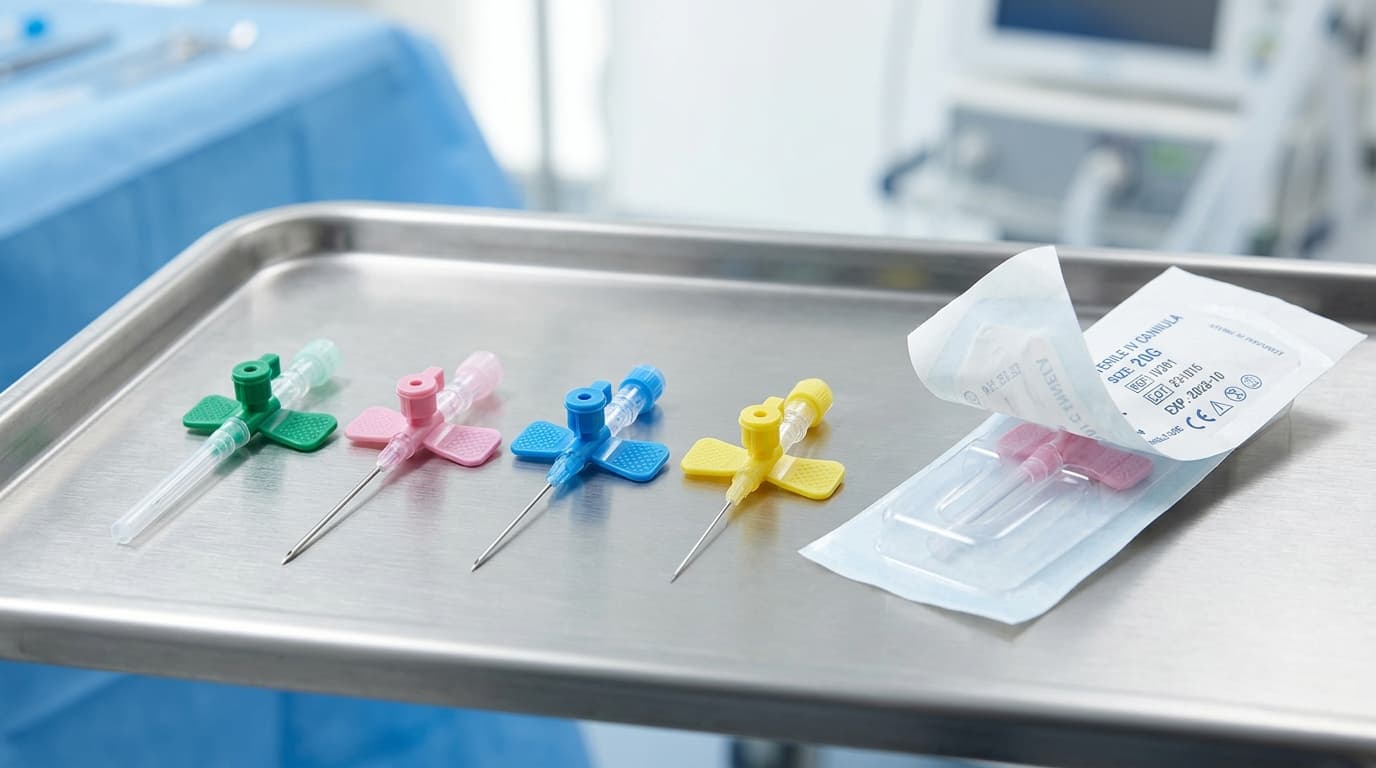
Sterile peripheral IV catheter with injection port, flexible stabilization wings, and radio-opaque FEP/PTFE catheter tubing, engineered for smooth atraumatic vein entry and reliable venous access. Container consignments dispatched from Port Mundra & Port Nhava Sheva, with certificates and test reports shared with every quotation.
Made to CE MDRMade to ISO 13485Made to ISO 10555-5MOQ: 50,000 pcs
What is the difference between FEP, PTFE, and PUR IV cannulas?
PTFE (Teflon) is a stiffer fluoropolymer common in low-cost Chinese exports. FEP (Fluorinated Ethylene Propylene) provides superior lubricity, higher flexibility, and embedded radio-opaque lines. PUR (Polyurethane) is the highest clinical grade, remaining rigid for smooth insertion but softening up to 50% at body temperature inside the vein, drastically lowering mechanical phlebitis.
Why are Indian IV cannulas preferred for international public hospital tenders?
Indian manufacturers utilize siliconized Japanese triple-bevel needles conforming to ISO 10555-1 and ISO 10555-5 standards, providing lot-specific penetration force test certificates (<0.55 N). Additionally, Indian manufacturers hold unblemished regulatory compliance under CDSCO and CE MDR, avoiding the anti-dumping penalties frequently applied to Chinese medical plastics.
What is the standard export packaging for IV cannulas?
Each IV cannula is sealed in a medical-grade blister pack consisting of thermoformed medical plastic and Tyvek/medical-grade paper. Packaging format: 50 or 100 units per inner dispenser box, and 1,000 to 2,000 units per 7-ply export master carton with moisture-barrier poly lining.
Can international buyers order mixed gauges in a single container?
Yes. Manshav Impex allows international distributors to order balanced clinical assortments across 14G, 16G, 18G, 20G, 22G, 24G, and 26G sizes in a single shipment, ensuring hospital buyers avoid carrying excess inventory of slow-moving gauges.
What documentation accompanies export shipments of IV cannulas from India?
Every consignment includes a Commercial Invoice, Packing List with gross/net weights and CBM, Bill of Lading, Legalized Certificate of Origin (COO), Batch Certificate of Analysis (CoA), Ethylene Oxide (EO) Sterilization Validation Report, and Free Sale Certificate (FSC).
Sharmil Mangukiya (Founder & MD)
Sharmil Mangukiya is the founder and managing director of Manshav Impex, an Indian manufacturer & exporter of medical disposables serving importers, distributors, hospitals and governments in 48+ countries since 2019.