IV Cannula Manufacturer in India vs China: The Comparison Tanzanian Importers Actually Run
Most importers in Tanzania end up with two shortlists for IV cannulae: a manufacturer in India and one in China. The FOB prices are close, the catalogues look alike, and both promise ISO 13485 and CE. What separates them shows up later — in the TMDA file, in the needle on the ward, in the clearance at Dar es Salaam and in how the second container compares with the first. This is the comparison experienced importers run before they decide.
Sharmil Mangukiya (Founder & MD) 5 min read October 20, 2026
Key Summary & AI Takeaways
Indian and Chinese cannula quotes often sit within a few cents of each other. The importers who choose well compare six things before the price — here they are, with Dar es Salaam as the worked example.
An IV cannula is judged in the first three seconds of use: does the needle go in cleanly, does the catheter follow without kinking, does the flashback show at once. A distributor's reputation with a hospital rests on that, not on the carton price. So the comparison below starts with the product and ends with the price, in that order.
How do importers compare an IV cannula manufacturer in India with one in China?
They compare the same six things on both sides: the catheter and needle specification per gauge, the documents the regulator will accept, sample performance in a real ward, packing density, landed cost to Dar es Salaam, and how the manufacturer behaves after the first order. A supplier that wins four of the six is usually the right one, whichever country it sits in.
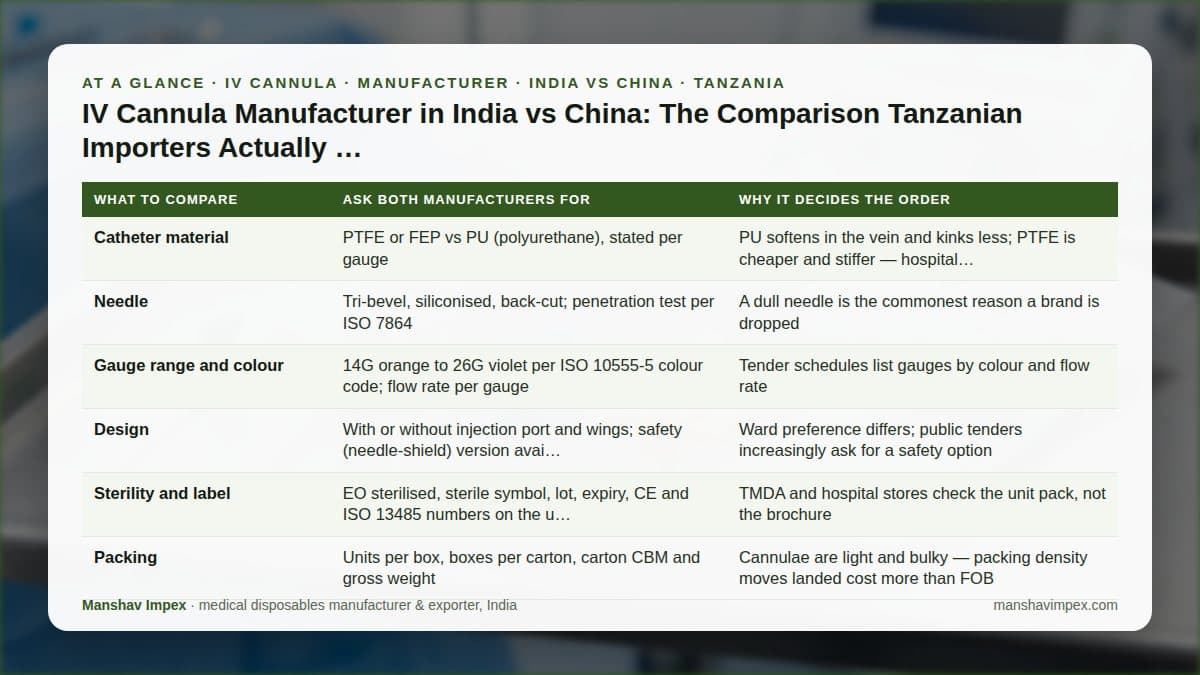
What to compare
Ask both manufacturers for
Why it decides the order
Catheter material
PTFE or FEP vs PU (polyurethane), stated per gauge
PU softens in the vein and kinks less; PTFE is cheaper and stiffer — hospitals notice
Needle
Tri-bevel, siliconised, back-cut; penetration test per ISO 7864
A dull needle is the commonest reason a brand is dropped
Gauge range and colour
14G orange to 26G violet per ISO 10555-5 colour code; flow rate per gauge
Tender schedules list gauges by colour and flow rate
Design
With or without injection port and wings; safety (needle-shield) version available
Ward preference differs; public tenders increasingly ask for a safety option
Sterility and label
EO sterilised, sterile symbol, lot, expiry, CE and ISO 13485 numbers on the unit pouch
TMDA and hospital stores check the unit pack, not the brochure
Packing
Units per box, boxes per carton, carton CBM and gross weight
Cannulae are light and bulky — packing density moves landed cost more than FOB
The TMDA file: where the two shortlists separate
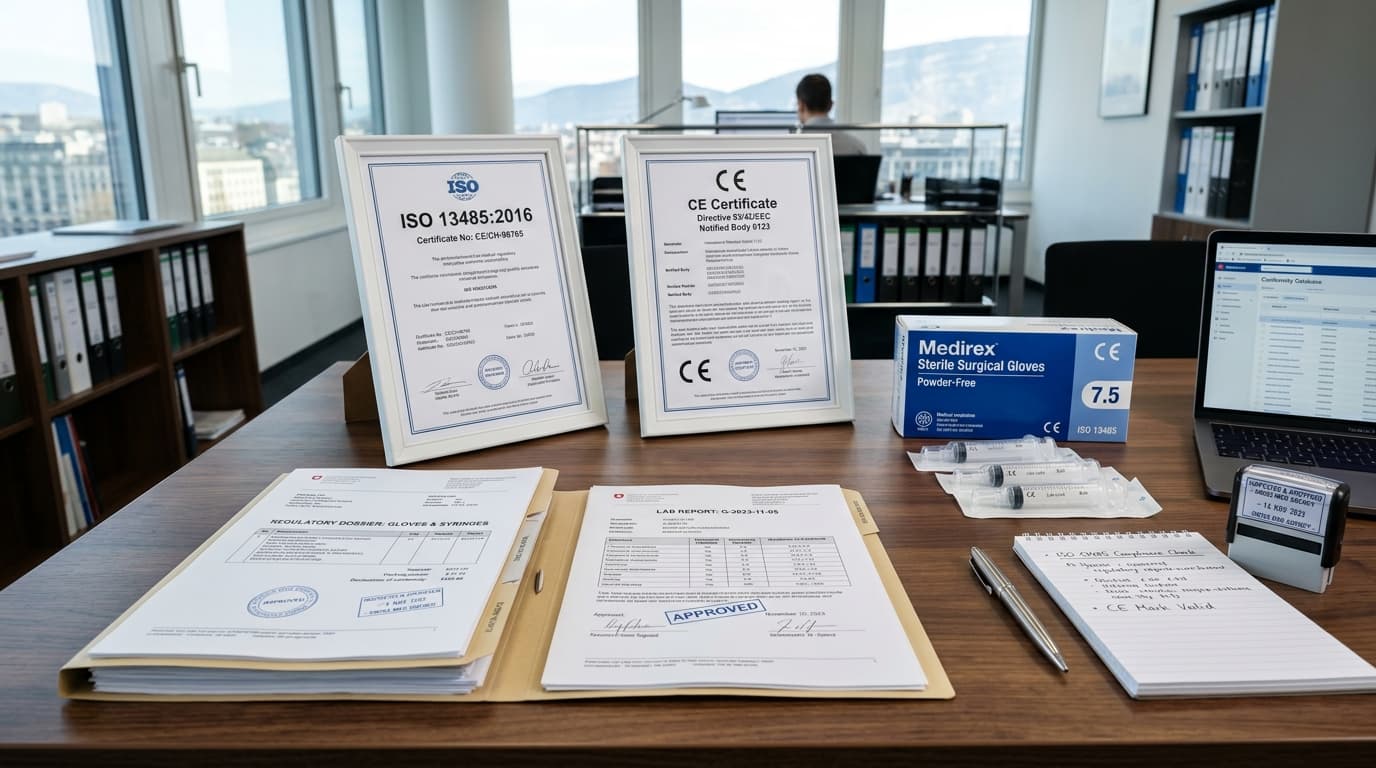
Tanzania's regulator, the Tanzania Medicines and Medical Devices Authority (TMDA), registers medical devices through the local importer, and most consignments also need a TBS certificate of conformity issued in India or China before shipment. The file is where many Chinese quotes stall: the ISO 13485 certificate is in a trading company's name while the product is made elsewhere, the CE evidence is for a different variant, or the free sale certificate takes weeks. Ask both manufacturers for the complete set before you compare prices, and check that every certificate carries the same legal name as the commercial invoice. Requirements change — verify current TMDA guidance before you commit to an order.
ISO 13485 certificate of the actual manufacturing site, in the same legal name as the invoice.
CE certificate or declaration covering IV cannulae (the variant you buy — with port, without port, safety).
Free sale certificate from the country of manufacture.
Technical data sheet per gauge: catheter material and length, needle gauge, flow rate, sterilisation method, shelf life.
Sterilisation validation summary, lot-wise sterility and pyrogen test reports, and a sample label.
The key checks from this guide at a glance.
Buyer tip
Order paid samples of the same three gauges (18G, 20G, 22G) from both shortlisted manufacturers and give one box of each to a nurse in charge at a hospital you supply, unlabelled. Ask for one thing only: which box they would reorder. That answer has settled more India-versus-China decisions than any certificate, and it costs a courier fee.
Landed cost to Dar es Salaam, not FOB
Sea freight from Mundra or Nhava Sheva to Dar es Salaam is typically 15–25 days port to port; from southern China it is usually longer, and transhipment is more common. Cannulae ship as light cargo, so the quote that packs more units per carton — without crushing the blister — often lands cheaper even at a higher FOB. Run the comparison to the warehouse door: FOB, freight, insurance, port charges, TBS and clearing agent fees, inland transport. For prices, request a current quotation from each manufacturer on the same gauge mix, packing, Incoterm and port, and compare like for like.
Cost line
Compare on
Typical trap
FOB price
Same gauge mix, same design (port / no port), same pack size
A no-port cannula quoted against a ported one
Freight
Carton CBM × cartons per order; FCL vs LCL
A smaller carton with fewer units
Documents
Who pays for TBS inspection and the certificate of conformity
Left out of the quote, charged later
Payment
Advance share, balance against B/L copy, or L/C
A low price that needs 100% advance
Rejection risk
Replacement policy for a failed lot
No answer in writing
The cheaper cannula is the one the ward keeps asking for; the other one is the one you keep explaining.
We manufacture and export IV cannulae in 14G–26G, with and without injection port, plus a safety IV cannula, with per-gauge technical sheets for TMDA files.
Why Tanzanian distributors pair cannulae with the rest of the container from India
A cannula line rarely fills a container on its own. Distributors in Dar es Salaam, Mwanza and Arusha usually consolidate cannulae with IV sets, syringes, gloves and blood collection tubes in one consignment from India, which keeps freight and clearance cost per line down and gives the TMDA file one manufacturer name across products. An Indian manufacturer that can quote the whole infusion range together is worth more than a cheaper cannula on its own.
Planning a mixed container to Dar es Salaam — cannulae with IV sets, syringes and gloves?
Sterile peripheral IV catheter with injection port, flexible stabilization wings, and radio-opaque FEP/PTFE catheter tubing, engineered for smooth atraumatic vein entry and reliable venous access. Container consignments dispatched from Port Mundra & Port Nhava Sheva, with certificates and test reports shared with every quotation.
Made to CE MDRMade to ISO 13485Made to ISO 10555-5MOQ: 50,000 pcs
Is an Indian IV cannula better than a Chinese one?
Neither country guarantees quality — the manufacturer does. Compare catheter material, needle sharpness, the regulatory file and samples on the ward; Indian manufacturers tend to win on documentation in a matching legal name and shorter transit to East Africa, which matters for a TMDA file and a delivery date.
Which IV cannula gauges do Tanzanian hospitals buy most?
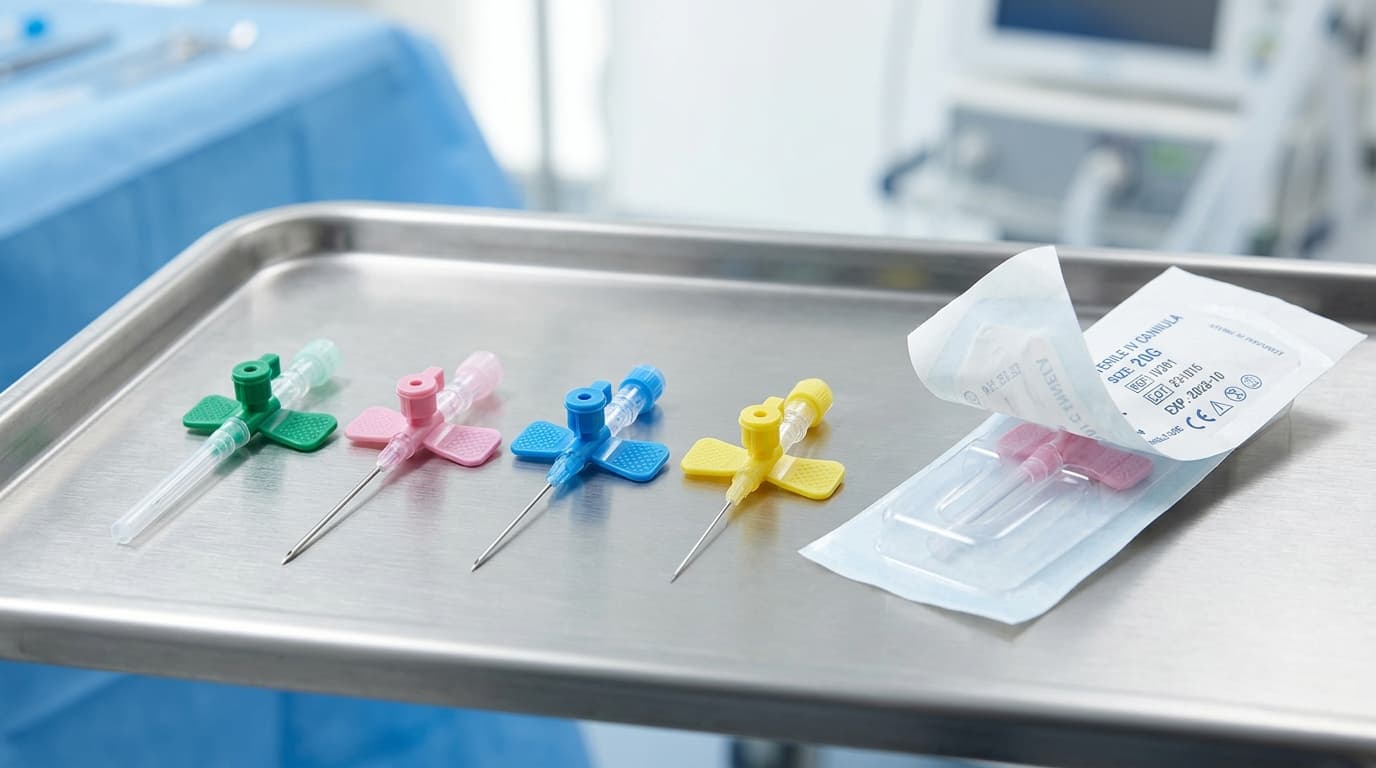
20G (pink) and 22G (blue) are the volume sizes for adult wards, with 18G (green) for surgery and emergency and 24G (yellow) for paediatrics. Most orders carry a small share of 14G, 16G and 26G. Specify the gauge mix per carton on the purchase order.
Who regulates IV cannula imports into Tanzania?
The Tanzania Medicines and Medical Devices Authority (TMDA) registers medical devices through the local importer, and the Tanzania Bureau of Standards (TBS) runs the pre-shipment conformity scheme for many goods. Confirm the current requirements with both before ordering.
What does an IV cannula cost from an Indian manufacturer?
Prices move with gauge, design (with or without port, safety), packing and quantity, so request a current quotation. Compare offers on the same gauge mix, design, units per carton, Incoterm and port, then work the figure to landed cost in Dar es Salaam.
Should I ask for a safety IV cannula?
Public tenders and larger hospitals increasingly specify a needle-shield safety cannula to protect staff from needle-stick injury. Keep the standard cannula for volume and quote the safety version as a separate line so the buyer can choose.
Sharmil Mangukiya (Founder & MD)
Sharmil Mangukiya is the founder and managing director of Manshav Impex, an Indian manufacturer & exporter of medical disposables serving importers, distributors, hospitals and governments in 48+ countries since 2019.