IV Set Supplier for Nigeria: What Hospital Procurement Checks Before Buying from India
An IV set is a cheap line that a hospital buys in the tens of thousands, so a small fault multiplies fast: a roller clamp that slips, a drip chamber that won't fill, a spike that cracks in a glass bottle. For procurement officers at Nigerian teaching, federal and private hospitals, the question is not only price per set but whether the next ten cartons will behave like the sample. This is the checklist they run before buying from an Indian supplier.
Sharmil Mangukiya (Founder & MD) 3 min read October 18, 2026
Key Summary & AI Takeaways
Nigerian wards go through IV sets faster than almost any other consumable. Here is what hospital buyers check — drop factor, filter, spike, clamp and paperwork — before they switch supplier.
Gravity infusion sets made to ISO 8536-4 are the workhorse on Nigerian wards. Hospitals typically buy an adult macro-drip set as the main line, a micro-drip or burette set for paediatrics, and blood transfusion sets separately. Each needs its own specification line — mixing them in one tender row is where many purchases go wrong.
How do Nigerian hospitals choose an IV set supplier?
They compare the set against a written specification — drop factor, filter, spike, clamp, tubing length and connector — then check sterility and labelling, then trial a sample lot on the ward. A supplier who documents every one of those per line, and whose papers support NAFDAC requirements through the importer, goes on the shortlist; price decides between shortlisted suppliers, not before.
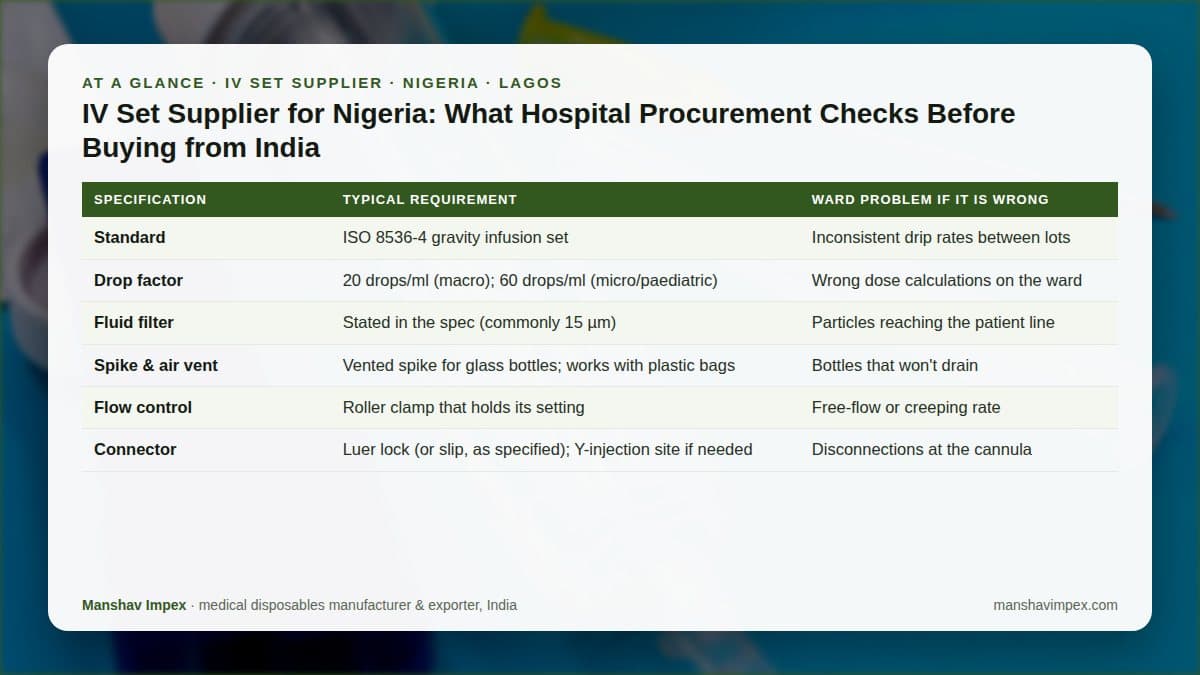
Vented spike for glass bottles; works with plastic bags
Bottles that won't drain
Flow control
Roller clamp that holds its setting
Free-flow or creeping rate
Connector
Luer lock (or slip, as specified); Y-injection site if needed
Disconnections at the cannula
Sterility & label
EO sterilised, single-use, lot and expiry on each pouch
Rejection at receiving or audit
NAFDAC, importers and the paperwork
In Nigeria the importer of record normally holds NAFDAC registration for the product, so the supplier's job is to provide a complete technical file: ISO 13485 certificate, product specification, sterilisation evidence, labels and instructions for use, and certificates of analysis per lot. Requirements and timelines change — confirm current guidance with NAFDAC and your registration agent before you plan deliveries.
The key checks from this guide at a glance.
Buyer tip
Run the sample on the ward that uses the most IV sets, not in the stores. Ask two nurses to set up ten sets each with your usual bottles and bags, and note any spike that leaks, clamp that drifts or chamber that over-fills. Twenty real set-ups tell you more than any certificate.
Nurses never read the certificate. They remember the clamp that let a bag run dry overnight.
We export IV infusion sets — macro and micro drip, vented spikes, Luer lock — with per-lot certificates of analysis.
IV sets are bulky for their value, so freight per set matters. Most Nigerian buyers bring them by sea into Lagos (Apapa or Tin Can Island) and fill the container with other fast-moving consumables — cannulas, syringes, gloves and urine bags — to spread the freight. Plan clearance time into stock levels: a ward that runs out of IV sets does not wait for the port.
Ask for the carton count and volume per 1,000 sets so you can plan container space.
Keep IV sets, cannulas and extension lines from the same supplier where possible — one technical file, one consignment.
For prices, request a current quotation and compare the same drop factor, filter, connector, sterility and Incoterm.
Want IV sets quoted in a mixed container with cannulas, syringes and gloves?
Medical-grade IV infusion administration sets featuring sharp spike with bacterial air vent, transparent drip chamber with 15µm fluid filter, roller clamp for accurate drop regulation, and latex-free injection site. Container consignments dispatched from Port Mundra & Port Nhava Sheva, with certificates and test reports shared with every quotation.
Made to CE MDRMade to ISO 13485Made to ISO 8536-4MOQ: 50,000 pcs
What is the standard drop factor for IV sets in Nigeria?
Adult gravity sets made to ISO 8536-4 are usually 20 drops per ml; paediatric micro-drip sets are 60 drops per ml. The drop factor should be printed on the pack and written into the specification so ward dose calculations stay correct.
Do IV sets need NAFDAC registration?
Medical devices sold in Nigeria are regulated by NAFDAC, and registration is normally held by the local importer. Confirm the current requirements for IV sets with NAFDAC or your registration agent.
What is the difference between an IV set and a blood transfusion set?
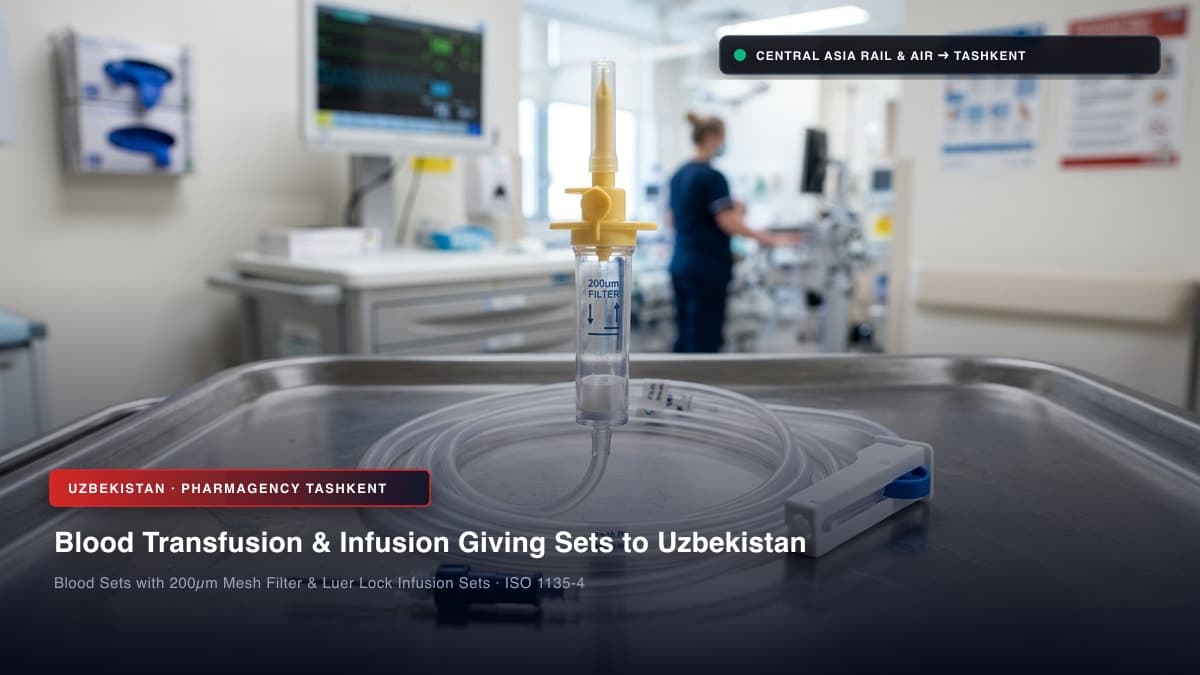
A blood transfusion set has a larger filter chamber (commonly around 200 µm) designed for blood components and a different drip chamber. It should be bought as its own line, not substituted with a standard infusion set.
Are Indian IV sets accepted by Nigerian hospitals?
Yes, Indian-made IV sets are widely used in Nigeria. Hospitals still check the specification, sterility, labelling and lot certificates, and most trial a sample lot on the ward before switching supplier.
How much does an IV set cost from India?
It depends on drop factor, filter, connector, packing and quantity, so request a current quotation and compare suppliers line by line on the same specification and Incoterm.
Sharmil Mangukiya (Founder & MD)
Sharmil Mangukiya is the founder and managing director of Manshav Impex, an Indian manufacturer & exporter of medical disposables serving importers, distributors, hospitals and governments in 48+ countries since 2019.