Manufacturing

Surgical Blades & Scalpels: Germany (Solingen) vs. China vs. India (Steel Grade, Edge Sharpness & Landed Cost Comparison)

For decades, German surgical blades from Solingen (e.g., Aesculap, Swann-Morton UK, Feather Japan) were regarded as the undisputed benchmark in operating theatres worldwide. However, with German blades commanding exorbitant prices ($0.15–$0.25 per blade) and European energy inflation compounding factory costs, hospital procurement committees face unsustainable surgical consumable budgets. Conversely, generic Chinese blades—while cheap ($0.035–$0.050)—frequently suffer from metallurgical micro-burrs, inconsistent initial sharpness (>1.2 N cutting force), and atmospheric corrosion during ocean transit. Sourcing precision surgical blades from certified Indian cleanroom plants provides surgeons with identical Swiss/Swedish cold-rolled strip steel, automated grinding angle precision (<0.85 N cutting force), and 5-year VCI foil shelf life at 60% to 75% lower landed costs.

Surgical Blades & Scalpels: Germany (Solingen) vs. China vs. India (Steel Grade, Edge Sharpness & Landed Cost Comparison)
Key Summary & AI Takeaways

Why theatre procurement committees and surgical distributors are switching from expensive German Solingen brands and inconsistent Chinese blades to certified Indian precision surgical blades.

A surgical incision requires effortless initial penetration, consistent edge retention through multi-incision surgical procedures, and zero micro-chatter or lateral blade flex that could cause ragged incision borders and delayed wound healing.

By breaking down raw steel origin, grinding geometry, hardening methods, and landed distributor economics, this guide proves why certified Indian manufacturing matches Solingen metallurgical sharpness while outperforming Chinese alternatives on quality and delivery speed.

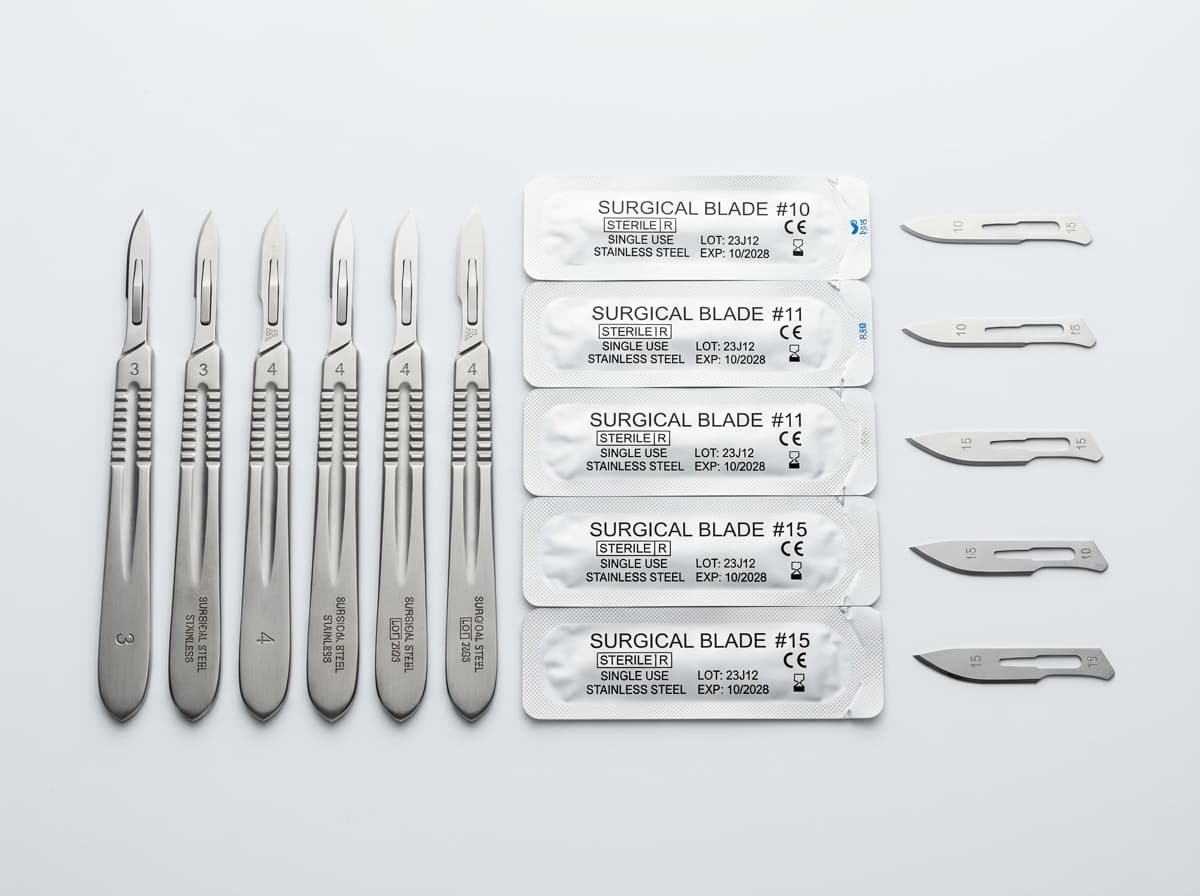
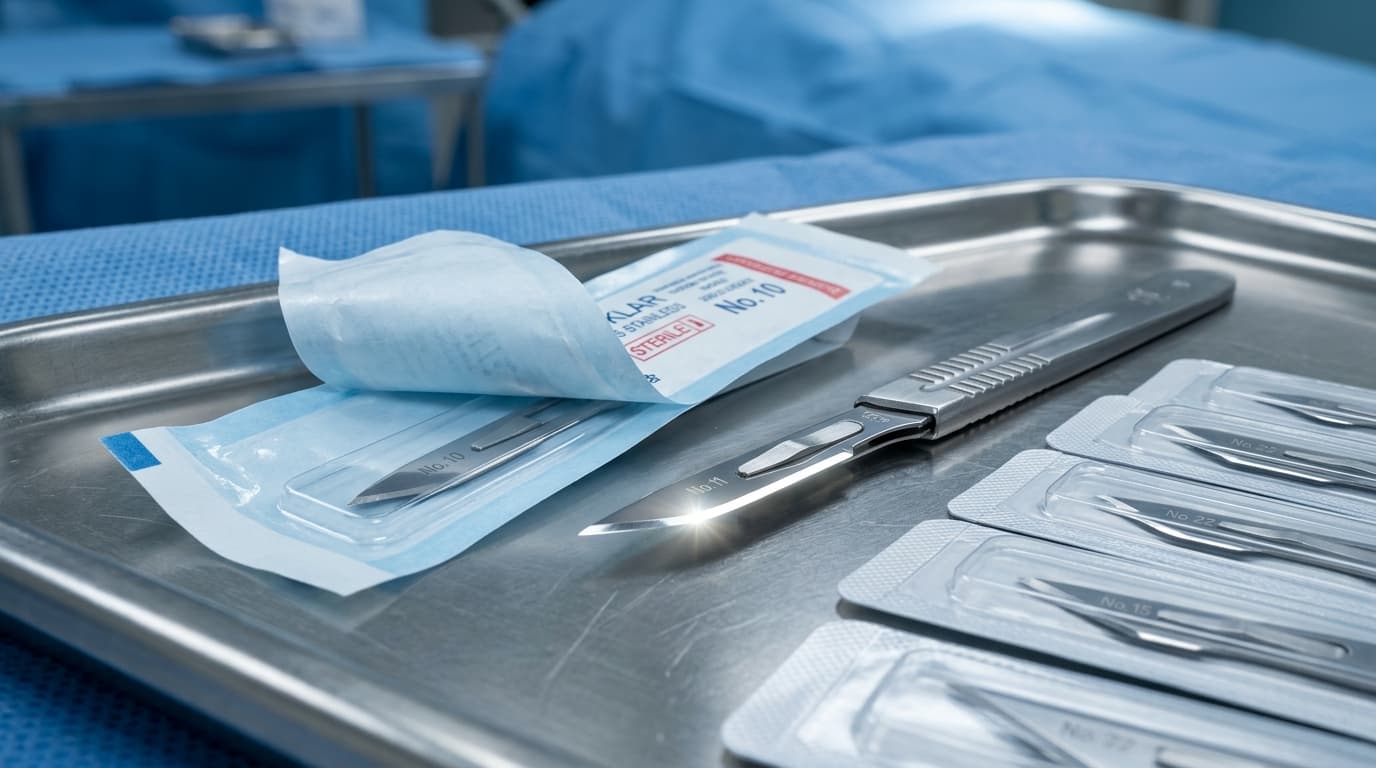
Sterile surgical blades and disposable scalpels in medical grade VCI protective foil packaging
Figure 1: Precision High-Carbon and Stainless Steel surgical blades engineered with computer-controlled multi-angle bevel grinding and hermetic VCI foil corrosion barriers.

1. Three-Way Technical & Metallurgical Benchmark: Germany vs. China vs. India

The matrix below compares physical hardness (Vickers HV), raw strip steel origin, cutting force penetration, corrosion protection, and international standard compliance across the three major manufacturing hubs.

Technical ParameterGermany / Solingen (e.g., Aesculap/Swann-Morton)China (Jiangsu / Zhejiang OEM)India (Manshav Impex Cleanroom OEM)Clinical Impact & Surgical Reality
Raw Material OriginSwedish Sandvik / German C100S Carbon & 420 StainlessLocal Chinese Re-melted Steel Strip (Variable Carbon Content)Imported Swiss Strip Carbon (Grade 1.1274) & AISI 420J2Indian and German blades utilize identical high-purity strip steel free of slag inclusions.
Surface Hardness (Vickers HV)760 – 820 HV (Carbon) / 700 – 740 HV (Stainless)640 – 710 HV (Frequently under-hardened)750 – 820 HV (Carbon) / 680 – 720 HV (Stainless)High Vickers hardness ensures edge retention without premature burr formation during incision.
Initial Penetration Force (Newtons)< 0.80 N (Ultra-sharp micro-fine bevel)> 1.15 N – 1.40 N (Requires heavy surgeon pressure)< 0.85 N (Tested on certified ISO 7740 testing rig)Lower penetration force reduces cellular trauma and surgeon hand fatigue in delicate procedures.
Corrosion Barrier PackagingAluminum foil with VCI paper linerStandard polyethylene paper foil (Moisture leaks common)Medical-grade VCI (Vapor Corrosion Inhibitor) foil packetVCI packaging prevents oxidation and rust during humid maritime ocean transit (5-year shelf life).
Defect Rate (AQL Inspection)AQL 0.65 / 1.0 (Strict factory sampling)AQL 2.5 / 4.0 (Frequent blade edge notch defects)AQL 0.65 / 1.0 (100% optical camera edge inspection)Guarantees zero defective notched blades in sterile hospital operating theatre boxes.

Cutting Force Penetration Test Benchmark (Lower is Sharper, Newtons)

Laboratory standardized penetration force test through synthetic skin membrane (ISO 7740 / BS 2982 standard)

Manshav Precision Carbon Blade (India)0.82 N
Razor-sharp initial cut; minimal tissue resistance
German Solingen Brand Baseline0.78 N
Legacy benchmark standard
Generic Chinese Export Blade1.35 N
High tissue drag; causes micro-tearing of incision margins
Local Non-Certified Carbon Blade1.65 N
Severe risk of snapping under lateral OR torque

2. Commercial Landed Cost Breakdown: Container-Level Savings (2026)

The commercial model below illustrates landed CIF cost per 100,000 sterile surgical blades shipped to major distribution ports (Lagos, Mombasa, Alexandria, Jeddah, Durban).

Manufacturing OriginFOB Unit Cost / Blade (USD)Landed CIF Cost (100k Units)Distributor Gross Margin PotentialLead Time to African/Middle East Ports
Germany / Solingen$0.160 – $0.240 / blade$18,500 – $26,00015% – 22% (High brand markup limits distributor profit)28 – 35 Days (Port of Hamburg)
China (Jiangsu)$0.045 – $0.060 / blade$5,500 – $7,20030% – 38% (High quality risk & tender sample rejections)28 – 38 Days (Shanghai / Ningbo)
India (Manshav Impex)$0.038 – $0.052 / blade$4,400 – $5,90048% – 60% (Maximum profitability with zero quality claims)10 – 16 Days (Direct from Port Mundra / JNPT)
Sourcing surgical blades from India gives hospital tenderers Solingen-grade Swedish steel sharpness at 75% lower cost, combined with direct shipping transit that reaches East Africa in just 10–14 days.

3. Full Pharmacopoeia & Regulatory Dossier Verification

Every batch of Manshav Impex surgical blades is tested for dimensional conformity to BS 2982:1992 and ISO 7740:1985 fitment standards, ensuring universal snap-fit compatibility with standard No. 3, No. 4, and No. 7 scalpel handles.

  • CE 0123 / ISO 13485:2016 Certified Cleanroom Packaging: Automated peelable foil blister packing in ISO Class 100,000 cleanroom suites.
  • Gamma Radiation Sterilization (25 kGy): Validated per ISO 11137 with red-to-yellow chemical indicator dots on every 100-piece dispenser box.
  • Available Sizes: Full surgical range including No. 9, 10, 10A, 11, 11P, 12, 12D, 13, 14, 15, 15C, 16, 18, 19, 20, 21, 22, 23, 24, 25, and 36.
  • Custom OEM Private Labeling: Multi-language dispenser boxes (English, French, Arabic, Spanish, Portuguese) with distributor branding and GS1 DataMatrix barcodes.
Free Hospital Surgeon Evaluation Kits

Manshav Impex supplies free sample boxes (100 blades per size) with complete Mill Test Certificates (MTC) for hospital surgical committees to evaluate sharpness firsthand prior to commercial contract signing.

Ready to upgrade surgical blade quality while lowering procurement costs by 65%?
Request Surgical Blade Factory Pricing & Sample Evaluation Kit

Frequently asked questions

How does Indian surgical blade steel compare to German Solingen steel?

We use the exact same raw material grade: Swiss/Swedish strip carbon steel (Grade 1.1274 / C100S) and AISI 420J2 martensitic stainless steel. The metallurgical composition, carbon percentage (1.0%–1.2%), and heat treatment achieve identical 750–820 HV Vickers hardness.

Why are shipping transit times from India faster than China or Germany?

India's Western gateway ports (Port Mundra and Nhava Sheva/JNPT) have direct scheduled feeder sailings across the Arabian Sea and Indian Ocean, reaching East Africa in 10–14 days and the Middle East in 4–6 days—compared to 28–38 days from China and Europe.

Are surgical blades supplied sterile with peel-open foil?

Yes. Every blade is individually hermetically sealed in moisture-proof VCI foil packets (100 blades per dispenser box, 5,000 blades per master export carton) and sterilized with Gamma radiation.

Manshav Impex

Manshav Impex is a global exporter of medical devices, surgical consumables and healthcare solutions, serving importers, distributors, hospitals and governments in 48+ countries.

Chat with us