How to Choose a Surgical Gloves Supplier in India: a Buyer's Checklist
Every exporter on page one calls itself the best. Buyers who import gloves year after year ignore the label and run the same six checks - this is that list, written down.

In Mexico, a surgical glove offer is judged twice. First by the paperwork, because the glove has to be registered and labelled for the Mexican market before a hospital can buy it. Then by the theatre nurses, who decide in a week of trial use whether the glove tears at the cuff or slips on a wet instrument. A distributor who prepares for both rounds wins the contract; one who prepares only for price usually loses it at the second.
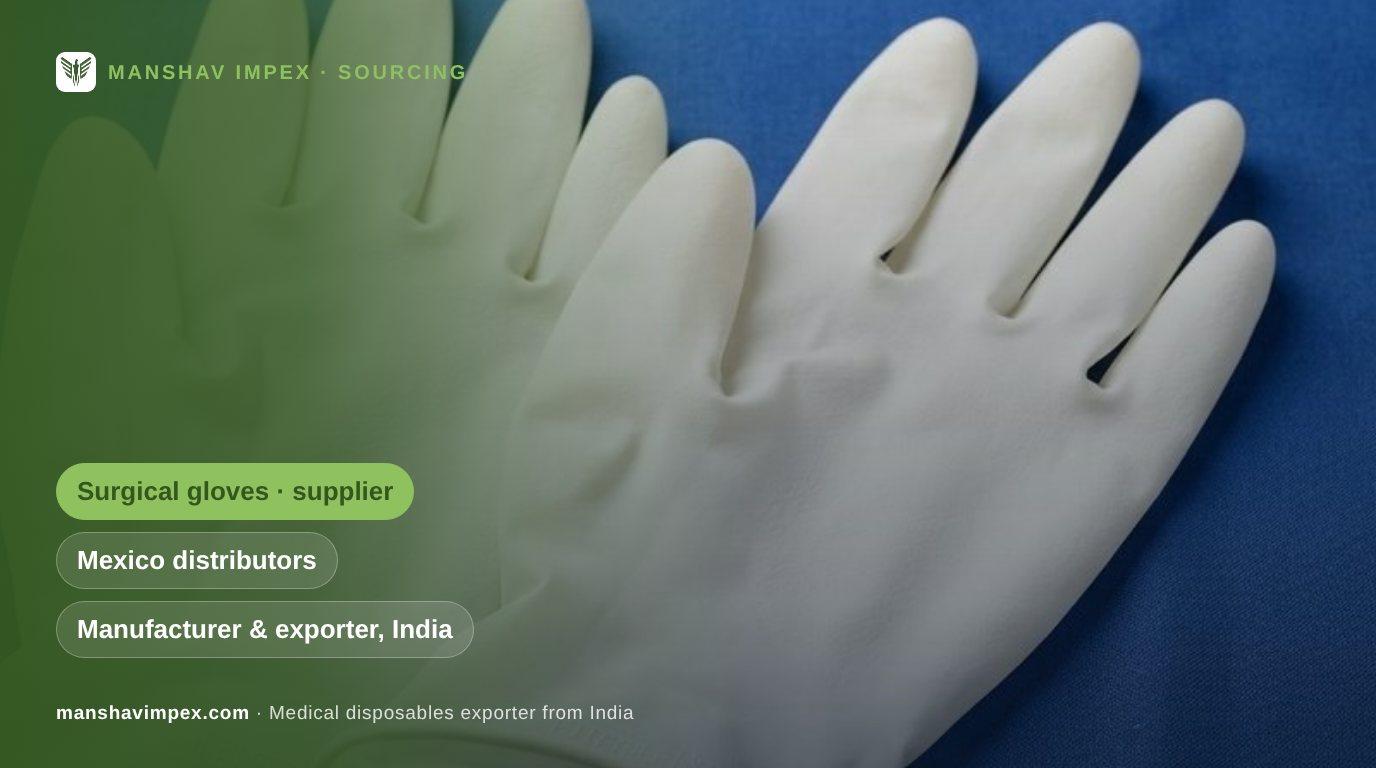
A Mexican distributor who adds a new surgical glove line is betting on two things: that the product clears registration and that it survives the hospital's own evaluation. Here is the checklist we see Mexican importers work through before they put an Indian surgical glove in front of a buyer.
Full specifications, packing and MOQ are on our sterile latex surgical gloves product page. This guide is written for importers and distributors in Mexico who supply public institutions (IMSS, ISSSTE, IMSS-Bienestar and state health services) and private hospital groups in Mexico City, Guadalajara and Monterrey, and who are weighing an Indian surgical gloves supplier for Mexico against their current Asian source.
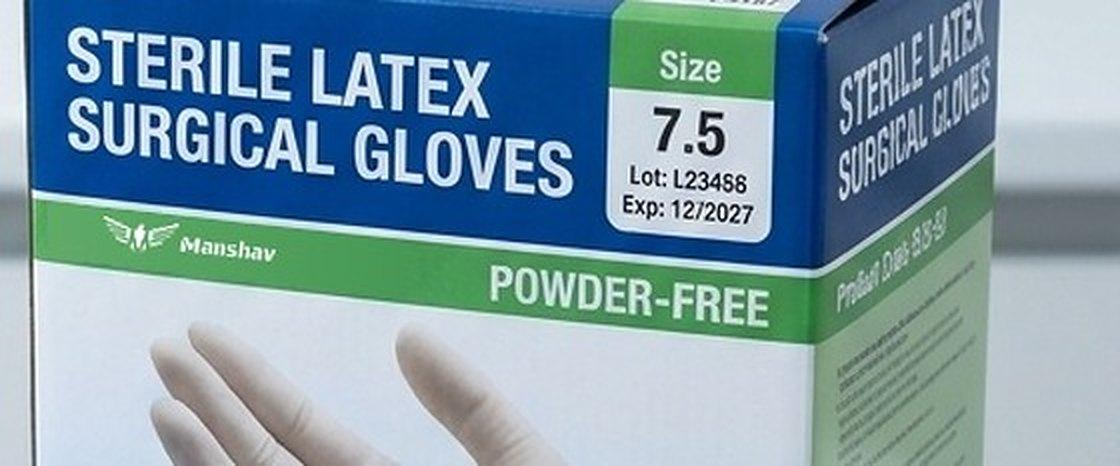
A surgical gloves supplier for Mexico should provide a complete technical file for the exact glove (material, powder status, sterilisation method, sizes, thickness, AQL and the standards it is tested to), the manufacturer's quality and product certificates, label artwork that can carry the Spanish text Mexican rules require, and samples in every size you plan to sell. The registration itself is held by a Mexican company, so the supplier's job is to give your registration holder everything the application needs and to keep that file current.
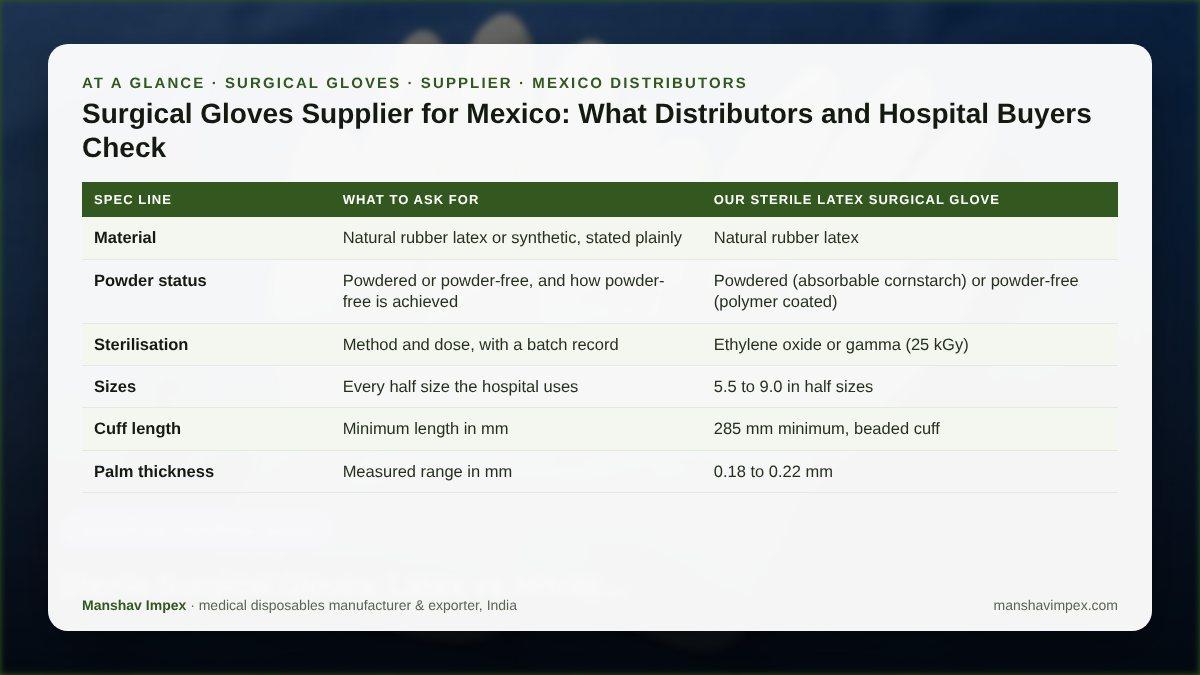
Hospital evaluation committees compare offers line by line. A spec sheet that leaves a line blank gets marked down even when the glove is good. These are the lines we fill for our sterile latex surgical glove, and the ones to demand from any supplier you are comparing.
| Spec line | What to ask for | Our sterile latex surgical glove |
|---|---|---|
| Material | Natural rubber latex or synthetic, stated plainly | Natural rubber latex |
| Powder status | Powdered or powder-free, and how powder-free is achieved | Powdered (absorbable cornstarch) or powder-free (polymer coated) |
| Sterilisation | Method and dose, with a batch record | Ethylene oxide or gamma (25 kGy) |
| Sizes | Every half size the hospital uses | 5.5 to 9.0 in half sizes |
| Cuff length | Minimum length in mm | 285 mm minimum, beaded cuff |
| Palm thickness | Measured range in mm | 0.18 to 0.22 mm |
| Pinhole AQL | AQL level and the test standard | AQL 0.65 / 1.0 |
| Protein content | Value and unit for latex grades | Below 50 µg/dm² |
| Standards | The standards actually tested to | EN 455 parts 1–4, ASTM D3577, ISO 10282 |
| Shelf life | From date of manufacture | 5 years |
| Packing | Pouch, box and carton counts | 1 pair per peel pouch, 50 pairs per box, 400 pairs per carton |
Medical devices sold in Mexico need a sanitary registration (registro sanitario) issued by COFEPRIS, held by a company established in Mexico. For most Mexican importers that means either holding the registration themselves or working with a registration holder who imports on their behalf. Sterile surgical gloves are a regulated medical device, so plan the registration before the first commercial order, not after the container is booked.
Rules and timelines change. Verify current guidance with COFEPRIS or a licensed Mexican regulatory consultant before you quote a delivery date to a hospital.
| Document | Why the Mexican side needs it |
|---|---|
| ISO 13485 certificate of the manufacturing site | Shows the quality system covers the factory that makes the glove |
| Product certificates and declaration of conformity | Supports the registration file and hospital technical review |
| Test reports for thickness, AQL, tensile strength and protein | Lets the committee check the spec sheet against evidence |
| Sterilisation validation and batch sterility record | Required for a sterile device and asked for in audits |
| Free sale certificate or equivalent | Often requested in registration and public tenders |
| Label and pouch artwork, with the Spanish version | Has to match the registration and the delivered goods |
| Certificate of origin and commercial invoice | Needed at customs in Manzanillo or Lázaro Cárdenas |
Before you sign a supply agreement, send ten boxes of the two fastest-moving sizes (usually 7.0 and 7.5) to the theatre you most want to win and ask the scrub nurses to use them for a full week. Ask them three things: did the cuff roll down, did the glove tear while donning, and did it grip a wet instrument. Their answers predict the hospital's decision better than any datasheet, and they tell you whether to stock powder-free or powdered.
Mexico's public institutions buy largely through consolidated purchases and published tenders, where a registered product, a complete document file and a firm delivery schedule decide the technical stage before price is opened. Private hospital groups buy more like any large customer: they trial, they negotiate, and they reorder monthly. Many Mexican surgical gloves distributors run both channels, and the same supplier has to serve both.
Hospitals in Mexico rarely switch glove suppliers because of a lower price. They switch when the current glove fails in the theatre, and the distributor with registered stock on the shelf that week gets the order.
Ask every supplier for a current quotation on the same basis: the same grade (powdered or powder-free), the same size mix, the same packing and the same Incoterm, ideally CIF Manzanillo so freight is included. Then compare what the price buys: thickness, AQL, cuff length, shelf life remaining at delivery and who pays for Spanish labelling. A glove that is cheaper per pair but arrives with two years of shelf life left, or needs over-labelling in Mexico, often costs more by the time it reaches the hospital.
Most Indian shipments to Mexico load at Nhava Sheva or Mundra and discharge at Manzanillo, with Lázaro Cárdenas as the alternative Pacific port. Latex gloves are not dangerous goods, but they are sensitive to heat and crushing, so ask for cartons packed to the stated 400 pairs and avoid stacking the container beyond the carton marks. Keep the certificate of origin, packing list and lot list ready for your customs broker so the goods are not held while documents are corrected.
Pre-donned sterile natural latex surgical gloves with curved anatomical fingers, micro-textured anti-slip finish, beaded cuff, available in powdered and powder-free polymer coated grades. Container consignments dispatched from Port Mundra & Port Nhava Sheva, with certificates and test reports shared with every quotation.
Yes. Sterile surgical gloves are a medical device, and medical devices sold in Mexico need a sanitary registration issued by COFEPRIS and held by a company established in Mexico. The foreign manufacturer supplies the documents; confirm the current route and timeline with COFEPRIS or a licensed consultant.
Yes. We can print the pouch and box artwork with the Spanish text your registration requires, as long as you approve the artwork before production. Some distributors prefer to over-label in Mexico instead; agree which route you use before the first order.
Surgical gloves of vulcanised rubber fall under HS 4015.11. Your Mexican customs broker will confirm the full national tariff line and any duty that applies at the time of import.
Our MOQ for sterile latex surgical gloves is 50,000 pairs, packed 50 pairs per box and 400 pairs per carton. Sizes can be mixed within the order.
Request a current quotation with your grade (powdered or powder-free), size mix, monthly quantity and the Incoterm you want, for example CIF Manzanillo. Compare quotes on the same basis, including shelf life at delivery and who pays for Spanish labelling.
Regulator, registration steps, import duty by HS code and sea freight for the markets in this article.
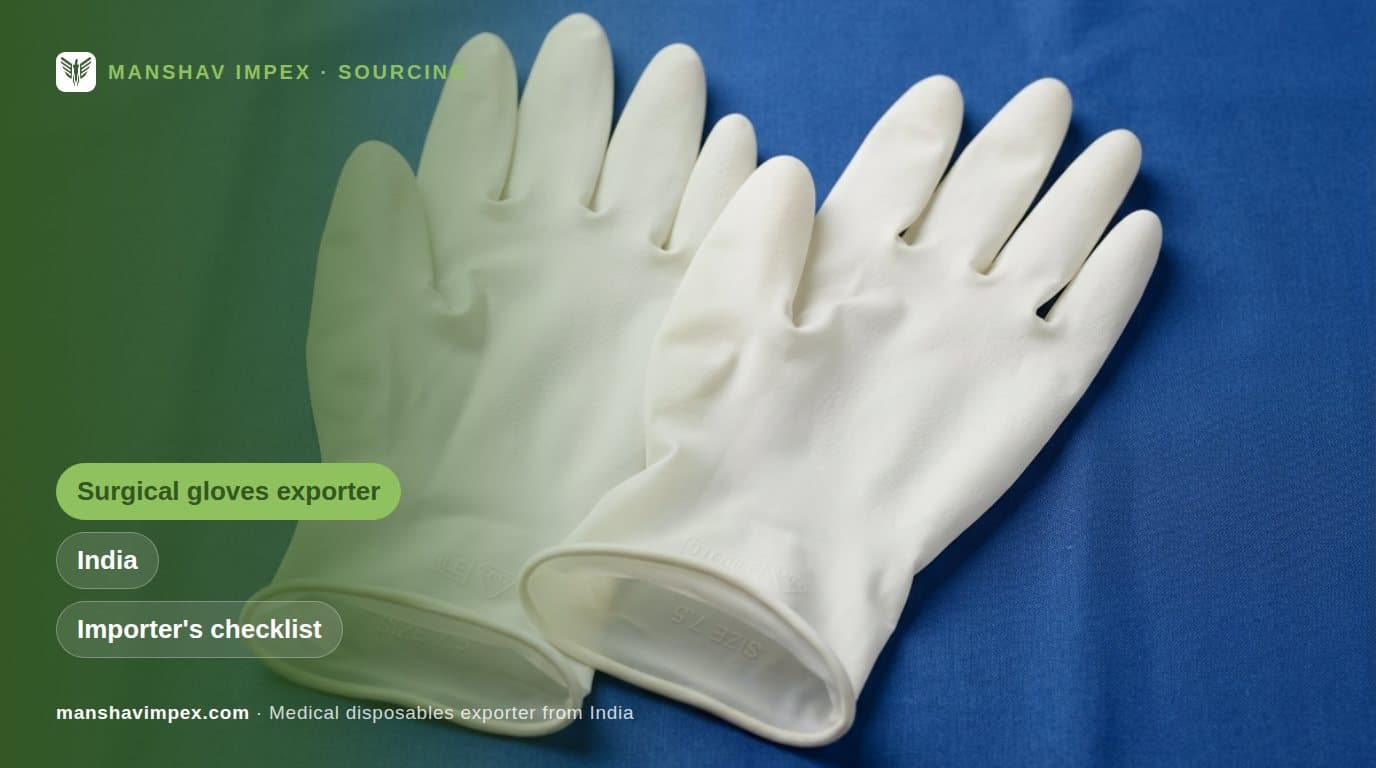
Every exporter on page one calls itself the best. Buyers who import gloves year after year ignore the label and run the same six checks - this is that list, written down.
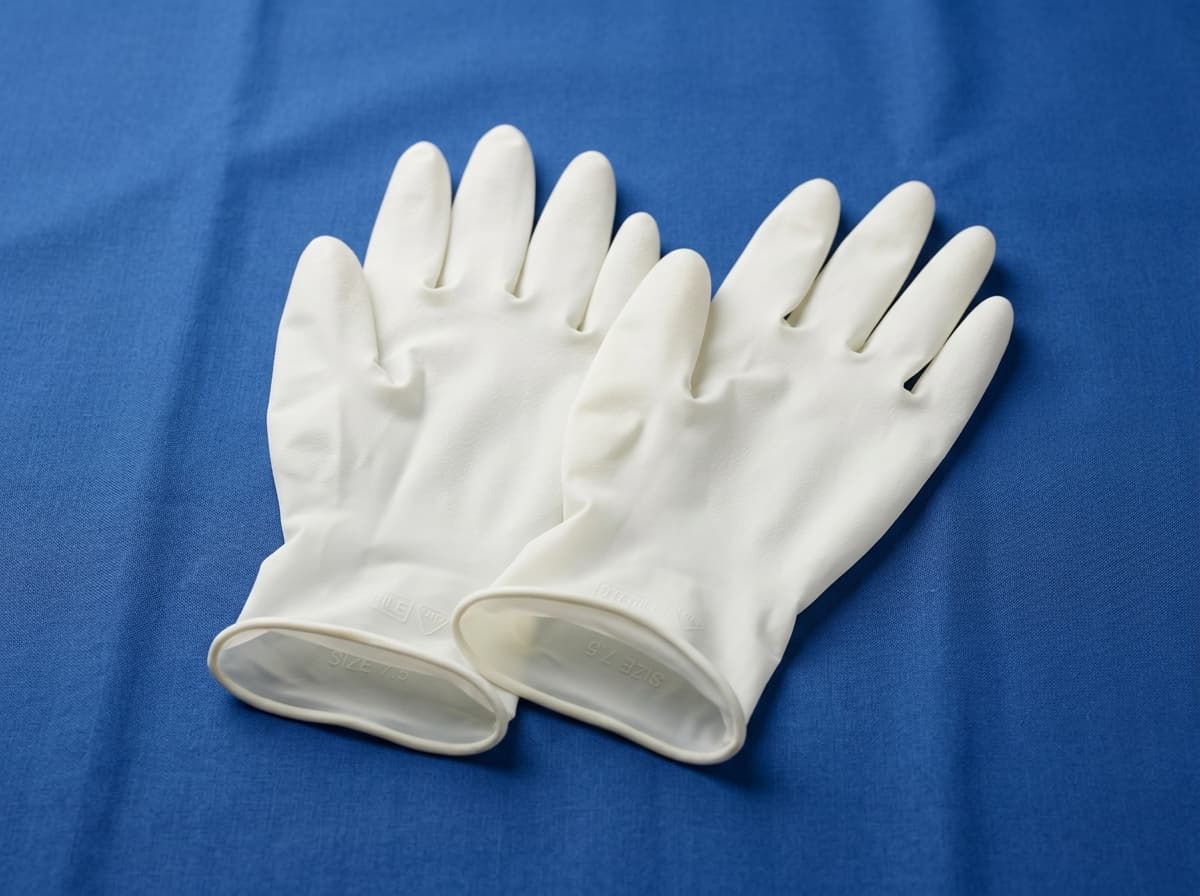
Compare protein content in latex surgical gloves under EN 455 and ASTM D3577. Chemical leaching, allergy prevention, and European hospital sourcing.
Surgical gloves come in half sizes from 5.5 to 9, and the number on the pouch is close to the hand's palm circumference in inches. Here is the size chart, what cuff length and palm thickness mean on a spec sheet, and how a hospital in Sri Lanka works out how many boxes of each size to order.