Surgical Sutures Supplier for Saudi Arabia: What Hospital Procurement Should Check
A suture tender in Riyadh or Jeddah rarely fails on price. It fails when the needle on the new box is a different shape from the one the surgeon has used for ten years, or when a carton sat on a hot quay and nobody checked the storage label. Both problems are avoidable if the specification is written properly before anyone asks for a price.
Sharmil Mangukiya (Founder & MD) 7 min read November 25, 2026
In short
Saudi hospital procurement teams buy sutures by item code, but surgeons judge them by needle feel and knot security. This guide is for procurement officers who want to add a supplier from India: how to turn a branded code into a generic specification, which documents the SFDA file needs, how evaluation samples should be run, and what to compare in a quotation.
Sizes, needle options, absorption profile, packing and the minimum order are on our synthetic absorbable PGA surgical sutures product page. This guide is written for procurement officers and materials managers at Ministry of Health hospitals, military and university hospitals and private hospital groups in Saudi Arabia, and for the importers and authorised representatives who bid for them, who want to qualify a suture supplier in India alongside their existing brands.
What should a Saudi hospital check before choosing a surgical sutures supplier?
Check four things in this order: that the supplier makes every size, length and needle combination on your list (written as a generic specification, not a brand code); that the products are made under ISO 13485 and tested to the USP or EP suture monographs; that the document set supports marketing authorisation with the Saudi Food and Drug Authority (SFDA) through your local authorised representative; and that evaluation samples pass your surgeons' trial. Registration and labelling rules change, so verify current guidance with the SFDA before you plan a tender timeline.
Turning brand codes into a PGA specification, department by department
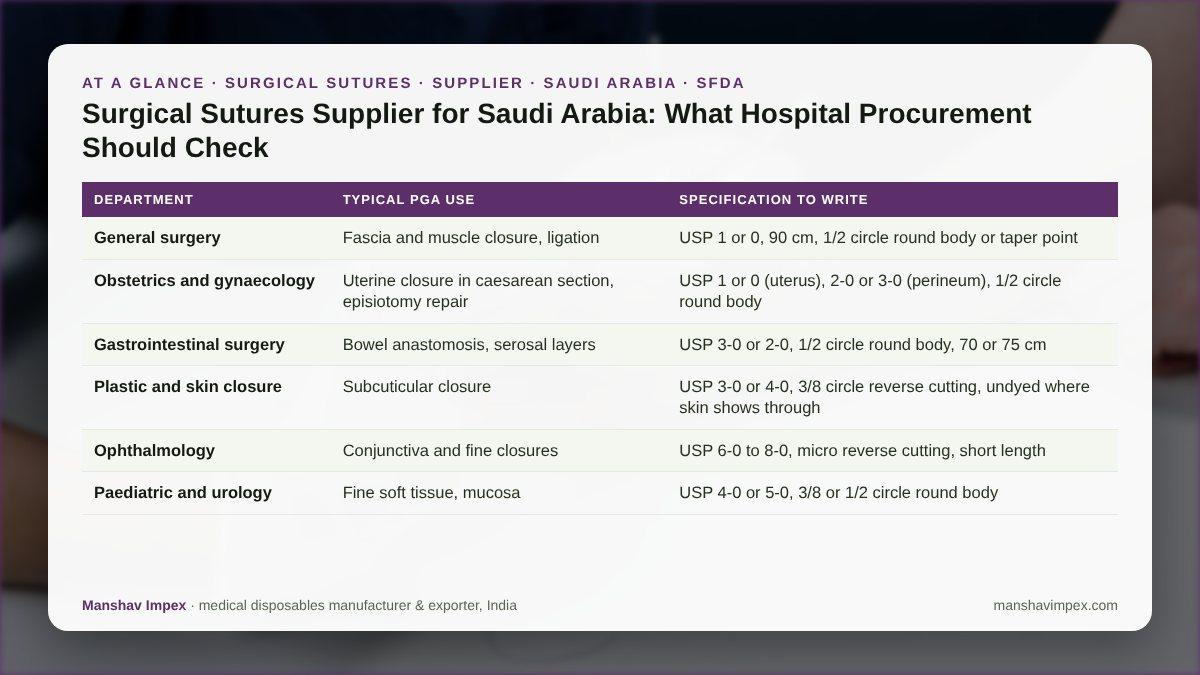
Most Saudi hospital suture lists are written as a competitor's catalogue numbers. A new supplier cannot quote against those reliably, so translate each code into the six fields that define a suture: material, USP size, length, needle type, needle curvature and needle length. The table shows common PGA uses as a starting point; your surgeons' current usage report should decide the final list and quantities.
Department
Typical PGA use
Specification to write
What to check on the sample
General surgery
Fascia and muscle closure, ligation
USP 1 or 0, 90 cm, 1/2 circle round body or taper point
Needle holds its curve in the holder; knot does not slip after four throws
Obstetrics and gynaecology
Uterine closure in caesarean section, episiotomy repair
USP 1 or 0 (uterus), 2-0 or 3-0 (perineum), 1/2 circle round body
Smooth pass through tissue; coating does not flake
Gastrointestinal surgery
Bowel anastomosis, serosal layers
USP 3-0 or 2-0, 1/2 circle round body, 70 or 75 cm
Needle-to-thread attachment holds on a firm pull
Plastic and skin closure
Subcuticular closure
USP 3-0 or 4-0, 3/8 circle reverse cutting, undyed where skin shows through
Clean cutting edge; thread runs without drag
Ophthalmology
Conjunctiva and fine closures
USP 6-0 to 8-0, micro reverse cutting, short length
Inspect needle tip under magnification before the trial
Paediatric and urology
Fine soft tissue, mucosa
USP 4-0 or 5-0, 3/8 or 1/2 circle round body
Absorption profile suits the surgeon's practice
Our PGA sutures come in USP 8-0 to 2, lengths of 45, 70, 75, 90 and 150 cm, violet or undyed, with round body, curved cutting, reverse cutting, taper point and blunt point needles in 1/4, 3/8, 1/2 and 5/8 circle or straight. Ask every supplier to state the needle length in millimetres for each item, because two "1/2 circle round body" needles from different makers can differ enough for a surgeon to notice.
SFDA registration and the papers to ask the supplier for
Medical devices placed on the Saudi market need SFDA marketing authorisation, held through a local authorised representative, usually the importer or distributor who bids for you. Sutures are implantable devices, so the technical file is examined closely. The manufacturer's job is to give the representative one consistent set of documents in one legal name; your job is to check that what was registered is what arrives.
Document
What procurement should check
ISO 13485 certificate
Manufacturing site and scope cover surgical sutures; valid on the delivery date
Test reports to USP or EP suture monographs
Diameter, knot-pull tensile strength and needle attachment, from current production
Absorption and tensile retention data
Matches the label claim; for our PGA about 75% strength at 14 days, 50% at 21 days, absorbed in 60 to 90 days
EO sterilisation validation and lot certificates
Lot numbers on the certificates match the boxes and the invoice
Label and instructions for use
Language and content in the form the SFDA and your representative require; storage conditions stated
Free sale certificate and certificate of origin
Ask the representative which form and legalisation are currently accepted
The key checks from this guide at a glance.
Procurement note
Run the surgeon trial blind. Put the new sutures and the incumbent brand in plain overwraps marked A and B, give each surgeon both for the same type of closure, and ask for a score on needle penetration, handling and knot security. Surgeons who know which box is new tend to mark it down out of habit; a blind score gives the committee something it can defend when the tender is challenged.
NUPCO, hospital tenders and private groups: who actually buys
Much of the public-sector demand is bought centrally through NUPCO, the national unified procurement company, while some hospitals and private groups run their own tenders or buy on annual contracts through distributors. The route changes what the supplier has to provide, so confirm the current rules for the tender you are bidding on.
Central tenders: the authorised representative bids, and the product must be registered with the SFDA before award. Item descriptions are fixed, so the generic specification has to match them word for word.
Hospital and military tenders: evaluation samples and surgeon sign-off often decide the award; plan two to three months for the trial.
Private hospital groups: buy through a distributor on yearly prices; they value consistent stock more than the lowest unit price.
Day-surgery and dental clinics: small, frequent orders of a few fine sizes; the distributor breaks master cartons.
A suture is chosen in the theatre and kept in the warehouse. A supplier who only satisfies one of the two will not survive the second tender.
See our PGA absorbable surgical sutures: USP 8-0 to 2, 45 to 150 cm, violet or undyed, five needle types and five curvatures, EO sterile.
From India to Jeddah or Dammam, and storing sutures in Gulf heat
Sea freight from India's west coast ports such as Nhava Sheva and Mundra reaches Jeddah Islamic Port on the Red Sea and King Abdulaziz Port in Dammam on the Gulf; urgent tender lots are often sent by air to Riyadh. PGA absorbs water slowly over time, and heat and humidity speed that up, so the storage condition printed on the label matters more for sutures than for most consumables.
Ask your forwarder for current transit times and rates to the port nearest your central store, and avoid cartons waiting on an open quay in summer.
Move cartons into temperature-controlled storage as soon as they clear, and check the label condition against your store's records.
Agree a minimum remaining shelf life on delivery in the contract; hospital stores check expiry at receipt.
Ask for master cartons marked with USP size, length, needle code and lot on two sides, so the store can pick without opening them.
Minimum order, lead time and comparing quotations
Our minimum order for PGA sutures is 10,000 pieces, and sizes and needle types can be combined to reach it. Sutures are packed 12 pieces per box and 50 boxes per master carton (600 pieces). Production normally takes 16 to 24 days after the order is confirmed, plus freight and clearance. We declare sutures under HS 3006.10; your clearing agent should confirm the Saudi tariff line and current duties.
Send every supplier the same generic specification per item and ask them to mark any item they cannot match exactly.
Ask for prices per box of 12 and per piece, at the same Incoterm, for example CIF Jeddah or CIF Dammam.
Request samples of every item and the full document set with the quotation, not after the award.
Work each offer to a landed cost in your store: freight, insurance, clearance, duty, representative fees and inland transport.
Prices move with polymer, needle steel and freight costs, so request a current quotation before each tender rather than reusing last year's.
Send us your suture list as item codes or a generic spec, annual quantity and delivery port, and we will match each item and quote it with the documents your SFDA file needs.
Sterile synthetic absorbable braided Polyglycolic Acid (PGA) sutures with polycaprolactone coating and precision attached 300-series stainless steel needles, providing predictable absorption and superior knot security. Container consignments dispatched from Port Mundra & Port Nhava Sheva, with certificates and test reports shared with every quotation.
Made to CE MDRMade to ISO 13485Made to USP / EPMOQ: 10,000 pcs
Do surgical sutures need SFDA registration in Saudi Arabia?
Yes. Sutures are medical devices and need SFDA marketing authorisation through a local authorised representative before they are sold or awarded in a tender. Confirm the classification and current requirements with the SFDA or your representative.
Can an Indian supplier match the sutures we buy from our current brand?
Usually, if the list is written as a generic specification: material, USP size, length, needle type, curvature and needle length. Send the codes and we will propose a match per item, then confirm it with samples before any order.
What is the minimum order for PGA sutures from Manshav Impex?
The minimum order is 10,000 pieces, and different sizes and needles can be combined. Sutures are packed 12 per box and 600 per master carton, with production of 16 to 24 days after the order is confirmed.
How should absorbable sutures be stored in Saudi Arabia's heat?
Follow the storage condition on the label, keep cartons in temperature-controlled storage after clearance, and keep them off open quays and unventilated trucks in summer. Heat and humidity shorten the usable life of absorbable sutures.
What is the price of surgical sutures for a Saudi hospital tender?
It depends on the size mix, needle type, quantity, packing, freight and local costs, and it changes with raw material prices. Request a current quotation per box and per piece at CIF Jeddah or Dammam and compare offers on landed cost.
Sharmil Mangukiya (Founder & MD)
Sharmil Mangukiya is the founder and managing director of Manshav Impex, an Indian manufacturer & exporter of medical disposables serving importers, distributors, hospitals and governments in 48+ countries since 2019.