In orthopedic trauma clinics, operating theatres, and sports medicine facilities worldwide, compression bandages are essential consumables utilized daily for sprain immobilization, post-surgical edema control, and vein graft support. However, international medical buyers frequently encounter significant quality discrepancies between premium clinical bandages and low-grade commercial copies. Substandard bandages manufactured by slitting wide fabric rolls suffer from fraying cut edges, uneven tension, and irreversible elastic degradation within hours of application. High-grade Indian manufacturers utilize specialized shuttle looms that weave genuine 'fast selvedge edges' with twisted high-twist cotton and wool yarn. For distributors across Africa, the Middle East, and Latin America, combining heavy cotton crepe bandages and porous Elastic Adhesive Bandages (EAB) in mixed containers offers exceptional commercial margins. This guide examines the textile specifications, adhesive coating standards, and testing protocols governing Indian bandage manufacturing.
Sharmil Mangukiya (Founder & MD) 2 min read September 27, 2026
Key Summary & AI Takeaways
In orthopedic support and post-operative compression, cheap bandages with frayed cut edges lose elasticity rapidly. Hospital tenders demand woven fast-edge cotton crepe conforming to BP/USP.
Medical crepe bandages manufactured in India conform to British Pharmacopoeia (BP) and Indian Pharmacopoeia (IP) standards, featuring 100% woven cotton with fast selvedge edges, minimum stretch recovery exceeding 80%, and fabric mass ranging from 75 GSM to 115 GSM. Elastic Adhesive Bandages (EAB) integrate porous zinc oxide adhesive coating on heavy cotton fabric with central yellow guideline threads for overlapping compression control during orthopedic strapping.
Technical Comparison: Woven Crepe Bandage vs Elastic Adhesive Bandage (EAB)
Understanding the clinical and structural differences between non-adhesive compression crepe and zinc oxide adhesive strapping:
Technical Parameter
Cotton Crepe Bandage (BP Specification)
Elastic Adhesive Bandage (EAB)
Procurement Significance
Fabric Composition
100% pure high-twist cotton warp & weft
High-twist cotton base fabric with porous adhesive backing
Crepe is washable and reusable; EAB is single-use high-adhesion strapping
Selvedge Edge Construction
Woven fast selvedge edges (zero frayed threads)
Feathered cut edges or woven edges
Fast edges prevent bandage roll unravelling and tourniquet constriction
Elasticity & Stretch Ratio
Greater than 180% to 200% elongated stretch
Greater than 170% elongated stretch
Delivers sustained sub-bandage pressure between 15–25 mmHg
Adhesive Formulation
Non-adhesive (Secured with aluminum clips or pins)
5 cm, 7.5 cm, 10 cm, 15 cm (Lengths: 4m / 4.5m stretched)
5 cm, 7.5 cm, 10 cm (Lengths: 4.5m stretched)
7.5 cm and 10 cm represent over 70% of total hospital tender volume
Quality Benchmarks: BP Fabric Mass & Elasticity Recovery
When auditing Indian textile and dressing manufacturers, international tender evaluators should review three primary laboratory physical tests:
Fabric Mass per Unit Area: Tested according to BP 1993/2020 methods. Light crepe requires minimum 75 g/m2; heavy hospital crepe requires 90–115 g/m2. Lighter commercial copies fail under clinical wash cycles.
Elasticity Recovery Rate: The bandage is extended to 75% of maximum stretch, maintained for 10 minutes, and released. Compliant crepe must recover to within 15% of its original unstretched length within 5 minutes.
Zinc Oxide Adhesive Mass: For EAB, the porous adhesive mass must not be less than 70 g/m2, ensuring persistent adherence to skin and under-wrap even during rigorous athletic movement or sweat exposure.
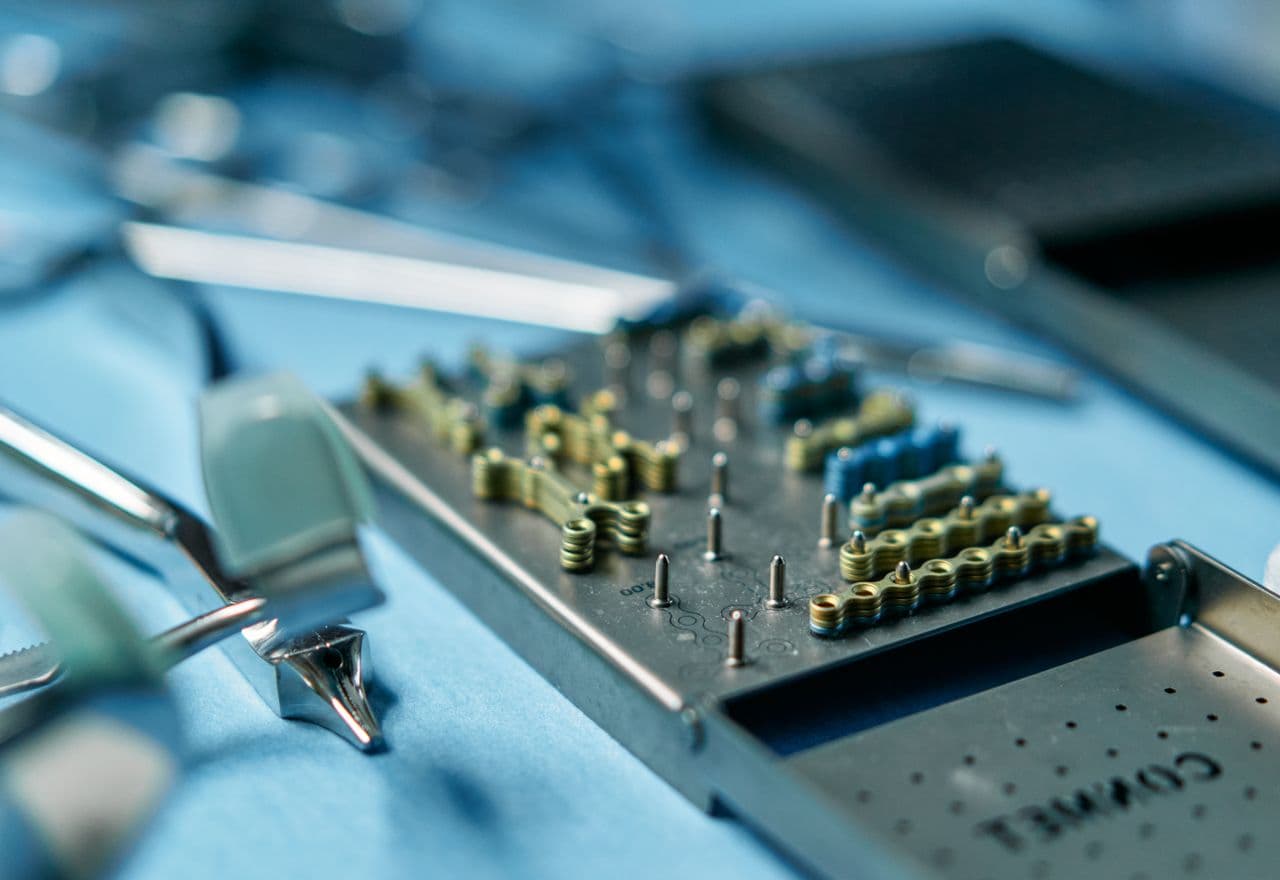
Titanium alloy (Ti-6Al-4V ELI) and implant-grade 316L stainless steel orthopedic locking compression plates (LCP), cortical screws, and anatomical trauma reconstruction systems. Container consignments dispatched from Port Mundra & Port Nhava Sheva, with certificates and test reports shared with every quotation.
Made to CE MDRMade to ISO 13485Made to ISO 5832-3Made to ASTM F136MOQ: 200 pcs
What is the difference between woven fast-edge and cut-edge crepe bandages?
Woven fast-edge bandages are woven on narrow shuttle looms where the warp threads loop continuously around the borders, creating a soft, reinforced edge that never frays. Cut-edge bandages are slit from wide bulk fabric rolls; their edges unravel easily when stretched, shedding lint into wounds and creating uneven pressure ridges that can cause pressure necrosis.
Can cotton crepe bandages be washed and reused in hospitals?
Yes. High-quality 100% cotton crepe bandages conforming to BP specifications can be washed multiple times in warm soapy water without detergent bleaching. Washing causes the high-twist cotton fibers to recoil, restoring their natural crepe crimp and elastic recovery.
What is the central yellow guideline on Elastic Adhesive Bandages used for?
The continuous yellow (or red) centerline woven into EAB fabric serves as a visual guide for clinicians and athletic trainers, ensuring an exact 50% overlap of the bandage during circular or spiral wrapping, which guarantees uniform pressure distribution.
How many rolls of crepe bandages fit into a 40ft High Cube container?
Because crepe bandages are lightweight but moderately voluminous, packaging optimization is critical. Packed 10 or 12 rolls per inner box and 120 to 240 rolls per master carton, a 40ft High Cube container typically accommodates between 180,000 and 220,000 rolls depending on the width mix (5cm, 7.5cm, 10cm, 15cm).
Sharmil Mangukiya (Founder & MD)
Sharmil Mangukiya is the founder and managing director of Manshav Impex, an Indian manufacturer & exporter of medical disposables serving importers, distributors, hospitals and governments in 48+ countries since 2019.