How to Import Medical Supplies from India to Africa: Complete 2026 Step-by-Step B2B Playbook
The commercial healthcare corridor connecting India to the African continent is one of the most vital medical supply chains in the global South. Over 70% of sterile surgical consumables, hospital disposables, and generic pharmaceuticals utilized across sub-Saharan Africa originate from certified manufacturing centers in India. However, for emerging medical distributors, hospital procurement consortia, and tender contractors, transforming a supplier quotation into cleared hospital inventory requires navigating a multifaceted matrix of trade finance, pre-shipment inspections, electronic cargo tracking notes (ECTN/BSC), tropical packaging engineering, and port logistics.
Sharmil Mangukiya (Founder & MD) 4 min read September 25, 2026
Key Summary & AI Takeaways
The master operational blueprint for African healthcare importers, hospital networks, and tender bidders importing high-volume surgical consumables from India.
Quick Buyer Summary: Importing Medical Consumables from India to Africa
Importing medical disposables from India into Africa delivers a 25% to 45% landed cost advantage over European brands while meeting ISO 13485 and CE MDR clinical standards. Success depends on following a disciplined 7-step trade sequence: regulatory dossier alignment (NAFDAC, PPB, TMDA, SAHPRA), choosing the correct Incoterm (CIF vs. FOB), securing Irrevocable Letters of Credit (L/C) or T/T terms, conducting mandatory pre-shipment inspections (PVoC/SONCAP), selecting direct maritime transit from Mundra/Nhava Sheva, securing legalized export documents within 24 hours, and applying active container humidity protection for Zone IVb tropical climates.
The 7-Step B2B Medical Sourcing & Importation Sequence
Every commercial medical import consignment from India to an African destination port must execute the following sequential milestones:
Product Selection & Technical Dossier Validation: Verify that the manufacturer holds ISO 13485:2016, CE conformity, and WHO-GMP certifications. Obtain technical data sheets, batch Certificate of Analysis (CoA), and a Free Sale Certificate (FSC) legalized by the relevant African embassy in New Delhi or apostilled.
Incoterm Selection & Commercial Contracting: Negotiate clear Incoterms 2020. First-time buyers should prioritize CIF (Cost, Insurance & Freight) or CFR to primary gateway ports, ensuring the exporter manages ocean booking, container loading supervision, and marine insurance.
Trade Finance & Payment Settlement: Establish agreed payment terms—standard international terms include 30% advance T/T with 70% against Bill of Lading copy, or an Irrevocable, Confirmed Letter of Credit (L/C at sight) opened through reputable international corresponding banks.
Regulatory Import Permits & Central Bank Filings: File destination import paperwork (e.g. Form M in Nigeria, IDF in Kenya, Import Declaration in Ghana). Register the proforma invoice with destination commercial banks to ensure legal foreign exchange allocation.
Pre-Shipment Inspection & Conformity Testing: Coordinate mandatory third-party inspection in India (KEBS PVoC for Kenya, SONCAP/CRIA for Nigeria, TBS for Tanzania, ZABS for Zambia) executed by accredited agencies such as Cotecna, SGS, or Bureau Veritas before container sealing.
Maritime Transit & Electronic Cargo Tracking: Ship containerized cargo from Port Mundra (APSEZ) or Nhava Sheva (JNPT). Secure mandatory destination tracking waivers (ECTN, BSC, FERI, or CTN) required by West and Central African maritime councils.
Destination Port Clearance & Health Ministry Release: Surrender original Bill of Lading (or electronic Telex Release), Legalized Certificate of Origin, Packing List, and Sterilization Certificates for joint customs and health authority cargo release.
African Regional Economic Communities: Tariffs, Clearance & Port Corridors
Africa is not a monolithic market; regulations, clearance times, and tariff structures vary fundamentally across regional trade blocs:
Trade Bloc / Region
Key Destination Ports
Average Sea Transit from India
Regulatory Authorities
Mandatory Cargo Waivers / Pre-Shipment Inspection
ECOWAS (West Africa)
Lagos Apapa (NG), Tema (GH), Abidjan (CI), Dakar (SN)
22 – 28 Days
NAFDAC (Nigeria), FDA (Ghana), AIRP (Ivory Coast), ARP (Senegal)
PPB (Kenya), TMDA (Tanzania), NDA (Uganda), Rwanda FDA
KEBS PVoC (Kenya), TBS PVoC (Tanzania); duty-free on essentials
SADC (Southern Africa)
Durban (ZA), Maputo (MZ), Beira (MZ), Walvis Bay (NA)
16 – 24 Days
SAHPRA (South Africa), ARMED (Mozambique), ZAMMSA (Zambia)
Strict ISO 13485 & CE technical dossier compliance
Maghreb (North Africa)
Alexandria (EG), Casablanca (MA), Tanger Med (MA), Algiers (DZ)
12 – 20 Days
EDA (Egypt), DMP (Morocco), Ministry of Health (Algeria)
MeDevice digital platform (Egypt); Arabic/French labelling
CEMAC (Central Africa)
Douala (CM), Libreville (GA), Pointe-Noire (CG)
26 – 34 Days
DPML (Cameroon), Ministry of Health
BESC waiver mandatory; French language documentation
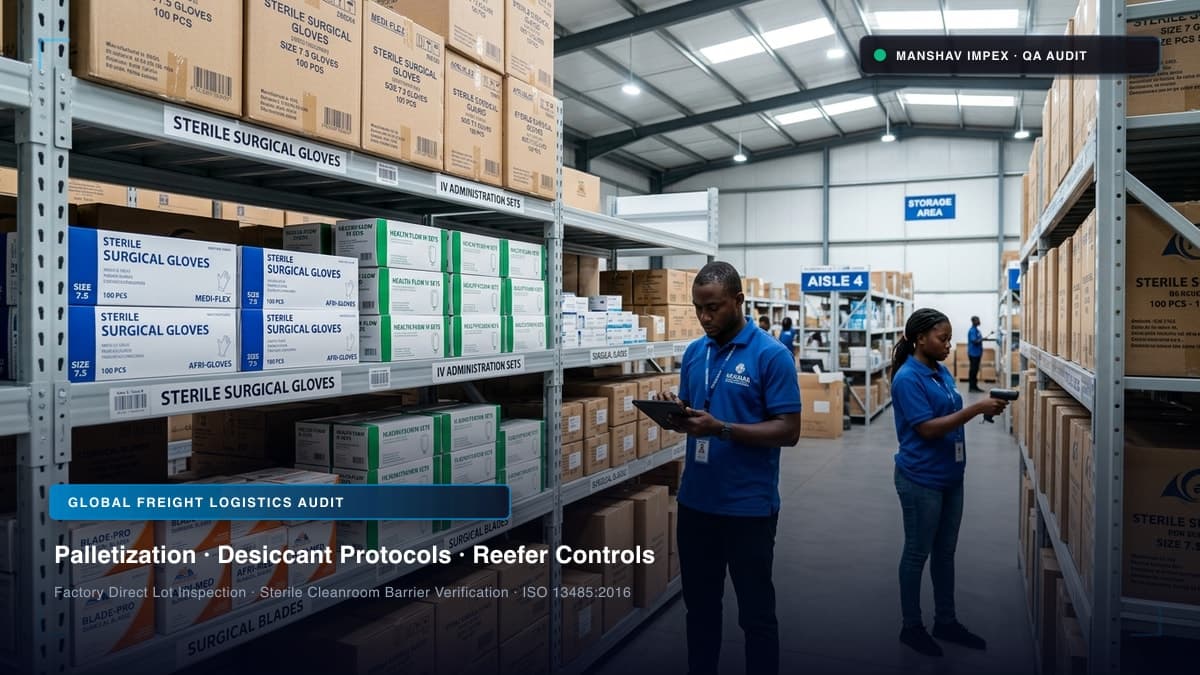
Desiccant placement and temperature monitoring for sterile medical goods shipped across tropical maritime corridors.
Packaging Engineering for Tropical Climates (Zone IVb Stability)
Sub-Saharan Africa falls within WHO Climatic Zone IVb (Hot and Very Humid: 30°C and 75% relative humidity). Maritime shipping through equatorial waters subjects cargo to intense thermal cycling and condensation inside containers ('container rain'). Substandard packaging results in crushed master cartons, mold growth, and compromised sterile peel pouches.
Manshav Impex mitigates tropical shipping risks through a comprehensive 5-point export packaging standard:
7-Ply Heavy-Duty Master Cartons: High-grammage virgin kraft corrugated cardboard with water-resistant sizing, maintaining structural rigidity under high stacking loads.
Heavy-Gauge Polyethylene Case Liners: Sealed inner plastic barrier bags protecting inner dispenser boxes from atmospheric humidity during port dwell time.
Active Container Desiccant Dry Poles: High-capacity calcium chloride moisture-absorbing poles hung along container corrugated walls to absorb condensation.
ISPM-15 Heat-Treated Wooden Pallets: Fumigated and certified wooden or composite pallets facilitating rapid forklift handling while preventing pest contamination.
Tamper-Evident High-Security Bolt Seals: ISO 17712 certified numbered container bolt seals preventing pilferage across multimodal transit routes.
Planning a commercial shipment of medical consumables to Africa? Consult our senior export desk.
Pre-donned sterile natural latex surgical gloves with curved anatomical fingers, micro-textured anti-slip finish, beaded cuff, available in powdered and powder-free polymer coated grades. Container consignments dispatched from Port Mundra & Port Nhava Sheva, with certificates and test reports shared with every quotation.
Made to CE MDRMade to ISO 13485Made to EN 455Made to ASTM D3577MOQ: 50,000 pairs
What is an ECTN or BSC number, and is it required for shipping to Africa?
An Electronic Cargo Tracking Note (ECTN), also known as Bordereau de Suivi de Cargaison (BSC) or Cargo Tracking Note (CTN), is a mandatory maritime document required by most West and Central African nations (such as Nigeria, Ghana, Senegal, Ivory Coast, and Cameroon). It must be validated before cargo departs India to avoid massive fines and clearance delays at destination ports.
What Incoterm is recommended for importing medical supplies from India?
For first-time or mid-sized African importers, CIF (Cost, Insurance, and Freight) or CFR to your primary discharge port is strongly recommended. This places the responsibility of freight booking, container stuffing, export customs clearance, and marine insurance on the experienced Indian exporter.
Can African buyers open an Irrevocable Letter of Credit (L/C) for Indian medical suppliers?
Yes. Manshav Impex regularly accepts Irrevocable, Confirmed Letters of Credit at sight issued by first-class African commercial banks and confirmed through international partner institutions in India or the UAE.
How fast can Manshav Impex dispatch export documentation?
Manshav Impex guarantees a 24-hour turnaround for the complete export documentation stack (Bill of Lading, Commercial Invoice, Packing List, Certificate of Origin, Certificate of Analysis, and Sterilization Certificates) following vessel departure.
Can I combine multiple medical product lines in a single container?
Yes. Manshav Impex specializes in mixed-container consolidation (FCL), allowing African hospital groups and distributors to combine sterile surgical gloves, surgical blades, syringes, IV cannulas, drapes, and gowns in a single 40ft High Cube container under unified clearance documentation.
Sharmil Mangukiya (Founder & MD)
Sharmil Mangukiya is the founder and managing director of Manshav Impex, an Indian manufacturer & exporter of medical disposables serving importers, distributors, hospitals and governments in 48+ countries since 2019.