Disposable Scalpel Price vs Handle and Blades: Cost per Procedure for Tanzania Hospitals
Procurement officers are often asked one blunt question by the finance committee: why buy a scalpel that costs several times more than a blade? The honest answer is that the piece price is the wrong number. What the hospital pays for is a sterile cutting edge at the moment of incision, and for a handle and blade that cost includes washing, packing, autoclaving, lost handles and the sharps risk of mounting blades by hand. Count those, and the choice becomes a calculation instead of a debate.
Sharmil Mangukiya (Founder & MD) 8 min read November 27, 2026
In short
A disposable scalpel always costs more per piece than a loose blade, yet many wards, health centres and outreach teams still spend less with it once handles, reprocessing and losses are counted. This guide is for hospital procurement officers in Tanzania: how to work out cost per procedure, which items move the disposable scalpel price, and how to compare quotations from different suppliers line by line.
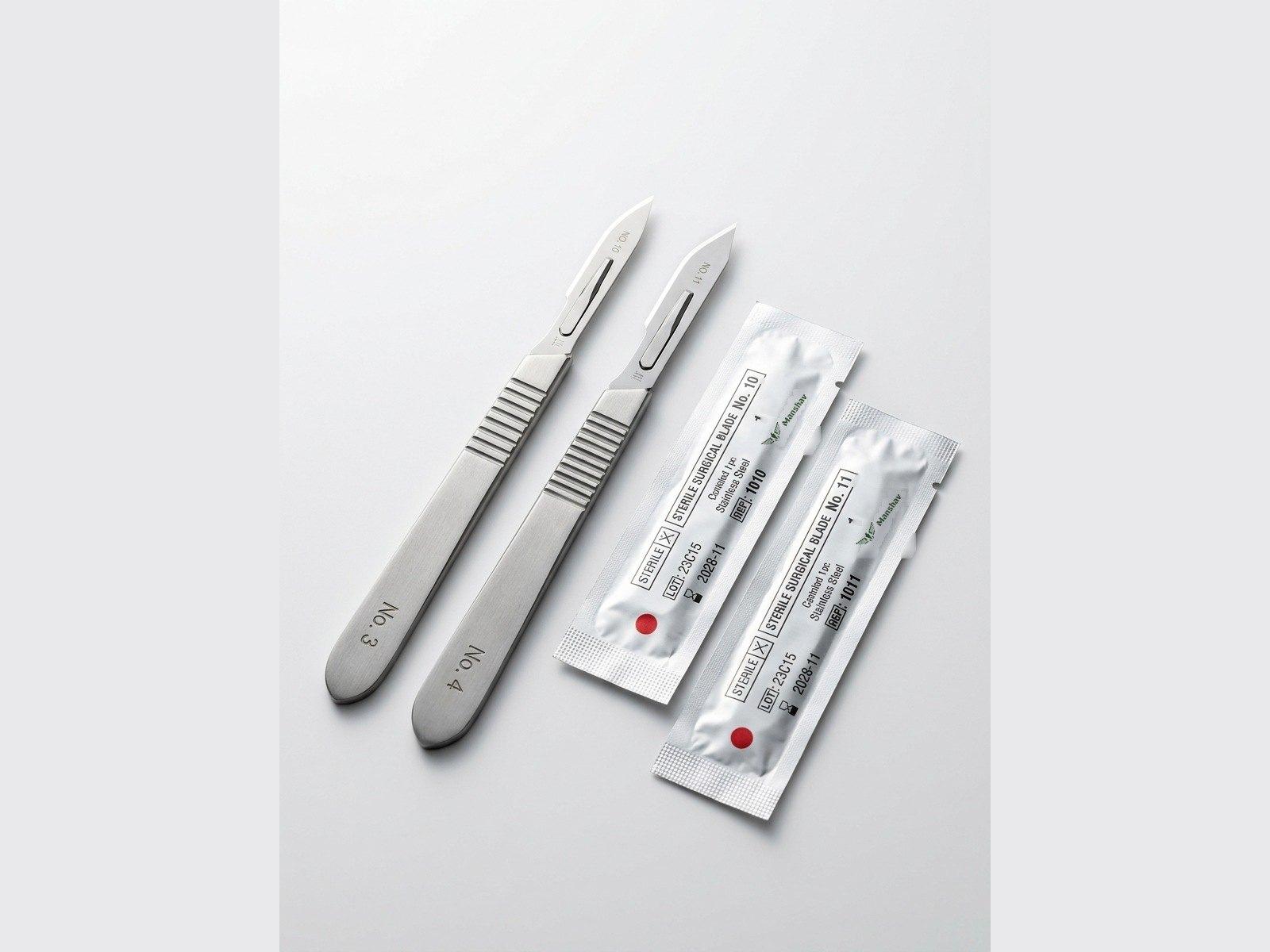
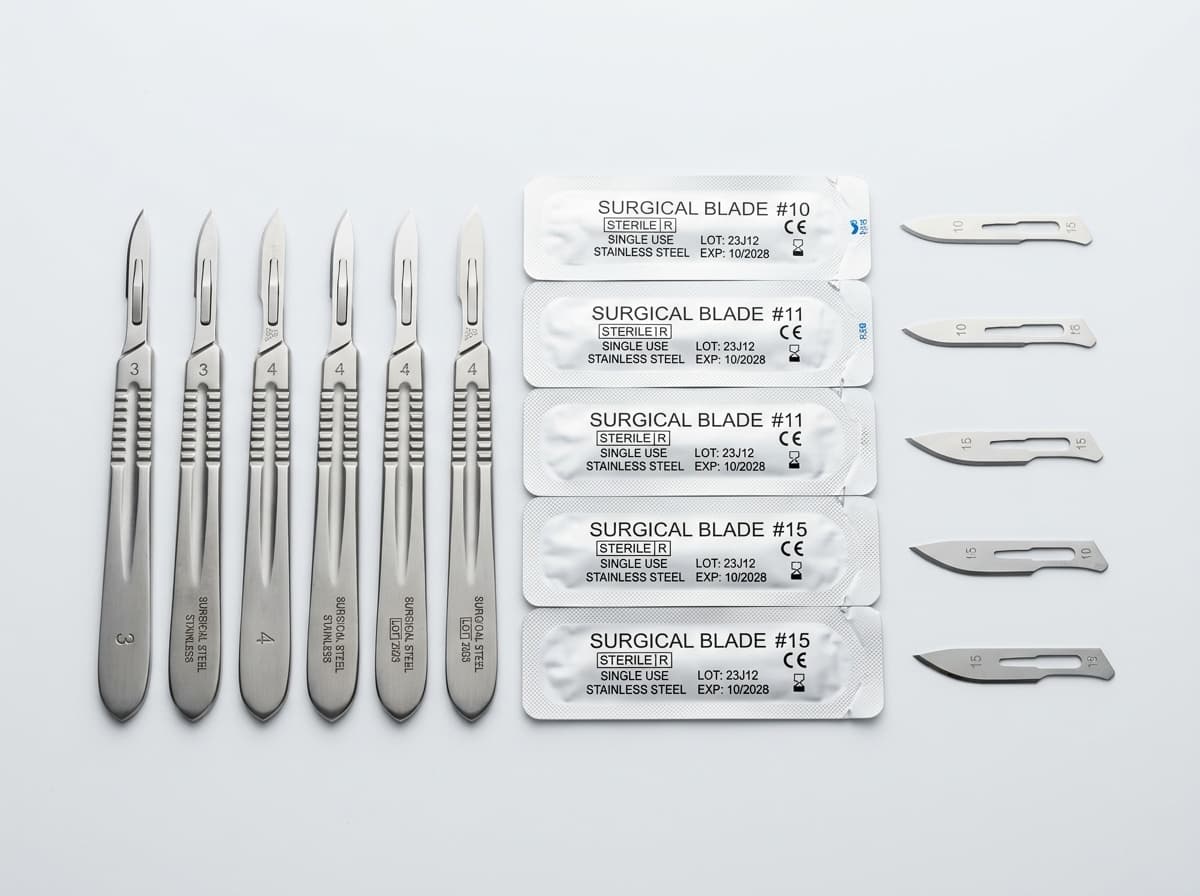
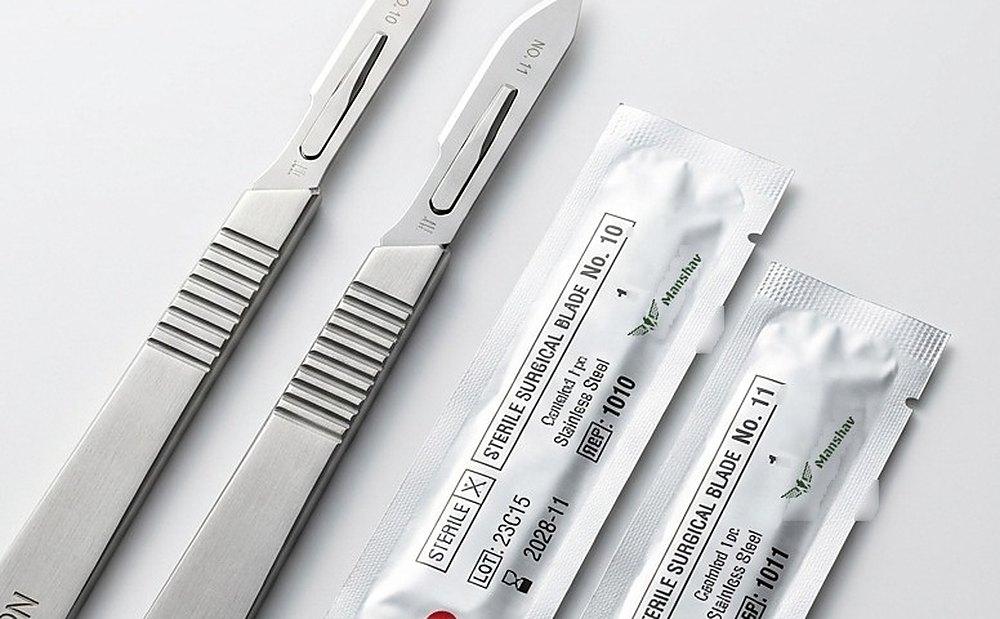
Blade numbers, steel, handle design, sterilisation and packing are listed on our disposable sterile scalpels product page, and loose blades with stainless handles are on the sterile surgical blades and scalpel handles page. This guide is written for procurement officers and supply chain managers at regional referral hospitals, district hospitals, faith-based hospitals and private hospitals in Tanzania who have to decide where disposable scalpels pay for themselves, and who need a fair way to compare supplier quotations.
Is a disposable scalpel cheaper than a handle and blade per procedure?
Per piece, no: a disposable scalpel adds a moulded handle, a sheath and a larger sterile pack to the blade, so its quoted price is always higher. Per procedure, it is often cheaper wherever a reusable handle has to be reprocessed for a single small cut, where handles go missing, or where no central sterile services department (CSSD) is close by. In a main theatre with a working CSSD and set trays, a stainless handle with loose blades usually stays the lower cost per case.
Disposable scalpel or handle and blade: what you are actually buying
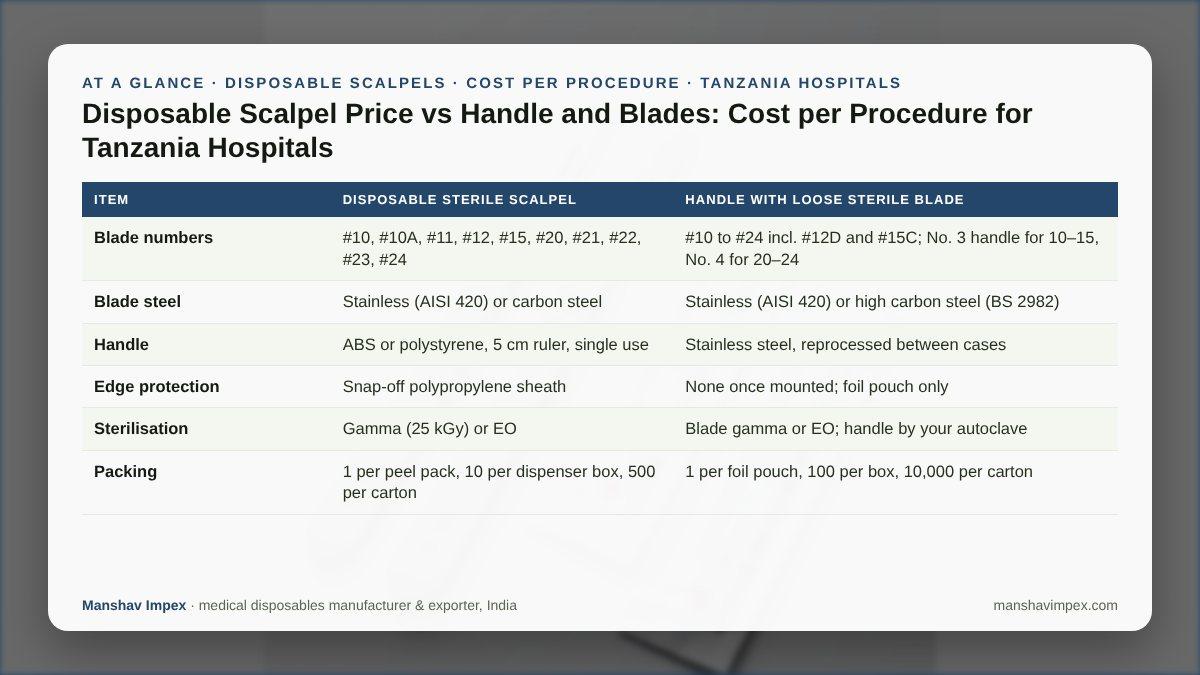
Before comparing money, compare what arrives in the store. The figures below are the specifications and pack sizes we supply; use them to check that two quotations describe the same product.
Item
Disposable sterile scalpel
Handle with loose sterile blade
Blade numbers
#10, #10A, #11, #12, #15, #20, #21, #22, #23, #24
#10 to #24 incl. #12D and #15C; No. 3 handle for 10–15, No. 4 for 20–24
Blade steel
Stainless (AISI 420) or carbon steel
Stainless (AISI 420) or high carbon steel (BS 2982)
Handle
ABS or polystyrene, 5 cm ruler, single use
Stainless steel, reprocessed between cases
Edge protection
Snap-off polypropylene sheath
None once mounted; foil pouch only
Sterilisation
Gamma (25 kGy) or EO
Blade gamma or EO; handle by your autoclave
Packing
1 per peel pack, 10 per dispenser box, 500 per carton
1 per foil pouch, 100 per box, 10,000 per carton
Minimum order
50,000 pcs
100,000 pcs
Shelf life
5 years
5 years
Two lines in that table drive most of the cost difference. The handle and sheath add moulded plastic and assembly to every unit. The carton holds 500 disposable scalpels against 10,000 loose blades, so freight, warehouse space and transport to district stores cost far more per piece for disposables. Any landed-cost comparison that ignores carton volume will flatter the disposable option.
How to work out cost per procedure in your own hospital
Do the sum with your hospital's figures, not a supplier's. For the handle and blade route, add four parts; for the disposable route, two.
Cost element
Handle and blade
Disposable scalpel
Where to get the figure
Cutting edge
Landed price of one blade
Landed price of one scalpel
Quotation plus freight, duty and clearing
Handle share
Handle price ÷ uses before it is lost or worn
Included
Theatre and ward handle count each quarter
Reprocessing
Wash, dry, pack, autoclave cost per cycle
None
CSSD running cost ÷ items processed
Sharps handling
Blade mounting and removal, injury follow-up
Lower: sheath, no blade change
Occupational health and incident register
Waste
Blade only into sharps box
Whole unit into sharps box
Sharps container use and disposal cost
The handle share is the number most hospitals guess wrongly. A stainless handle can last for years in a theatre tray, but handles kept on wards, in the emergency department and in outreach kits disappear into pockets, bins and other departments. If a ward loses a handle every few weeks, that loss can cost more than the extra paid for disposables in the same period.
Reprocessing is the second hidden figure. Sending one handle through the washer and autoclave for a single abscess drainage or suture removal costs staff time, pouches, indicators and energy, and it ties up the handle for hours. Where a health centre has only a small bench-top steriliser, a stock of disposable scalpels also removes the wait between patients.
Where disposable scalpels pay off, and where they do not
Usually worth it: emergency departments, wards and dressing rooms, labour wards for episiotomy, outpatient minor surgery, dermatology and biopsy clinics, mortuary and pathology work, outreach and mobile clinics, and dispensaries or health centres without their own CSSD.
Usually not worth it: main theatres with set trays and a working CSSD, high-volume general surgery lists where surgeons change blades during a case, and specialities that use #12D or #15C blades on fine handles.
Mixed approach: a common pattern is to keep handles and blades in theatre and switch everywhere else to disposables, which keeps the expensive units where they save labour and losses.
The key checks from this guide at a glance.
Procurement note
Before you build a business case, ask each ward and theatre sister to count scalpel handles on the first day of a quarter and again on the last day, and to record how many were received from CSSD in between. The difference is your real handle loss rate. One quarter of counting usually settles the disposable-versus-reusable argument with the finance committee better than any supplier brochure.
What sets the disposable scalpel price in a supplier quotation?
We do not publish a price list, because steel, resin and freight change through the year; request a current quotation for your exact mix. When quotations arrive, these are the items that explain most differences between them.
Blade steel: carbon steel takes a very keen edge but rusts if a pack is damaged; stainless steel holds up better in humid stores and is priced differently. Make sure each offer states the steel per blade number.
Blade number mix: common numbers such as #11, #15, #22 and #23 run in larger batches than #10A or #12, so a mix weighted to rare numbers can change the price.
Sterilisation method: gamma or EO; ask which one and for the sterilisation certificate per lot.
Sheath and handle details: a snap-off sheath and a printed ruler are not on every offer; a cheaper quote may simply leave them out.
Packing and labelling: units per dispenser box, language on the pack, and any own-label printing for a distributor.
Quantity: our minimum order is 50,000 pieces, and blade numbers can be combined to reach it; larger annual call-offs usually quote better than one-off orders.
Incoterm and freight: FOB India, CIF Dar es Salaam or delivered to your store are very different numbers, and carton volume makes freight a large share of the disposable scalpel price.
The cheapest scalpel on the quotation sheet is the one that arrives without a sheath, in a carton nobody measured, at a port price nobody converted into a ward price.
See our disposable sterile scalpels #10 to #24 with stainless or carbon steel blades, ruler-graduated handles, snap-off sheaths and a 5-year shelf life.
Comparing disposable scalpels supplier offers for Tanzania
Disposable scalpels importers in Tanzania and hospital buyers who import directly usually receive offers in different formats. Put every offer into one sheet with the same columns before anyone looks at the total.
Same product: blade numbers, steel per number, sheath, ruler handle, sterilisation method and units per box.
Same delivery point: convert every offer to landed cost at your store, including sea freight to Dar es Salaam, insurance, duties and fees, clearing and inland transport to Dodoma, Mwanza, Mbeya or Arusha.
Same documents: ISO 13485 certificate, CE marking where claimed, ISO 7740 compliance for the blade, sterilisation and batch test reports, and the documents your registration with the Tanzania Medicines and Medical Devices Authority (TMDA) requires.
Same shelf life at arrival: ask for the minimum remaining shelf life on delivery, not just the five-year total.
Same samples: test two or three blade numbers from each supplier for sharpness, sheath fit and pack seal before award.
Registration and import rules for medical devices change, so verify current guidance with TMDA and your clearing agent before you place an order, and confirm whether your tender is open to direct imports or only to locally registered disposable scalpels distributors in Dar es Salaam. Many hospitals buy through a local distributor who holds the registration; in that case, ask the distributor to show you the manufacturer's documents rather than a summary.
Storage, stock rotation and ordering rhythm
Disposable scalpels take far more shelf space than loose blades. A year's supply for a busy regional hospital can fill a corner of the medical store, so plan for it before switching. Keep cartons off the floor and away from roof heat, rotate stock first-expiry-first-out, and issue in dispenser boxes of 10 so wards do not hoard. Split the annual quantity into two or three shipments if your store is small, and keep the blade number mix the same across shipments so ward staff are not confused by changes.
Send us your blade numbers, steel per number, annual quantity and delivery point (FOB India or CIF Dar es Salaam), and we will quote disposable scalpels with the document set your evaluation needs.
Pre-assembled sterile single-use disposable scalpels combining high-precision stainless or carbon steel blades firmly integrated into graduated ergonomic ABS plastic handles with blade guards. Container consignments dispatched from Port Mundra & Port Nhava Sheva, with certificates and test reports shared with every quotation.
Made to CE MDRMade to ISO 13485Made to EN ISO 7740MOQ: 50,000 pcs
It depends on blade steel, blade number mix, sterilisation method, sheath and handle details, packing, order quantity and the Incoterm. Request a current quotation for your exact mix and compare offers on landed cost per piece at your store, not on the factory price.
Why is a disposable scalpel more expensive than a surgical blade?
A disposable scalpel adds a moulded handle, a protective sheath, assembly and a larger sterile pack to the blade. It also ships 500 pieces per carton against 10,000 loose blades, so freight and storage per piece are higher.
When should a hospital use disposable scalpels instead of reusable handles?
Where a handle would be reprocessed for one small procedure, where handles are often lost, or where there is no CSSD nearby: emergency departments, wards, labour rooms, outpatient minor surgery, outreach and health centres. Main theatres with set trays usually stay with handles and blades.
What is the minimum order for disposable scalpels from Manshav Impex?
The minimum order is 50,000 pieces, and different blade numbers can be combined to reach it. Packing is one scalpel per sterile peel pack, 10 per dispenser box and 500 per carton.
How do I find a disposable scalpels supplier for Tanzania?
Ask manufacturers or local distributors for the full document set (ISO 13485, ISO 7740 compliance, sterilisation and batch reports), samples of your main blade numbers and a landed-cost quotation to your store. Check current registration requirements with TMDA before placing an order.
Sharmil Mangukiya (Founder & MD)
Sharmil Mangukiya is the founder and managing director of Manshav Impex, an Indian manufacturer & exporter of medical disposables serving importers, distributors, hospitals and governments in 48+ countries since 2019.