The Landed Cost of Disposable Syringes: a Worksheet for Importers
Two quotations for the same 5 ml syringe can be 8% apart on FOB and land at the same warehouse cost - packing density, freight base and duty treatment decide the real number.

For over two decades, China served as the default manufacturing floor for global medical consumables and hospital disposables, driven by massive state-subsidized industrial clusters and aggressive export pricing. However, the global medical procurement landscape has experienced a seismic structural realignment. Soaring maritime freight volatility, Section 301 US tariffs on Chinese medical equipment, European Union supply chain due diligence directives, and geopolitical risks have forced healthcare supply chain directors, hospital groups, and multinational distributors to execute aggressive 'China+1' sourcing strategies. India has emerged as the premier manufacturing alternative, combining world-class cleanroom infrastructure, native English technical communication, competitive labor costs, and favorable international trade relationships. This strategic analysis compares the quantitative and qualitative variables governing Indian vs Chinese medical consumable sourcing.

With geopolitical trade tensions, Section 301 tariffs, and supply chain disruptions, healthcare procurement executives are executing China+1 diversification strategies with Indian manufacturers.
While China maintains massive scale in plastics and electronics, India holds distinct structural advantages in pharmaceutical-grade medical disposables, surgical consumables, orthopedic implants, and precision metal fabrication. Indian medical manufacturers operate under rigorous CDSCO and European CE MDR frameworks with zero US Section 301 tariff penalties (which impose up to 25%–50% duties on Chinese medical goods entering the US). Along with this, India offers direct maritime access to Africa, the Middle East, and Europe via Western ports (Mundra and Nhava Sheva), delivering 10–14 days faster ocean transit than East Asian ports.
Procurement directors must evaluate the full total cost of ownership (TCO) rather than superficial ex-factory unit price quotes:
| Procurement Variable | Indian Medical Device Manufacturers | Chinese Medical Device Manufacturers | Strategic Procurement Impact |
|---|---|---|---|
| US Import Tariffs (Section 301) | Standard MFN Tariff rates (0% to 5%) | Punitive Section 301 Tariffs (25% to 50% additional duty) | Sourcing from India provides an immediate 20%–45% landed cost advantage in the US |
| Ocean Transit to Middle East / GCC | 3 to 6 days (Direct from Mundra/Nhava Sheva) | 18 to 24 days (Via Malacca Straits) | India slashes distributor working capital cycle by 60% in Gulf markets |
| Ocean Transit to East Africa (Mombasa) | 10 to 14 days direct ocean transit | 25 to 32 days ocean transit | Enables rapid hospital tender fulfillment without massive local buffer inventory |
| Regulatory & Audit Transparency | English-language native audits, ISO 13485, open-door plant access | Language translation barriers; state regulatory opacity | Direct engineering communication eliminates costly misunderstanding in OEM tooling |
| Natural Rubber Latex Supply Chain | Domestic rubber plantations in Kerala; world-class latex access | Relies heavily on imported raw latex concentrate from SE Asia | Indian surgical glove plants maintain stable raw material pricing and quality control |
| Minimum Order Quantities (MOQs) | Flexible: 10,000 to 50,000 units; mixed container consolidation | High rigid MOQs: 100,000+ units per single line | India allows mid-sized distributors to maintain lean inventory across diverse SKUs |
| Intellectual Property & OEM Protection | Common Law legal framework; strong IP enforcement | Persistent risk of local gray-market cloning and brand copying | Protects distributor proprietary brand equity and patent designs |
India medical manufacturing ecosystem benefits from deep domestic upstream integration:
A Chinese syringe quoted at $0.022 ex-factory appears cheaper than an Indian syringe at $0.024. However, after factoring in a 25% Section 301 tariff ($0.0055), $4,500 trans-Pacific container freight, and an additional 30 days of inventory financing charges, the Chinese syringe lands at $0.034 while the Indian syringe lands at $0.028. Smart buyers look at the total landed balance sheet, not the FOB invoice.
Distributors transitioning from Chinese suppliers should follow a disciplined three-step onboarding process:
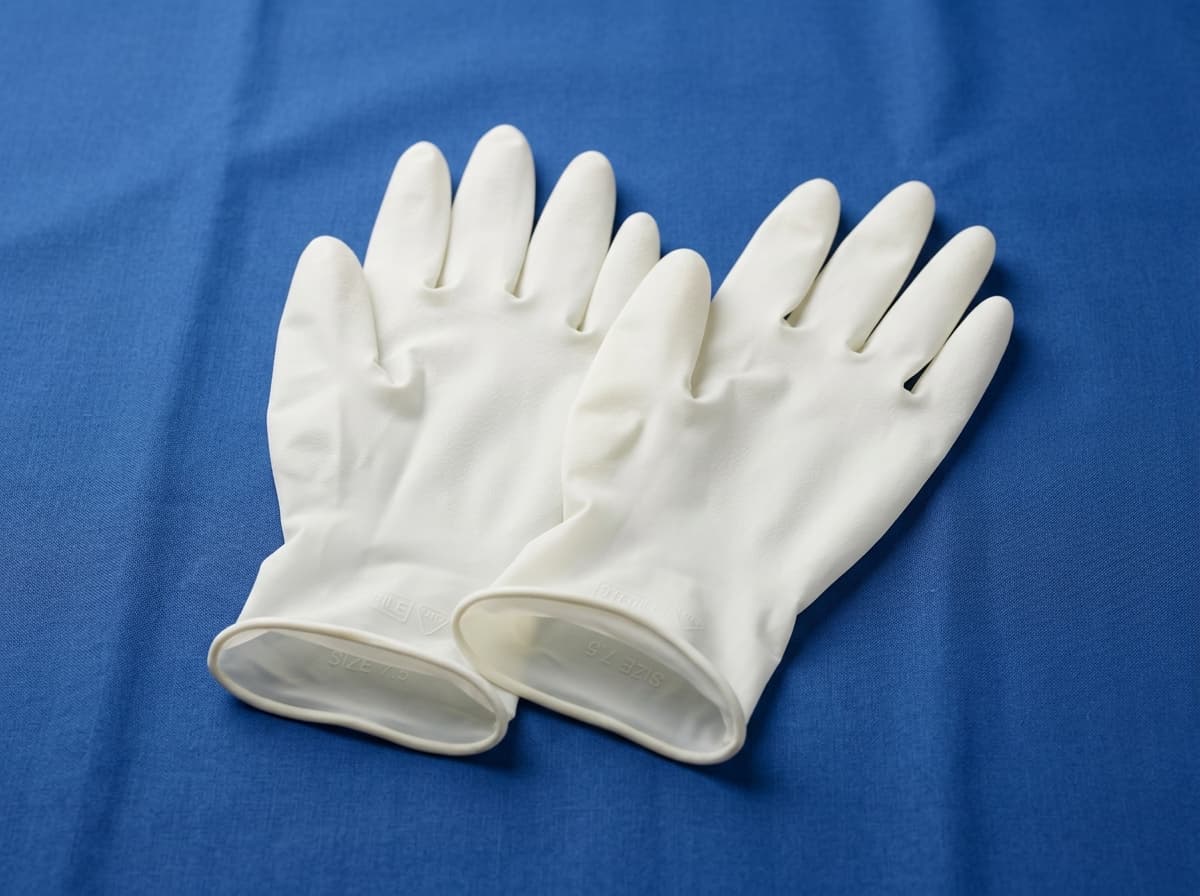
Pre-donned sterile natural latex surgical gloves with curved anatomical fingers, micro-textured anti-slip finish, beaded cuff, available in powdered and powder-free polymer coated grades. Container consignments dispatched from Port Mundra & Port Nhava Sheva, with certificates and test reports shared with every quotation.
The US Government enforces Section 301 trade tariffs imposing 25% to 50% additional import duties on Chinese medical disposables, gloves, and syringes. Indian medical devices enter the US under standard Most Favored Nation (MFN) tariffs (typically 0% to 5%), creating an immediate landed cost saving of 20% to 45% for American distributors.
For shipments destined for the Middle East, Africa, and Southern Europe, Indian ports (Mundra and Nhava Sheva) are geographically closer than Chinese ports. Indian shipments reach Jebel Ali in 4 days (vs 20 days from China), Mombasa in 12 days (vs 28 days from China), and Alexandria in 14 days (vs 26 days from China).
Yes. Top-tier Indian medical device manufacturers operate high-speed automated assembly and dipping lines capable of producing tens of millions of syringes, needles, surgical blades, and gloves monthly, easily supporting national public healthcare tenders.
Yes. English is the official language of corporate, medical, and engineering commerce in India. Indian quality managers, regulatory directors, and factory technicians communicate natively in English, eliminating translation misunderstandings and accelerating technical file review.
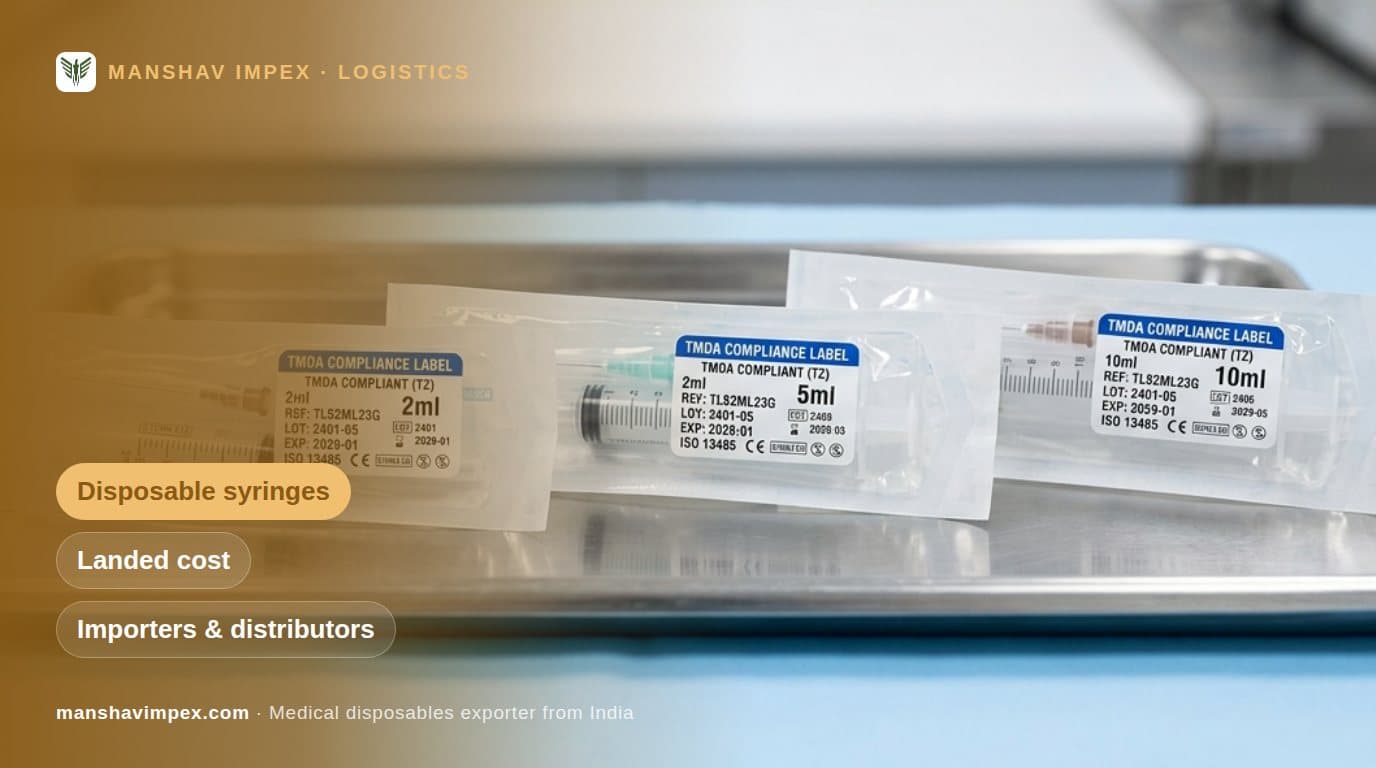
Two quotations for the same 5 ml syringe can be 8% apart on FOB and land at the same warehouse cost - packing density, freight base and duty treatment decide the real number.
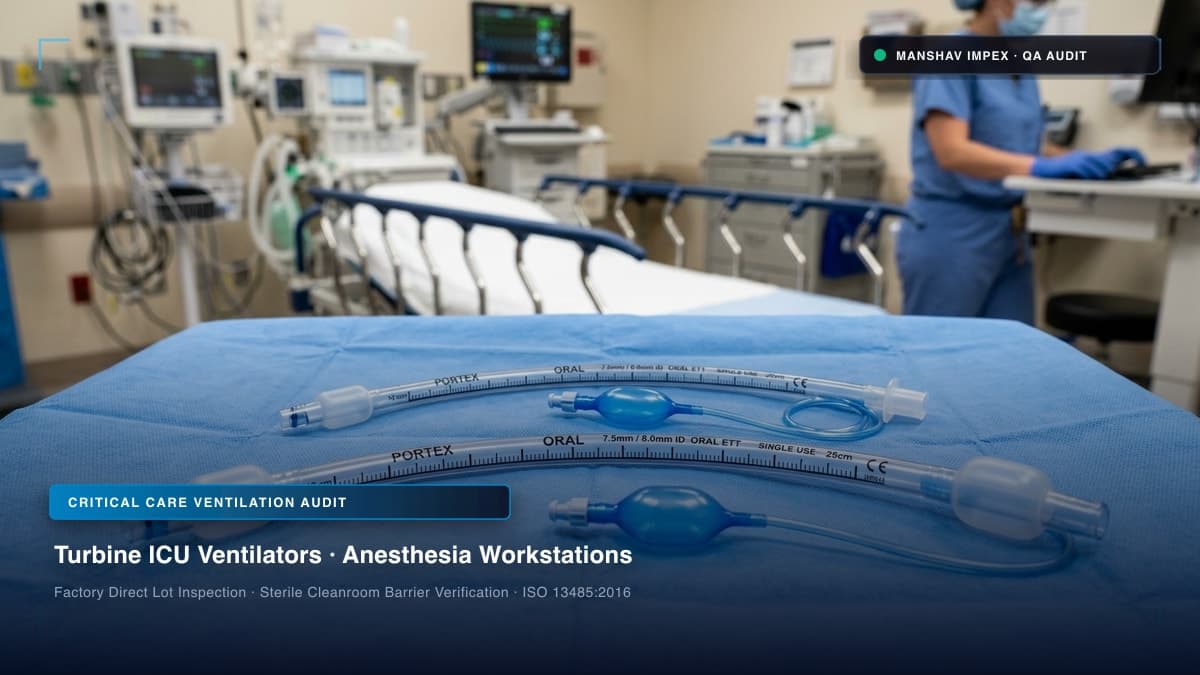
In emergency wards, obstetric surgery theaters, and hematology departments across West Africa, rapid, safe blood administration is an everyday clinical requirement.
How healthcare distributors in Uganda, Rwanda, Burundi, South Sudan, and DR Congo can use the EACMRH joint assessment procedure to register medical devices once across the entire East African Community while cutting procurement costs by 60%.