MOQs and Pricing at Scale: Planning Your First Medical Import
How order volume shapes pricing — and how to plan a first import that is easy to scale.

A distributor can receive three quotations for the same 5 ml Luer-slip syringe and still end up paying very different landed costs. The reason is usually not the syringe - it is carton volume, freight basis, duty treatment and the commercial terms sitting behind the unit price. This worksheet walks through the full calculation once, so you can reuse the structure on every order.
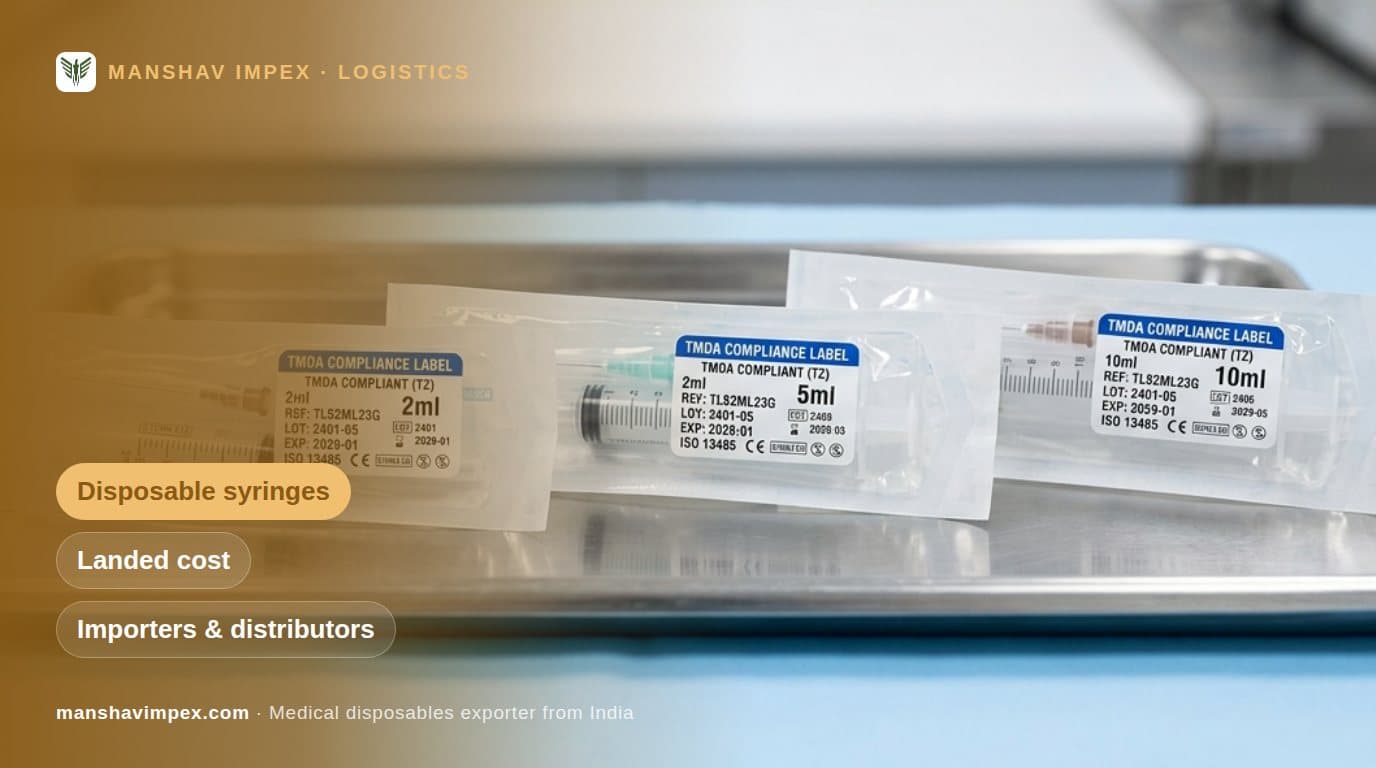
Two quotations for the same 5 ml syringe can be 8% apart on FOB and land at the same warehouse cost - packing density, freight base and duty treatment decide the real number.
Landed cost is everything it takes to get a unit from the factory gate to your warehouse shelf: the FOB price, ocean or air freight, marine insurance, import duty and taxes at your port, clearing-agent charges, port handling, and inland transport. For low-value high-volume consumables like syringes, the non-product part of that chain is often 20-40% of the final figure - which is why comparing FOB prices alone misleads.
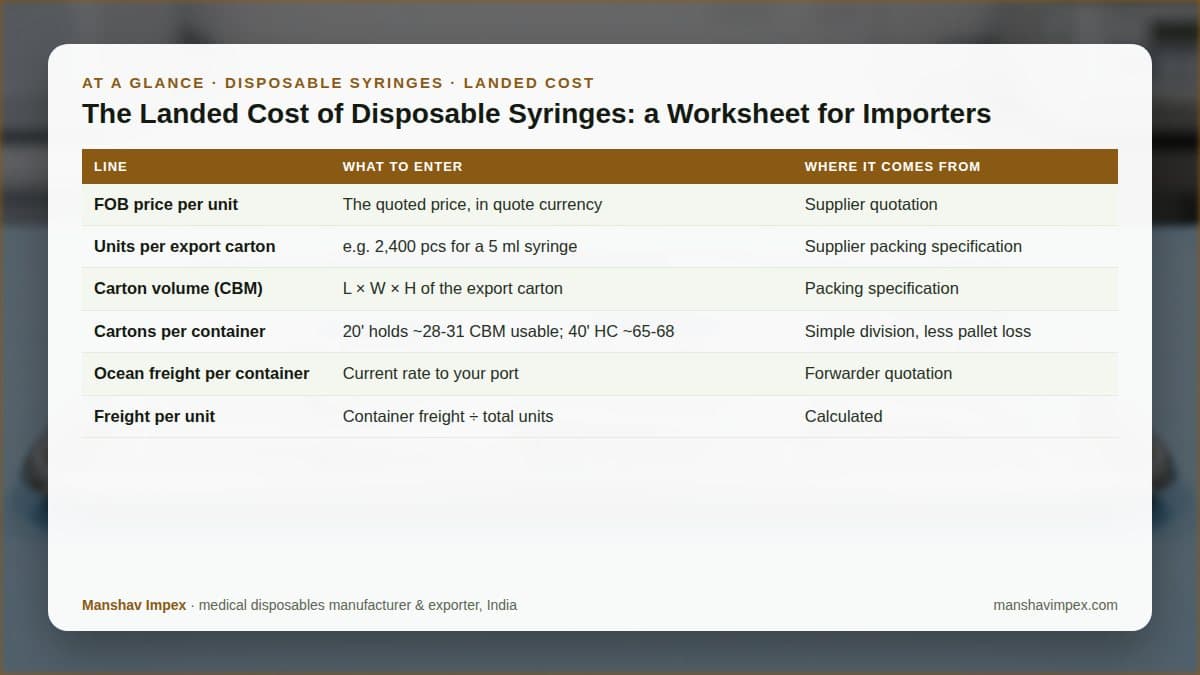
| Line | What to enter | Where it comes from |
|---|---|---|
| FOB price per unit | The quoted price, in quote currency | Supplier quotation |
| Units per export carton | e.g. 2,400 pcs for a 5 ml syringe | Supplier packing specification |
| Carton volume (CBM) | L × W × H of the export carton | Packing specification |
| Cartons per container | 20' holds ~28-31 CBM usable; 40' HC ~65-68 | Simple division, less pallet loss |
| Ocean freight per container | Current rate to your port | Forwarder quotation |
| Freight per unit | Container freight ÷ total units | Calculated |
| Insurance | Usually a small % of CIF value | Your policy or forwarder |
| Duty + taxes | Your tariff line's rate on the customs value | Your country's tariff schedule |
| Clearing + port + inland | Agent fee, port charges, truck to warehouse | Clearing agent quotation |
The single most underestimated line is units per carton. A supplier who packs 2,400 syringes in a slightly denser carton against a competitor's 2,100 ships roughly 14% more product in the same freight spend. On a sea rate of a few thousand dollars per container, that difference routinely outweighs a lower FOB price.
Ask every supplier for the packing specification sheet (units/inner box, inner boxes/carton, carton dimensions, gross weight) before comparing prices. Then compare freight per 1,000 units, not per carton - cartons are not the same size.
FOB keeps freight in your hands, which suits importers with a trusted forwarder and regular volume. CIF is simpler for a first order - the exporter books freight and insurance to your port - but you should still see the freight amount separately so you can compare it with your own forwarder's rate next time. DDP (delivered, duty paid) is rare in medical consumables because duty treatment depends on your import registration; treat a DDP offer as a convenience to verify, not a number to assume.
The cheapest quotation on screen is often just the one that moved the most cost into lines you have not priced yet.
Run the worksheet on two or three suppliers' real packing data and the spread usually narrows to a clear winner - sometimes the one with the higher FOB price. Our export terms page explains the Incoterms we quote under, and the shipping routes page shows typical sailings from Indian ports.
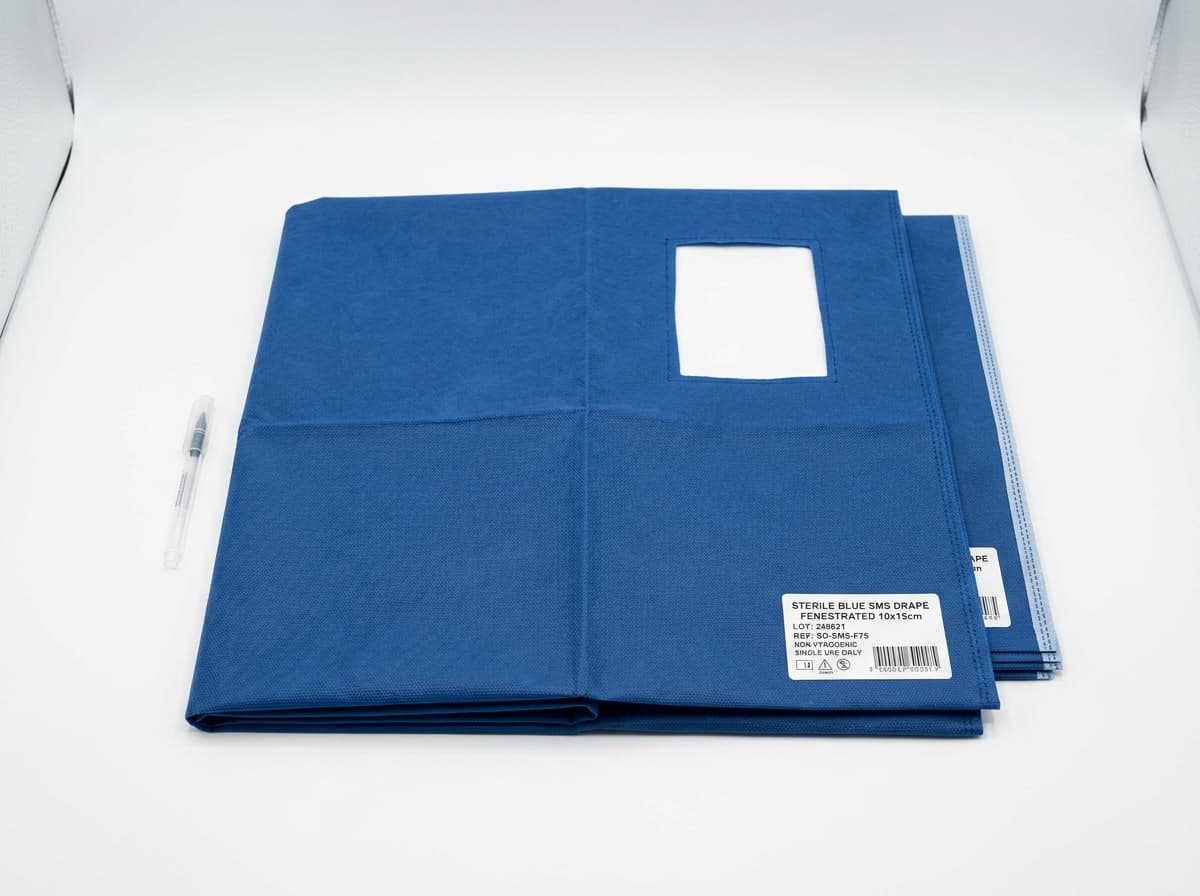
Fluid-resistant sterile surgical drapes with fenestration options — supplied as individual sheets or procedure-specific kit packs for standard and custom OR setups. Container consignments dispatched from Port Mundra & Port Nhava Sheva, with certificates and test reports shared with every quotation.
It varies with route and rates, but for dense, low-value consumables like syringes, freight plus clearing commonly adds 15-35% over FOB on sea shipments. Packing density (units per carton) is the biggest lever an importer controls through supplier choice.
CIF is operationally simpler for a first order because the exporter arranges freight and insurance to your port. Ask for the freight shown separately so you can benchmark it; many importers move to FOB with their own forwarder once volumes become regular.
Take the supplier's carton dimensions, compute carton CBM, and divide usable container volume (roughly 28-31 CBM for a 20', 65-68 CBM for a 40' HC) by carton CBM, allowing some loss for palletisation. Multiply by units per carton.
Yes. Units per carton drop as syringe size rises, and needle-attached, auto-disable and insulin syringes each pack differently and may sit on different tariff lines, so run the worksheet per SKU rather than once per order.
A correct commercial invoice, packing list, certificate of origin and any registration your regulator requires. Errors here cost storage and demurrage days, which land on the same worksheet as everything else.
How order volume shapes pricing — and how to plan a first import that is easy to scale.

Balancing cost, speed and product type when choosing how to ship your order.
A complete step-by-step procurement blueprint for international buyers importing surgical gloves, blades, syringes, and hospital disposables from Indian factories.