Micro Drip vs Macro Drip IV Sets: What Egypt Importers Order from an IV Set Manufacturer in India
An Egyptian importer reordering infusion sets usually knows the total volume. What decides whether the next shipment sells cleanly is the split: how many macro drip sets for adult wards, how many micro drip and burette sets for paediatrics, and whether every line is specified tightly enough that the IV set manufacturer in India ships exactly what Cairo and Alexandria hospitals expect. This guide covers the difference between the two, the drip-rate maths nurses rely on, and the RFQ lines that keep the order right.
Sharmil Mangukiya (Founder & MD) 5 min read October 24, 2026
In short
Macro drip and micro drip sets look almost identical in the carton, but they deliver different volumes per drop. Here is how Egyptian distributors split the order, write the RFQ lines and check a sample before they commit to an Indian manufacturer.
Most complaints about infusion sets are not about sterility or leaks. They are about the wrong set reaching the ward: a macro drip set sent where the paediatric unit counts drops per minute against a 60 drops/ml chart, or a set with a different drop factor from the one printed on the hospital's protocol. Both are avoidable at the ordering stage.
What is the difference between a micro drip and a macro drip IV set?
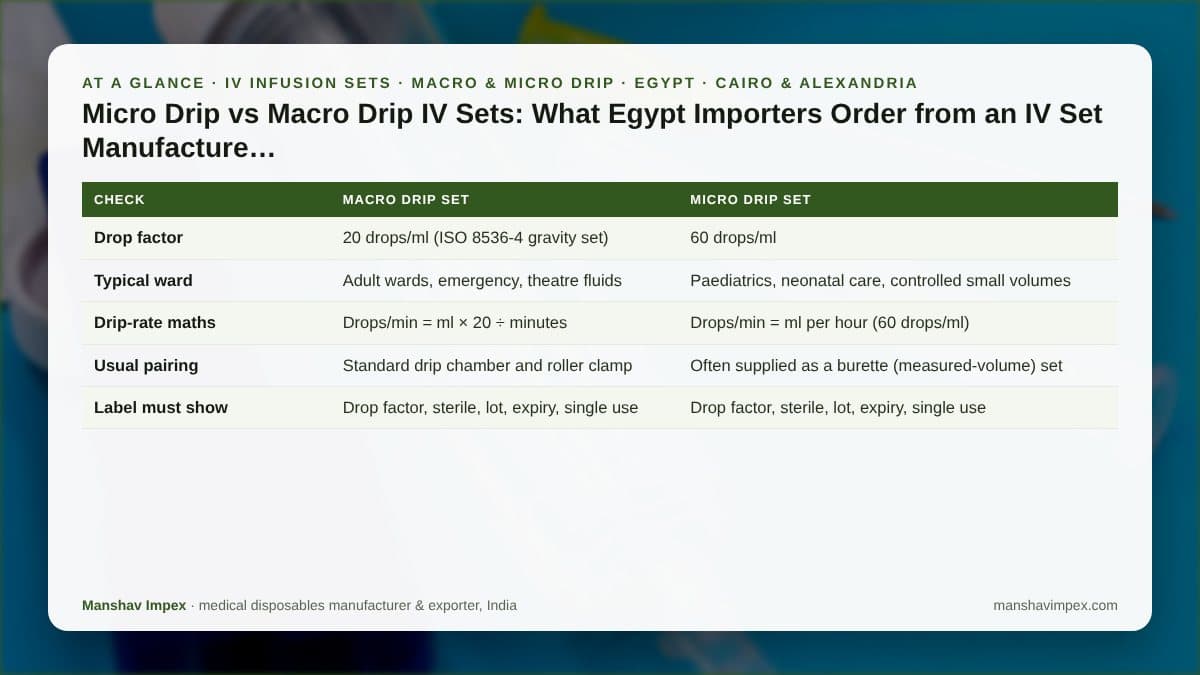
The difference is the drop factor: how many drops make one millilitre. A macro drip set forms large drops — gravity sets made to ISO 8536-4 are calibrated so that 20 drops of distilled water equal 1 ml — and suits adult fluid replacement. A micro drip set forms 60 small drops per millilitre, which lets nurses give small, steady volumes to children and neonates without a pump.
Check
Macro drip set
Micro drip set
Drop factor
20 drops/ml (ISO 8536-4 gravity set)
60 drops/ml
Typical ward
Adult wards, emergency, theatre fluids
Paediatrics, neonatal care, controlled small volumes
Drip-rate maths
Drops/min = ml × 20 ÷ minutes
Drops/min = ml per hour (60 drops/ml)
Usual pairing
Standard drip chamber and roller clamp
Often supplied as a burette (measured-volume) set
Label must show
Drop factor, sterile, lot, expiry, single use
Drop factor, sterile, lot, expiry, single use
Why the drop factor matters to the hospitals you sell to
Where no infusion pump is used, nurses set the rate by counting drops. The formula is drops per minute = volume in millilitres × drop factor ÷ time in minutes. One litre over eight hours on a 20 drops/ml set is about 42 drops a minute. On a 60 drops/ml set the number of drops per minute equals the millilitres per hour, which is why paediatric units prefer micro drip: 50 ml an hour is simply 50 drops a minute.
That is also why a hospital will not accept a substitute drop factor, even at a better price. Its charts, training and protocols are written around one number. When you take an order, confirm the drop factor the ward uses before you confirm the product.
The key checks from this guide at a glance.
Procurement note
Ask the manufacturer to print the drop factor large on the unit pouch and on the carton, not only in the instructions. Stores staff in a busy hospital pick by what they can read on the shelf; a carton that says '60 drops/ml' in the corner of the label is how macro and micro sets end up mixed on the same ward.
Writing the RFQ to an IV set manufacturer in India
Give each set type its own RFQ line, even if the manufacturer offers them as variants of one product. Then quotations from different Indian exporters line up row by row, and the proforma invoice, packing list and labels all carry the same description.
Specify on each line
Why it matters in Egypt
Ask the exporter to show
Drop factor (20 or 60 drops/ml)
Hospitals buy against their dosing charts
Drop factor on pouch and carton artwork
Vented or non-vented spike
Glass bottles need a vented spike; collapsible bags do not
Spike type per line on the proforma
Fluid filter
Standard on gravity sets; hospitals check it is present
Filter stated in the technical data sheet
Connector (Luer slip or Luer lock)
Must match the cannulas the hospital uses
Sample from current production
Tubing length and injection site
Ward layout and add-on medication practice
Length and site position in the drawing
Labelling language and shelf life
Registration and tender conditions may require Arabic text
Draft artwork before production
Medical devices sold in Egypt fall under the Egyptian Drug Authority, and public hospital supply runs largely through the Unified Procurement Authority's tenders. Requirements for registration, labelling and tender documents change; confirm current guidance with the authority and your registration consultant before you place the order, and make sure the manufacturer's certificates are issued in the same legal name that will appear on your registration file.
We stopped losing paediatric business the month we split the order into separate lines for micro drip and burette sets. Before that, the boxes looked the same in our warehouse and the wrong ones kept going out.
Deciding the macro and micro mix for an Egyptian shipment
There is no standard ratio. Work from your customers' actual usage: the last twelve months of sales by set type, the paediatric and neonatal beds in the hospitals you supply, and any open tenders that specify burette sets. Many distributors carry macro drip as the volume line and order micro drip and burette sets in smaller, more frequent lots, so short-dated paediatric stock never builds up.
Price each set type separately and compare manufacturers line by line, not on a blended average.
Request samples of every variant you will order, from current production, and check them against the RFQ line.
Agree minimum remaining shelf life on arrival at Alexandria or Port Said, not only at dispatch.
Put the drop factor, spike type and connector on the proforma invoice so customs and stores see the same description.
We export IV infusion sets — 20 drops/ml macro drip, 60 drops/ml micro drip and burette sets — with documents in the manufacturer's legal name.
Prices vary with drop factor, spike, connector, packing and quantity, so request a current quotation and compare exporters on the same basis. Ask each one to quote the same Incoterm to the same Egyptian port, the same unit of issue and the same shelf-life commitment. A lower unit price on a set without a filter or with a slip connector where the hospital uses lock is not a saving.
Send us your macro, micro and burette set lines with quantities and destination port, and we will quote each line separately.
Medical-grade IV infusion administration sets featuring sharp spike with bacterial air vent, transparent drip chamber with 15µm fluid filter, roller clamp for accurate drop regulation, and latex-free injection site. Container consignments dispatched from Port Mundra & Port Nhava Sheva, with certificates and test reports shared with every quotation.
Made to CE MDRMade to ISO 13485Made to ISO 8536-4MOQ: 50,000 pcs
What is the difference between micro and macro drip sets?
The drop factor. A macro drip set delivers about 20 drops per millilitre (ISO 8536-4 gravity sets are calibrated to 20 drops = 1 ml), and suits adult fluid replacement. A micro drip set delivers 60 drops per millilitre, giving smaller, finer control for children, neonates and small-volume infusions.
How do you calculate the drip rate for a micro drip set?
Drops per minute = volume in ml × drop factor ÷ time in minutes. With a 60 drops/ml micro drip set, the drops per minute equal the ml per hour, so 50 ml/h runs at 50 drops a minute.
How do I choose an IV set manufacturer in India for Egypt?
Shortlist IV set manufacturers in India who give a separate technical sheet for each set type, supply samples from current production, print the drop factor clearly on pouch and carton, and issue certificates in the manufacturer's legal name for your Egyptian Drug Authority file. Compare quotations line by line on the same Incoterm and port.
Should Egyptian distributors stock both micro and macro drip sets?
Most do, because adult wards use macro drip and paediatric and neonatal units use micro drip or burette sets. Base the split on your customers' actual usage and open tenders rather than a fixed ratio, and keep the lower-volume micro line in smaller, fresher lots.
What should an IV set RFQ include?
One line per set type with drop factor, vented or non-vented spike, fluid filter, Luer slip or lock connector, tubing length, injection site, labelling language, shelf life on arrival, quantity and destination port. That lets you compare exporters from India row by row.
Sharmil Mangukiya (Founder & MD)
Sharmil Mangukiya is the founder and managing director of Manshav Impex, an Indian manufacturer & exporter of medical disposables serving importers, distributors, hospitals and governments in 48+ countries since 2019.