Manufacturing

Surgical Scalpel Blade Handles (No. 3, No. 4, No. 7): Fitment & Specification Guide

While surgical blades are single-use sterile consumables discarded after every incision, their operational precision and tactile feedback depend entirely on the mechanical fitment, weight balance, and locking geometry of the surgical scalpel handle. Sourcing re-usable stainless steel scalpel handles alongside container-load sterile blade shipments allows medical distributors to offer turn-key surgical cutting solutions to private clinics and hospital operating theatres worldwide. However, dimensional mismatches between foreign handles and international blade tangs can lead to blade wobble, dangerous accidental dislodgement, or surgical glove tearing during mounting. This guide details the metallurgy, handle geometries, and fitment standards required for global hospital tenders.

Surgical Scalpel Blade Handles (No. 3, No. 4, No. 7): Fitment & Specification Guide
Key Summary & AI Takeaways

While surgical blades are single-use consumables, their clinical performance depends directly on the mechanical fitment, rigidity, and balance of the reusable surgical scalpel handle.

Quick Buyer Summary: Scalpel Handles & Blade Fitment

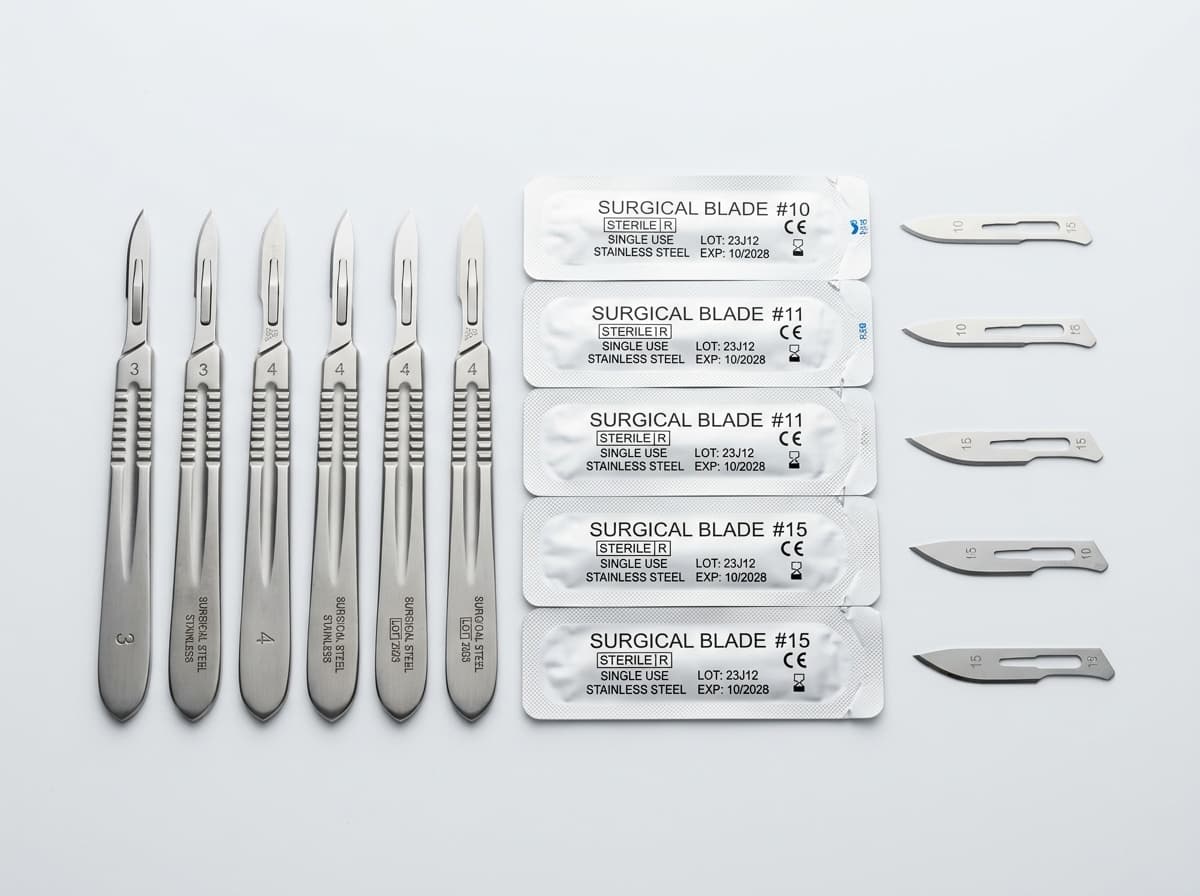
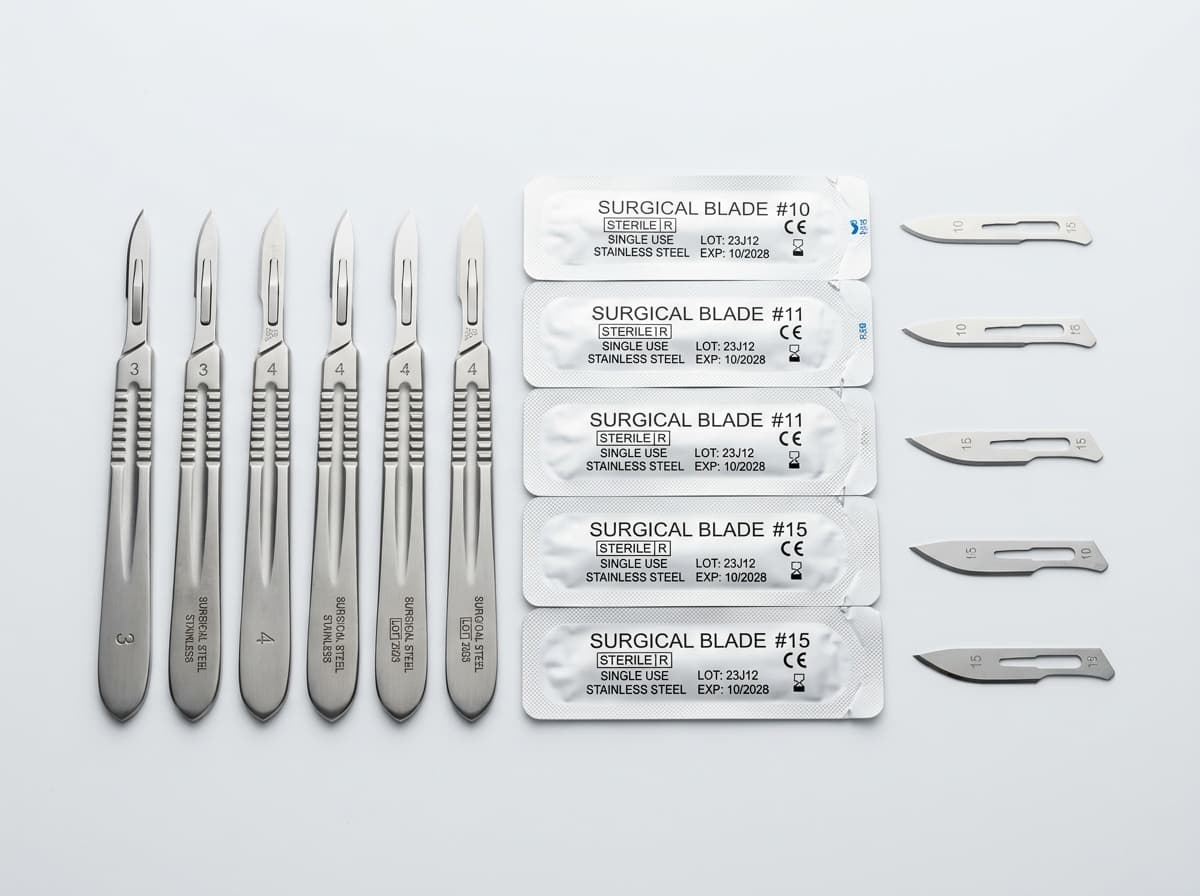
Surgical scalpel handles manufactured in India are crafted from medical-grade martensitic (AISI 410/420) or austenitic (AISI 304) surgical stainless steel conforming to ISO 7153-1. Handle No. 3 and No. 7 feature a small fitment tang engineered exclusively for small blades (#10, #11, #12, #15), whereas Handle No. 4 features a wider, dependable tang engineered for heavy-duty incision blades (#18, #20, #21, #22, #23, #24, #25).

Master Fitment Matrix: Handles vs Surgical Blades

Mounting the wrong blade size on an incompatible handle is physically impossible without permanently warping the metal slot. Procurement buyers must align their purchase orders according to the standard fitting system:

Handle ModelTang Fitting StandardCompatible Blade SizesTotal LengthPrimary Surgical Discipline
Handle No. 3Small Tang (Slot ~1.5 mm)#10, #11, #12, #12D, #13, #15, #15C125 mm (Standard)General surgery, dermatology, plastic surgery, vascular incisions
Handle No. 3L (Long)Small Tang (Slot ~1.5 mm)#10, #11, #12, #15210 mm (Extended)Deep abdominal, thoracic, pelvic cavity surgery
Handle No. 4Large Tang (Slot ~2.3 mm)#18, #19, #20, #21, #22, #23, #24, #25135 mm (Heavy-duty)Orthopedic surgery, trauma, post-mortem, thick skin incisions
Handle No. 4L (Long)Large Tang (Slot ~2.3 mm)#20, #21, #22, #23, #24215 mm (Extended)Deep orthopedic exposure, spinal surgery, bariatric procedures
Handle No. 7Small Tang (Slim Pencil)#10, #11, #12, #15165 mm (Slender)ENT, oral maxillofacial, ophthalmic, plastic reconstructive surgery

Metallurgical Specifications: AISI 410/420 vs Passivation Standards

Reusable surgical handles undergo aggressive hospital autoclave sterilization cycles (steam under pressure at 134°C) and enzymatic cleaning. Low-grade commercial steel rapidly develops pitting corrosion around the mounting slot, ruining dimensional accuracy. Indian export-grade scalpel handles must fulfill three physical benchmarks:

  • Rockwell Hardness: Heat-treated to HRC 40–48 to ensure the locking tang does not bend or wear down after hundreds of blade attachments.
  • Chemical Passivation: Treated according to ASTM A967 with citric or nitric acid bath, creating a durable chromium-oxide passive barrier against rust.
  • Copper Sulfate Testing: Rigorous boil and copper-sulfate immersion test (ISO 13402) verifying zero free-iron residue on knurled gripping surfaces.
Surgical Safety Protocol: Metric Graduations

Handle No. 3 and No. 4 are available with laser-engraved metric ruler graduations (0–50 mm) along the reverse edge, allowing surgeons to rapidly verify incision lengths and excision margins without introducing separate measuring calipers.

Combine your stainless steel scalpel handles with Manshav Impex sterile carbon and stainless steel surgical blades in a single ocean shipment.
Request Surgical Blades & Handles Catalog & Pricing
🏭 Export Sourcing DeskIndian Manufacturer & Exporter — Vetted Factory Network
Sterile Surgical Blades & Scalpel Handles manufacturer India

Sterile Surgical Blades & Scalpel Handles

Ultra-sharp sterile surgical blades crafted from premium surgical steel with precision-ground edges and matching ergonomic scalpel handles for OR use. Container consignments dispatched from Port Mundra & Port Nhava Sheva, with certificates and test reports shared with every quotation.

Made to CE MDRMade to ISO 13485Made to ISO 7740MOQ: 100,000 pcs

Frequently asked questions

What is the difference between a satin matte finish and mirror finish on scalpel handles?

A satin matte (or sandblasted) finish diffuses harsh operating theatre overhead lighting, eliminating blinding reflections for the surgeon. A mirror finish is polished smooth, offering slightly higher resistance to chemical stains but reflecting bright surgical lamps.

Can Handle No. 3 take a No. 22 blade?

No. A No. 22 blade has a large tang slot (approx. 2.3 mm width) designed specifically for Handle No. 4. Attempting to fit it onto Handle No. 3 will result in a loose, dangerously unstable blade that dislodges during surgical cutting.

What is the recommended cleaning and sterilization protocol for stainless steel handles?

Handles should be rinsed in enzymatic detergent immediately after use, ultrasonically cleaned to dislodge tissue remnants from the knurled grip and locking grooves, and autoclaved at 134°C for 5 minutes (or 121°C for 20 minutes) wrapped in sterilization pouches.

What is the standard packaging for bulk export of scalpel handles?

Surgical handles are packed in individual protective PVC pouches or heat-sealed polybags, boxed in sets of 10 or 20 units per inner carton, and packed 500 units per corrugated export master carton lined with moisture-barrier film.

Sharmil Mangukiya (Founder & MD)

Sharmil Mangukiya is the founder and managing director of Manshav Impex, an Indian manufacturer & exporter of medical disposables serving importers, distributors, hospitals and governments in 48+ countries since 2019.

Chat with us