Syringe Sizes Chart: 1 ml to 60 ml, Needles and Uses for Tanzanian Hospitals
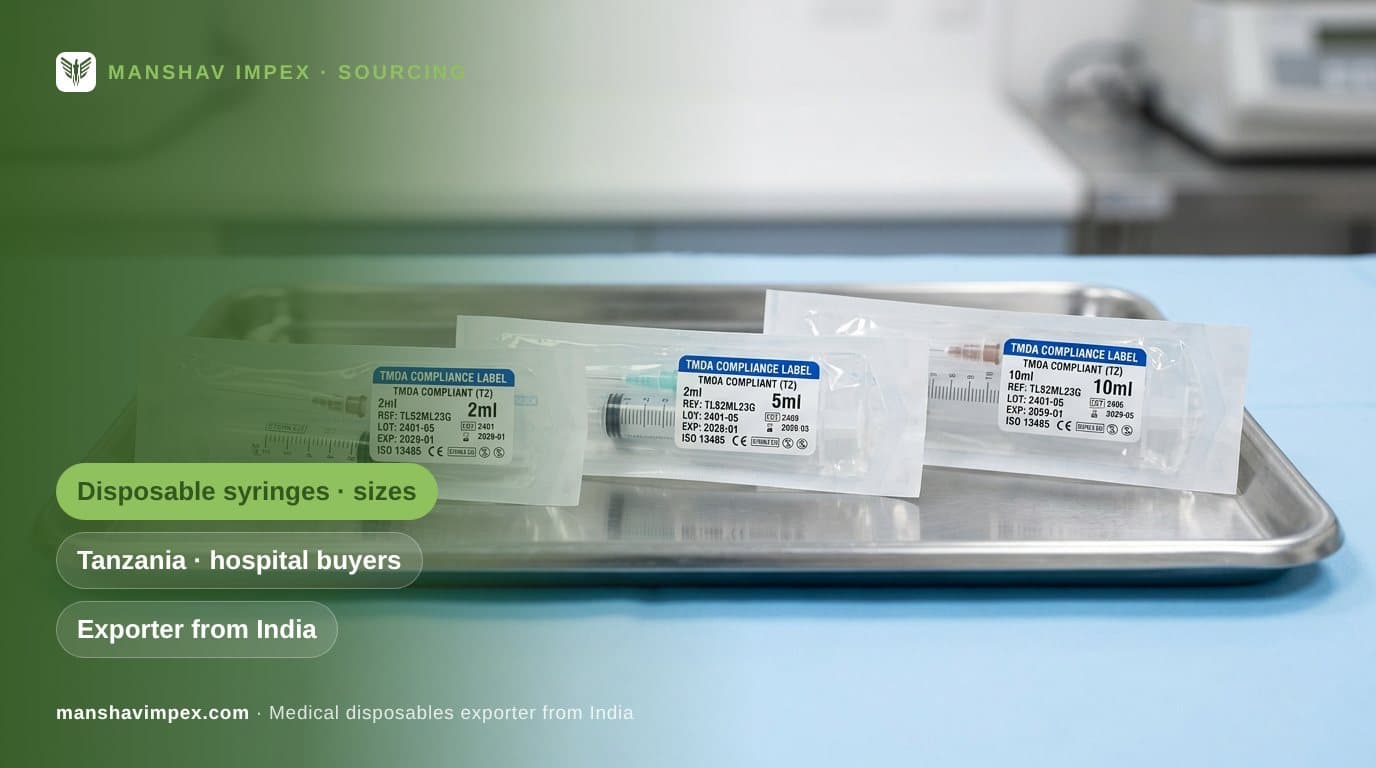
A procurement officer in Dar es Salaam or Mwanza is rarely asked whether the hospital needs syringes. The question is which ones: a 2 ml for the vaccination clinic, a 10 ml for the IV flushes on the medical ward, a 50 ml Luer lock for the ICU's syringe pumps. This chart sets out the common syringe sizes, what each is used for and the needle that usually comes with it, then shows how to turn that into tender lines a disposable syringes supplier in Tanzania can quote like for like.
Sharmil Mangukiya (Founder & MD) 4 min read October 31, 2026
In short
Most syringe orders in a hospital come down to six sizes. Here is what each one is for, which needle and tip usually goes with it, and how procurement teams in Tanzania write the lines so every ward gets the syringe it actually uses.
A syringe is described by its volume in millilitres, its tip (where the needle or line attaches), whether it is 2-part or 3-part, and the needle mounted on it, if any. Volume decides the job; the needle decides how it is given. Getting both right per ward matters more than the price per piece, because the wrong size is opened, found unsuitable and thrown away.
What syringe sizes do hospitals use, and what is each one for?
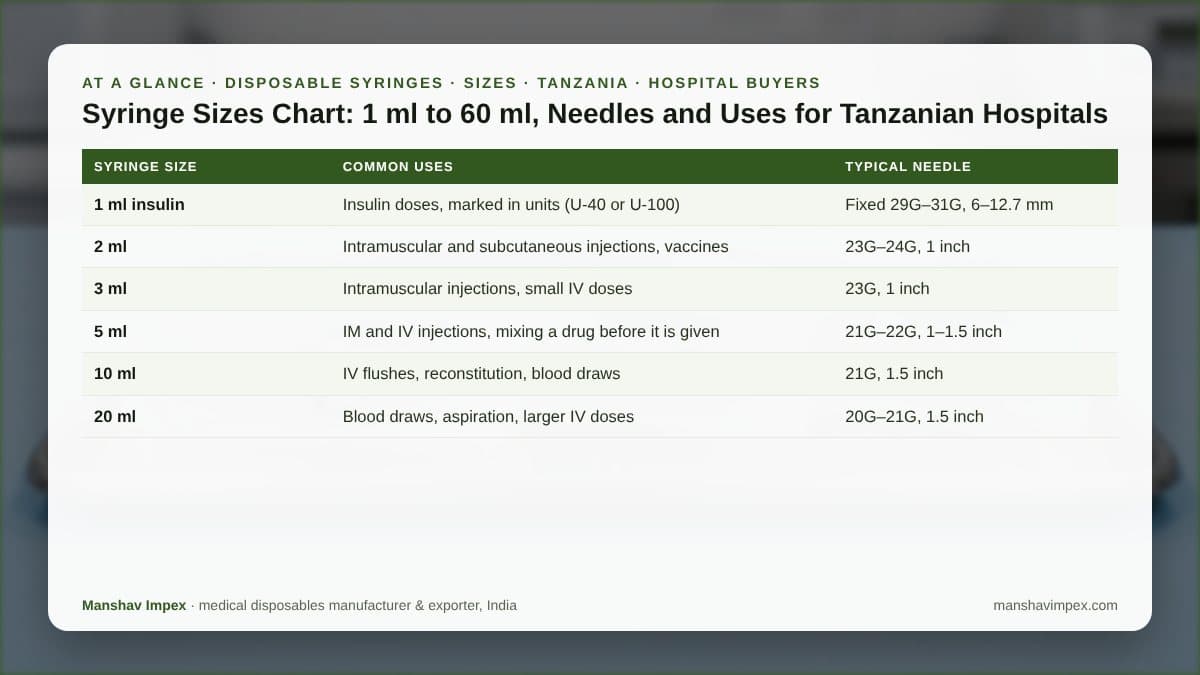
Most hospitals use 2 ml, 3 ml and 5 ml syringes for injections, 10 ml and 20 ml for flushes, drug mixing and blood draws, and 50/60 ml Luer lock syringes on syringe pumps. Insulin is given with its own 1 ml (or smaller) syringe marked in units, with a fixed fine needle. The table gives the usual pairing; the ward's protocol has the final word.
Syringe size
Common uses
Typical needle
Tip
1 ml insulin
Insulin doses, marked in units (U-40 or U-100)
Fixed 29G–31G, 6–12.7 mm
Fixed needle
2 ml
Intramuscular and subcutaneous injections, vaccines
23G–24G, 1 inch
Luer slip, central
3 ml
Intramuscular injections, small IV doses
23G, 1 inch
Luer slip, central
5 ml
IM and IV injections, mixing a drug before it is given
21G–22G, 1–1.5 inch
Luer slip, central
10 ml
IV flushes, reconstitution, blood draws
21G, 1.5 inch
Luer slip, central or eccentric
20 ml
Blood draws, aspiration, larger IV doses
20G–21G, 1.5 inch
Eccentric slip or Luer lock
50/60 ml
Syringe pumps, irrigation, larger volumes
Usually none: connects to a line
Luer lock
Needles are colour-coded by gauge under ISO 6009 (a 23G needle is deep blue, 21G deep green), and that code differs from the one on IV cannula hubs. Our needle and cannula colour chart shows both side by side.
The key checks from this guide at a glance.
Procurement note
Before the next tender, take last year's issue records from the pharmacy store and count syringes by size and by ward, not as one total. Hospitals that do this usually find one or two sizes running out every quarter while another sits in the store until it expires. Order by what was issued, and write the needle with each size, not as a separate line.
How hospital procurement in Tanzania writes syringe tender lines
A line that only says "disposable syringe 5 ml" lets each bidder choose the needle, the tip and the number of parts, and the evaluation ends up comparing different products. Write each of these per size:
Volume and whether a needle is mounted, with its gauge and length (for example 5 ml with 22G × 1.25 inch).
Tip: central or eccentric Luer slip, or Luer lock for pumps and pressurised lines.
Construction: 2-part or 3-part (a rubber-tipped plunger moves more evenly).
Sterilisation (usually ethylene oxide) and the shelf life left on delivery.
Standards: ISO 7886-1 for the syringe and ISO 7864 for the needle, with test reports for each size.
Packing: units per box and boxes per carton, so the store can plan shelf space.
Medical devices sold in Tanzania are regulated by TMDA, and public hospitals often buy through MSD or their own tenders. Registration and labelling rules change, so confirm the current requirements with TMDA before the first shipment.
We used to buy one syringe line and argue about it every month. Now the store issues by size and by ward, and the 10 ml shortage we blamed on the supplier turned out to be our own order.
We manufacture 2-part and 3-part disposable syringes from 2 ml to 50/60 ml, central or eccentric Luer slip and Luer lock, with or without a needle.
Comparing quotations from disposable syringes manufacturers in India
Syringe prices move with polypropylene costs, the needle and the number of parts, so request a current quotation and compare line by line: the same volume, needle, tip, construction and packing, on the same Incoterm to Dar es Salaam. Ask each exporter for test reports to ISO 7886-1 per size and for samples from current production, and check that the factory named on the ISO 13485 certificate is the one on the box.
Our minimum is 100,000 pieces, packed 100 per box and 16 boxes per carton, and the volumes can be mixed in one container. Insulin syringes (0.3 ml, 0.5 ml and 1 ml, U-40 or U-100) are a separate line with their own fixed needles.
Send your syringe sizes, needles and yearly quantities per ward and we will quote each line separately to Dar es Salaam.
High-precision sterile single-use disposable syringes with Luer-Lock and Luer-Slip options, clear graduation barrel, smooth gliding medical-grade plunger, and mounted ultra-sharp hypodermic needles. Container consignments dispatched from Port Mundra & Port Nhava Sheva, with certificates and test reports shared with every quotation.
Made to CE MDRMade to ISO 13485Made to ISO 7886-1MOQ: 100,000 pcs
What size syringe is used for an intramuscular injection?
Usually a 2 ml, 3 ml or 5 ml syringe, with a 21G–23G needle long enough to reach the muscle (often 1 to 1.5 inches in adults). The volume of the dose and the hospital's protocol decide which.
What is a 50 ml syringe used for?
Mostly on syringe pumps, which give a drug at a steady rate over hours, and for irrigation. Syringes for pumps have a Luer lock tip so the line cannot slip off under pressure.
What is the difference between a 2-part and a 3-part syringe?
A 3-part syringe has a rubber gasket on the plunger, which gives smoother movement and a more even dose; a 2-part syringe has a one-piece plunger and costs less. Tenders should say which one each line needs.
How do I choose a disposable syringes exporter from India for Tanzania?
Shortlist disposable syringes manufacturers in India that make every size and needle on your list, hold ISO 13485 in the factory's own name and have test reports to ISO 7886-1 for each size. Then compare quotations line by line on the same Incoterm to Dar es Salaam, and check the documents TMDA registration needs.
What is the minimum order for disposable syringes from India?
Our minimum is 100,000 pieces, packed 100 per box and 16 boxes per carton, with different volumes allowed in the same container. Send your sizes and quantities and we will confirm what fits a 20-foot or 40-foot container.
Sharmil Mangukiya (Founder & MD)
Sharmil Mangukiya is the founder and managing director of Manshav Impex, an Indian manufacturer & exporter of medical disposables serving importers, distributors, hospitals and governments in 48+ countries since 2019.