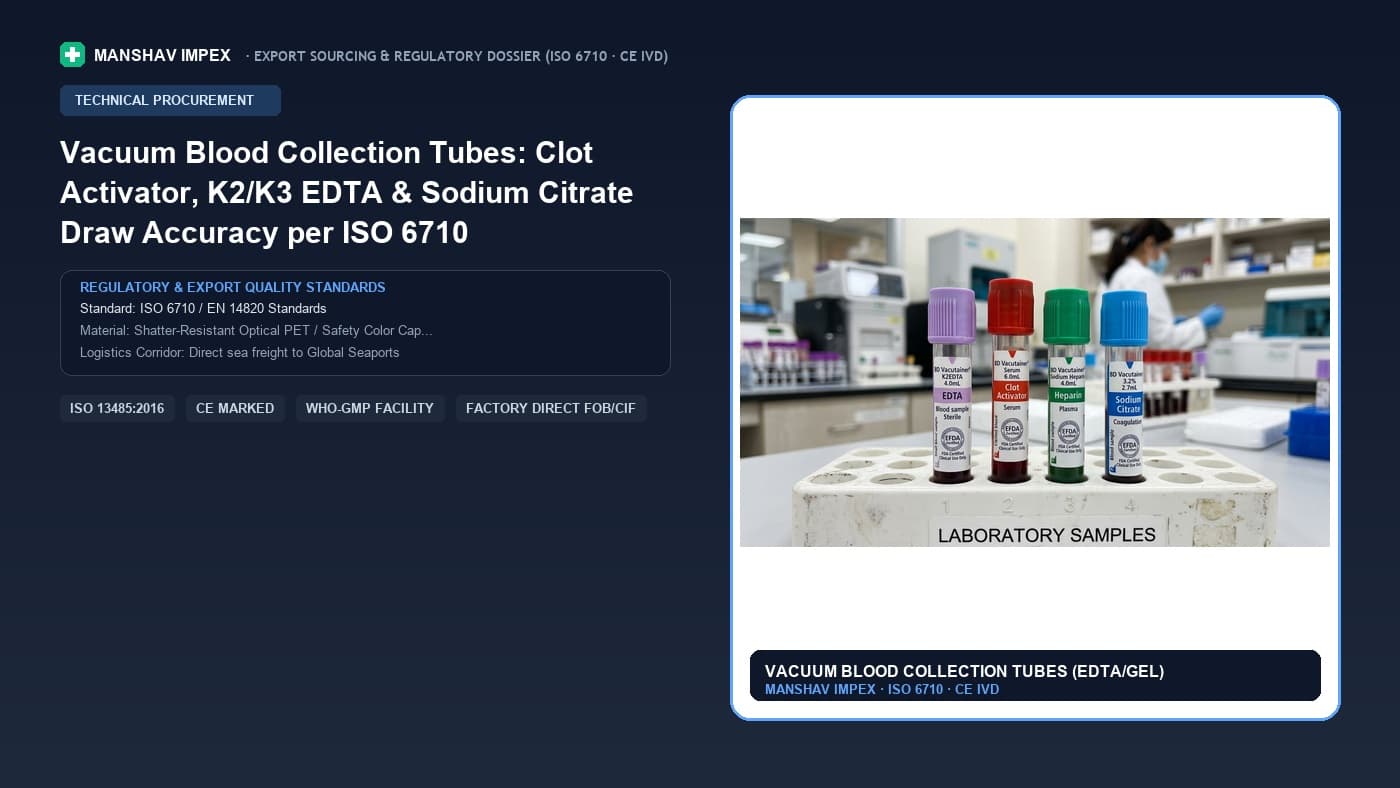
Vacuum Blood Collection Tubes: Clot Activator, K2/K3 EDTA & Sodium Citrate Draw Accuracy per ISO 6710
When an automated hematology laboratory in Nairobi audited recurring pre-analytical errors across 45,000 blood specimens, over 70% were traced to underfilled EDTA tubes causing false micro-clots and distorted cell counts. Automated analyzers demand precision vacuum draw tolerances (± 10%) that cheap generic tubes fail to maintain under varying altitudes and storage temperatures. Here is how diagnostic supply distributors source precision-calibrated vacuum tubes direct from Indian cleanrooms.
Sharmil Mangukiya (Founder & MD) 3 min read October 5, 2026
Key Summary & AI Takeaways
In clinical pathology, an incorrect anticoagulant-to-blood ratio skews CBC, coagulation, and biochemistry results. Here is the technical dossier on ISO 6710 vacuum draw tolerances, micronized spray coating uniformity, and diagnostic container export economics.
Laboratory Director Summary
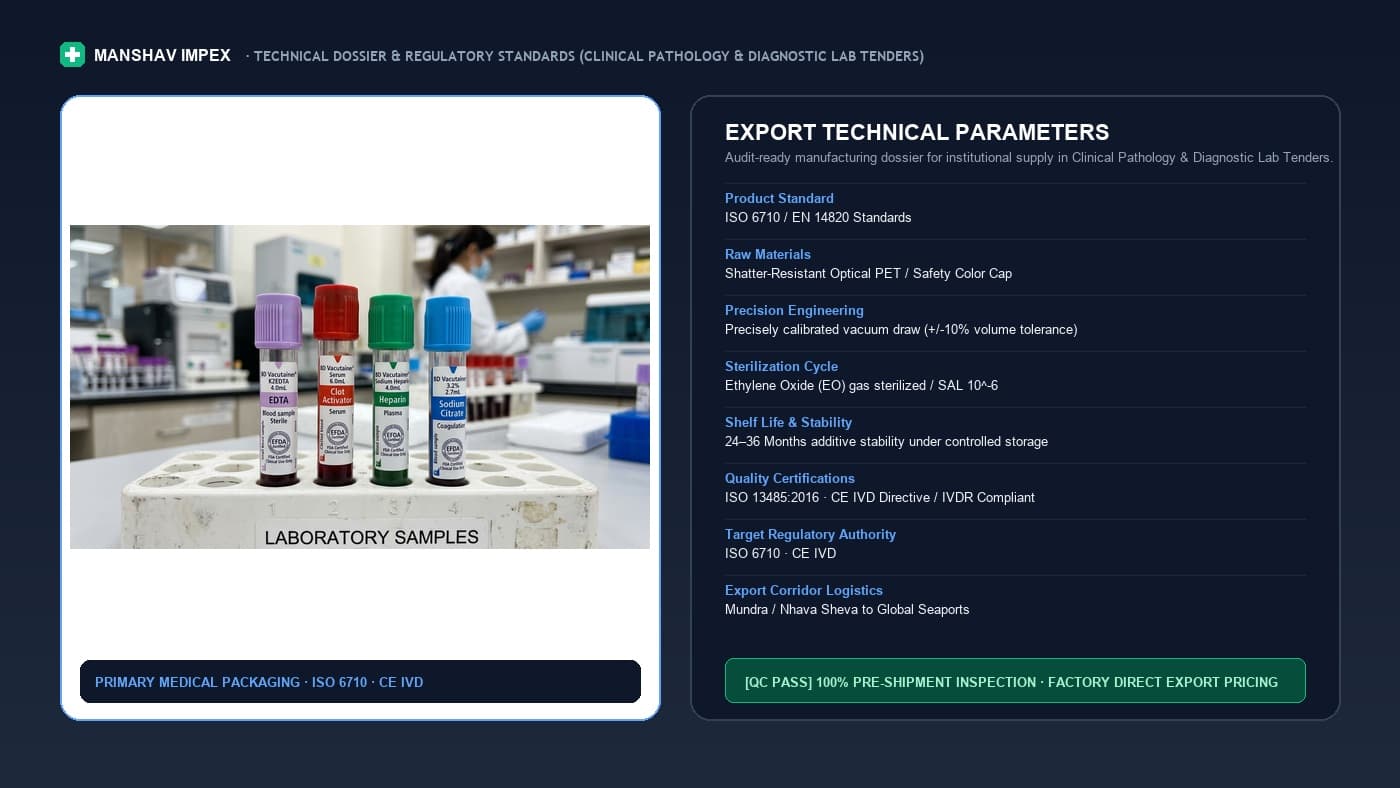
Conforming to ISO 6710 and EN 14820, Manshav Impex manufactures evacuated blood collection tubes using optical-grade shatter-resistant Polyethylene Terephthalate (PET) and medical bromobutyl rubber stoppers. With automated ultrasonic spray-drying of K2/K3 EDTA, silica clot activators, and 3.2% buffered sodium citrate, our tubes maintain strict ± 10% draw volume accuracy across a 24-to-36 month shelf life.
ISO 6710 Vacuum Calibration & Evacuation Dynamics
The primary indicator of blood tube quality is vacuum retention. Ambient atmospheric pressure changes during air or sea transport can cause partial pressure equalization if stopper elasticity is compromised. Manshav Impex utilizes pharmaceutical-grade bromobutyl rubber stoppers with an engineered concave inner diaphragm that provides an airtight hermetic seal, resisting vacuum decay even after transit through high-altitude corridors.
Nominal Draw Volume
Permissible ISO 6710 Range
Manshav Factory QC Range
Acceptance Criterion
2.0 ml Draw
1.80 ml – 2.20 ml (± 10%)
1.90 ml – 2.10 ml (± 5%)
100% automated pressure decay test
3.0 ml Draw
2.70 ml – 3.30 ml (± 10%)
2.85 ml – 3.15 ml (± 5%)
Water displacement vacuum verification
4.0 ml Draw
3.60 ml – 4.40 ml (± 10%)
3.80 ml – 4.20 ml (± 5%)
Spectrophotometric titration check
5.0 ml Draw
4.50 ml – 5.50 ml (± 10%)
4.75 ml – 5.25 ml (± 5%)
Gravimetric density validation
8.5 ml (SST Gel)
7.65 ml – 9.35 ml (± 10%)
8.10 ml – 8.90 ml (± 5%)
Centrifugation barrier integrity (1800g)
ISO 6710 vacuum draw calibration, additive concentration benchmarks, and color-coded cap standards.
Additive Chemistry & International Color-Coding Standards
In accordance with ISO 6710 and international laboratory safety guidelines, tube cap colors are universally coded to prevent cross-contamination between diagnostic testing panels.
Clinical plasma chemistry, stat electrolyte panels
8 – 10 gentle inversions
K2 EDTA vs. K3 EDTA: Why Modern Analyzers Mandate K2
While K3 EDTA is supplied as an aqueous liquid that dilutes the blood sample by 1% to 2% (causing slight under-reporting of hematocrit), K2 EDTA is an anhydrous salt spray-dried onto the internal PET walls. Manshav Impex applies micronized K2 EDTA via ultrasonic atomization, ensuring instantaneous dissolution upon blood contact without red cell shrinkage or osmotic fluid shifts.
Export Packaging & Ocean Container Economics
Tubes are arranged 100 pcs per vacuum-sealed styrofoam rack with clear shrink film, preventing cap displacement during transit. 12 racks (1,200 pcs) are packed per double-wall export master shipper.
Container Size
Master Cartons
Total Blood Tubes
Gross Weight (kg)
CBM Volume
20ft Ocean Container
550 Master Cartons
660,000 Tubes
5,200 kg
28.5 CBM
40ft High Cube Container
1,200 Master Cartons
1,440,000 Tubes
11,500 kg
63.0 CBM
Mixed Pallet (Tubes + Needles)
Custom Ratio
Consolidated
As scheduled
Shared CBM
Request vacuum blood tube samples, ISO 6710 draw calibration reports, and FOB export container pricing.
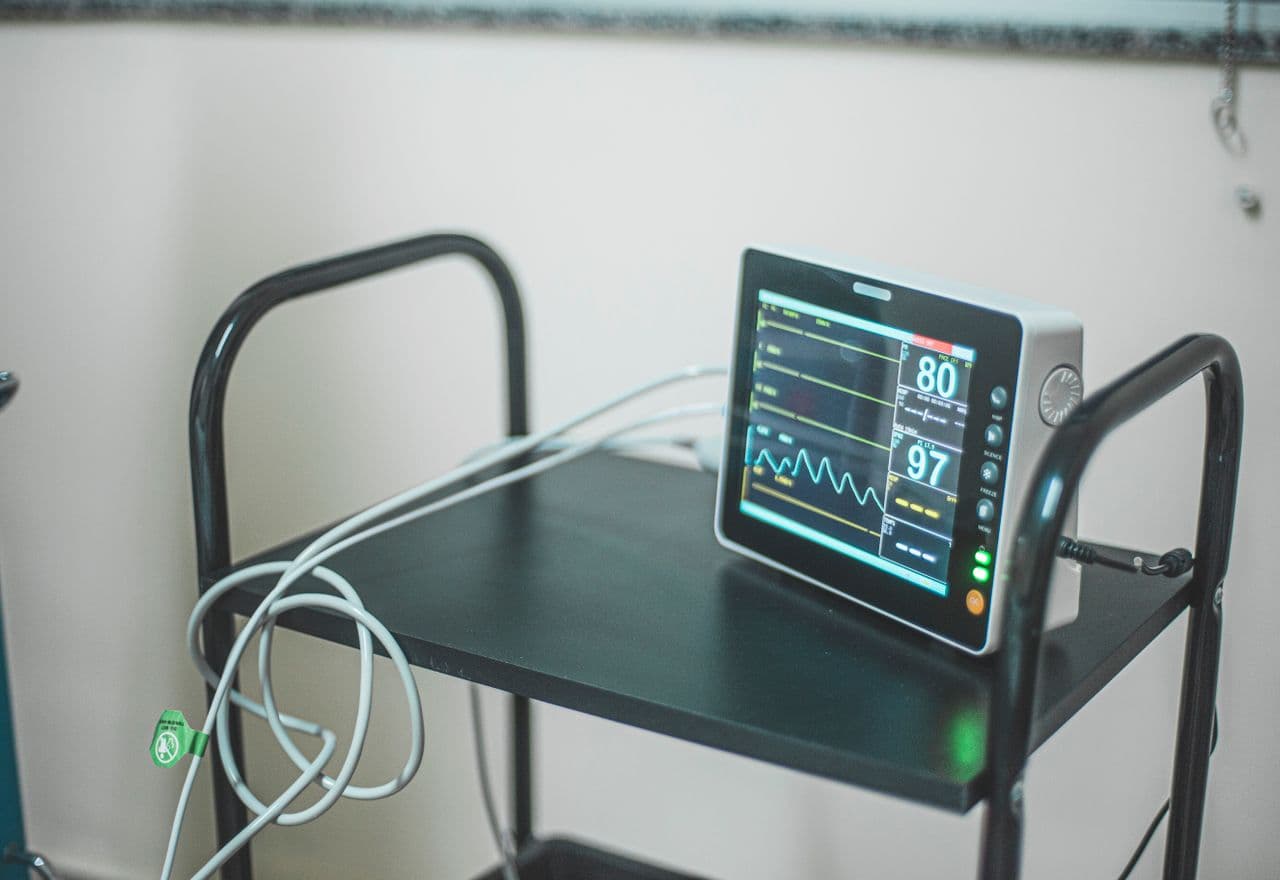
12.1-inch color TFT touch-screen multi-parameter patient monitor measuring 5-lead ECG, SpO2, NIBP, Respiration, dual Temperature, and optional dual IBP / EtCO2 with central station networking. Container consignments dispatched from Port Mundra & Port Nhava Sheva, with certificates and test reports shared with every quotation.
Made to CE MDRMade to ISO 13485Made to IEC 60601-1Made to IEC 60601-2-27MOQ: 20 units
Why is K2 EDTA preferred over K3 EDTA in hematology?
K2 EDTA is spray-dried as an anhydrous coating, preserving exact blood sample volume. K3 EDTA is dispensed as a liquid solution, which causes a 1-2% dilution of the sample and can lead to osmotic shrinkage of red blood cells, impacting MCV and hematocrit accuracy.
How does Manshav Impex maintain vacuum stability in high-temperature export markets?
We use thick-walled optical-grade PET with low gas permeability combined with ultra-dense bromobutyl rubber stoppers. Our tubes are batch-tested under simulated tropical heat (40°C) and pressure cycles to guarantee stable vacuum draw over a 24-to-36 month shelf life.
What is the recommended centrifugation protocol for your Gel & Clot Activator tubes?
Allow the sample to clot completely for 20-30 minutes at room temperature, then centrifuge at 1,300 to 2,000 x g for 10 minutes in a swing-bucket rotor. The inert thixotropic gel will form a stable barrier separating serum from the cell clot.
What needle systems are compatible with your vacuum blood collection tubes?
Our tubes are compatible with all standard multi-sample blood collection needles (20G, 21G, 22G), luer adapters, and safety blood collection sets conforming to ISO 6710 and ISO 7864.
Can you provide customized tube labels with pre-printed barcode ranges?
Yes. We offer OEM private-label manufacturing with customized paper or peelable synthetic labels, including pre-printed Code 128 or GS1 DataMatrix linear/2D barcodes tailored to your laboratory information system (LIS).
Sharmil Mangukiya (Founder & MD)
Sharmil Mangukiya is the founder and managing director of Manshav Impex, an Indian manufacturer & exporter of medical disposables serving importers, distributors, hospitals and governments in 48+ countries since 2019.