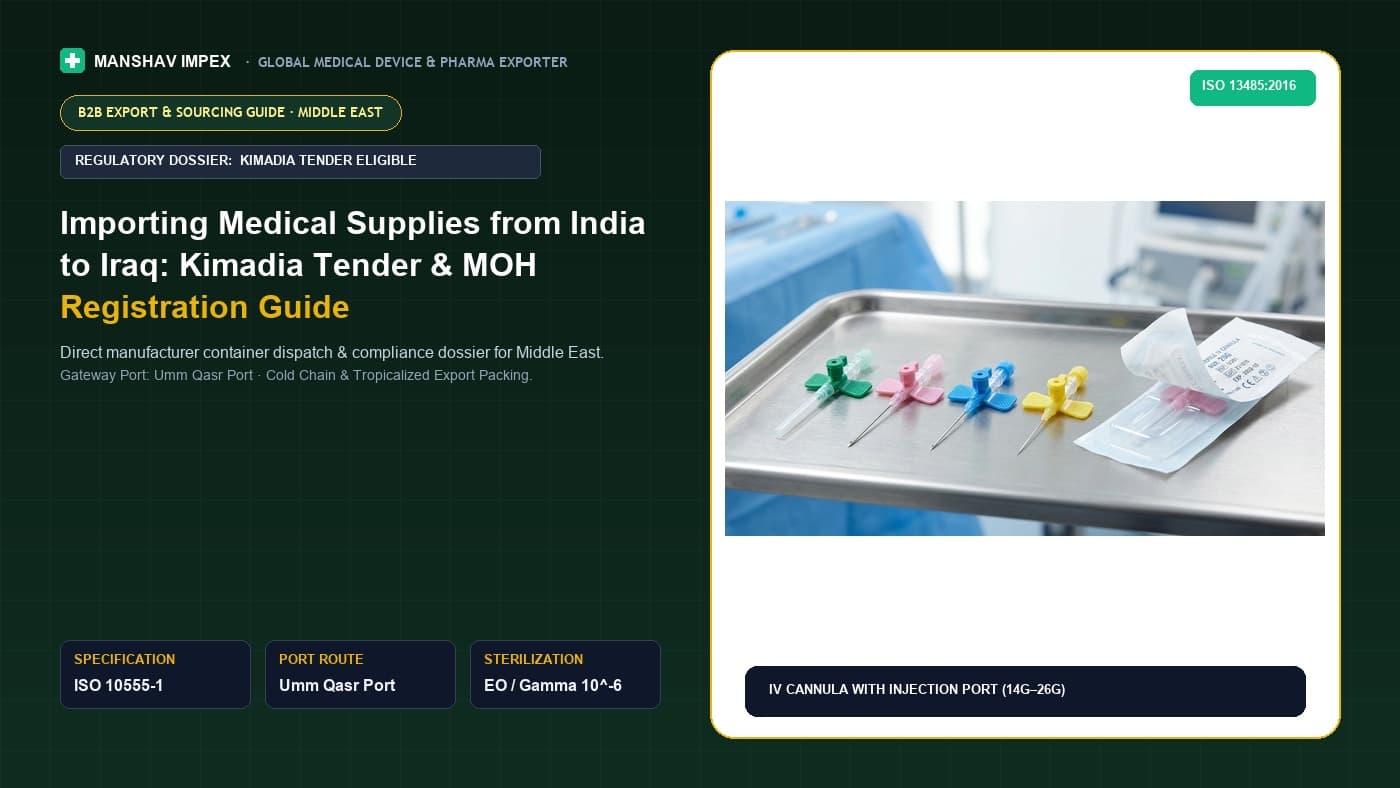
IV Cannula Supplier for Iraq: What KIMADIA Tenders Ask For, Gauge by Gauge
Most rejected cannula offers in a state tender are not rejected for price. They fall at the technical stage, because the gauge on the offer sheet does not match the gauge on the sample, a flow rate is missing, or the certificate names a different product. For an Iraqi tender agent bidding on peripheral IV cannulas, the work that decides the result happens before the envelope is sealed.
Sharmil Mangukiya (Founder & MD) 8 min read November 6, 2026
In short
A KIMADIA tender for IV cannulas is won or lost on paper: the gauge list, the flow rates, the standard on the label and a document file that matches the offer line by line. Here is what Iraqi tender bidders should prepare, and how to check a cannula supplier before naming it in a bid.
For the full specification, packing and MOQ, see our IV cannula with injection port and wings product page. This guide is written for government tender bidders in Iraq: the local agents and medical trading companies who submit offers to KIMADIA, the Ministry of Health's state company for marketing drugs and medical appliances, and to provincial health directorates. It covers what to put in front of the technical committee for standard ported, winged IV cannulas, and how to judge an IV cannula supplier for Iraq before you name it in a bid.
What does an IV cannula supplier for Iraq need to provide for a KIMADIA tender?
An IV cannula supplier for Iraq should give the bidding agent a gauge-by-gauge technical sheet, free samples of every gauge offered, and a manufacturer document file (quality system certificate, product certificates, test reports and label artwork) that matches the offer exactly. The exact list is set by each tender's own conditions and changes between rounds, so always read the current tender booklet and verify current guidance with KIMADIA and the Ministry of Health before you submit.
IV cannula gauges, colours and flow rates for the offer sheet
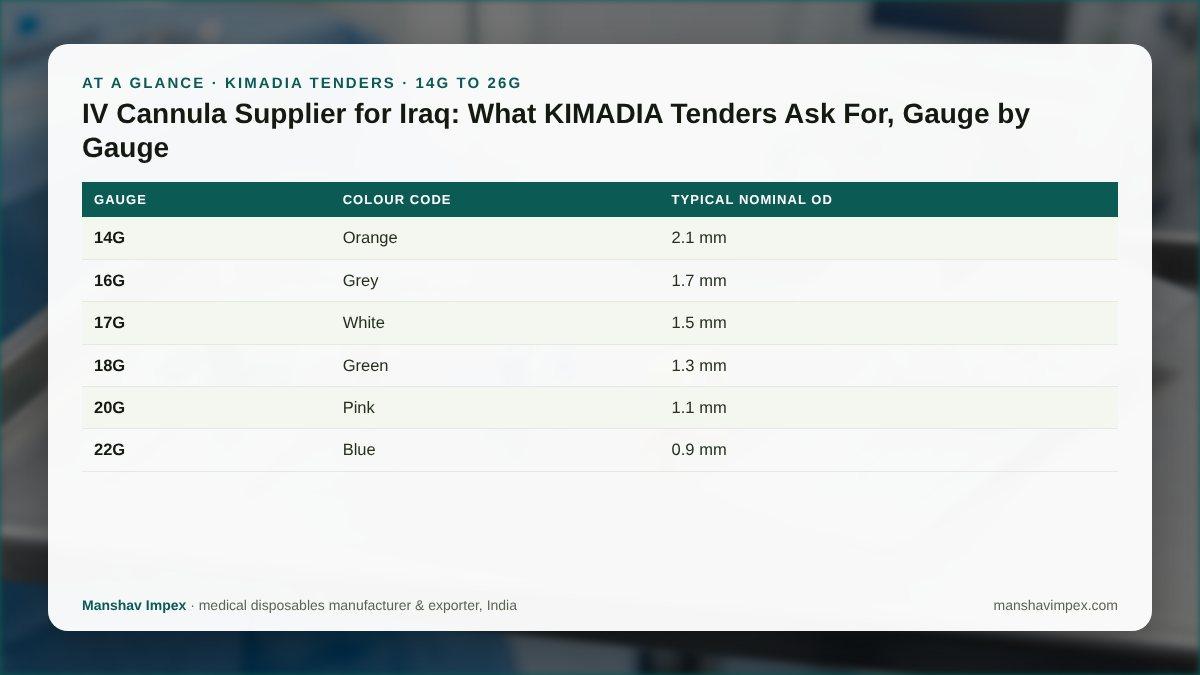
Tender line items for peripheral cannulas are almost always written per gauge, and the technical committee checks colour coding against the international scheme in ISO 10555-5. The table shows the gauges and flow rates for our cannula, with the typical nominal outer diameter that ISO 10555-5 associates with each colour. Put the same figures on your offer sheet, and ask any other supplier for theirs in the same format so the comparison is like for like.
Gauge
Colour code
Typical nominal OD
Flow rate (our spec sheet)
14G
Orange
2.1 mm
300 ml/min
16G
Grey
1.7 mm
Ask for the current test figure
17G
White
1.5 mm
Ask for the current test figure
18G
Green
1.3 mm
90 ml/min
20G
Pink
1.1 mm
61 ml/min
22G
Blue
0.9 mm
36 ml/min
24G
Yellow
0.7 mm
20 ml/min
26G
Violet
0.6 mm
Ask for the current test figure
Where a flow rate is not on our published sheet, we give the tested figure for the batch on request rather than quoting a number from memory, and you should expect the same discipline from any supplier. ISO 10555-5 lets the measured flow vary within a tolerance of the labelled value, so a bidder who copies a competitor's brochure figures can find the sample failing its own label. The 18G, 20G and 22G lines usually carry most of the volume in a ward tender, while 24G and 26G go to paediatric and neonatal units; our 24G and 26G neonatal cannula guide goes into the small sizes in detail.
IV cannula tender specifications: the features committees look for
Technical specifications in Iraqi tenders are often drafted from older brochures and can be loosely worded, for example "Teflon catheter" or "with valve". Your job as the bidder is to map each phrase to a clear, checkable answer. These are the features of our standard cannula and the wording we would use against them:
Catheter material: PTFE, FEP or PUR polyurethane, with encapsulated radio-opaque lines so the catheter shows on X-ray. State which material is offered for each gauge rather than listing all three.
Needle: Japanese back-bevelled, three-facet, siliconised needle tip for smoother skin and vein entry.
Injection port: medical-grade silicone back-check valve that allows needle-free bolus injection without disconnecting the line.
Flashback: optical flashback chamber with a hydrophobic filter, so blood confirms placement without leaking out of the back of the device.
Wings: flexible stabilisation wings for taping the cannula in place.
Sterilisation: ethylene oxide (EO), stated on each blister and box.
Standards: ISO 10555-1 and ISO 10555-5 for the device, made under an ISO 13485 quality system, with CE MDR certification.
If a tender asks specifically for a safety cannula with a passive needle shield, that is a different product with its own standard, ISO 23908 for sharps injury protection. Do not offer a standard ported cannula against that line. Our passive needle guard and ISO 10555 guide covers what that line item should be checked against.
The key checks from this guide at a glance.
Procurement note
Before you seal a bid, open one sample blister of every gauge you are offering and check three things against the offer sheet: the hub colour, the gauge and size printed on the blister, and the lot number and expiry on the box. Then photograph each one next to the matching line of your technical sheet. If the committee queries a line later, you have the evidence ready, and if anything does not match you find out while there is still time to fix it.
The document file: what to collect from the manufacturer
Iraqi tenders and Ministry of Health registration both rely on paperwork from the factory, and documents issued abroad generally need to go through attestation and legalisation before they are accepted. The sequence and the authorities involved can change, so confirm the current route with your registration agent and the Iraqi embassy before you start, because legalisation takes time that a short tender window may not allow. Our India to Iraq import and KIMADIA registration guide explains the wider process.
Document
What to check
Why the committee cares
ISO 13485 certificate
Manufacturer name and address, scope covering IV cannulas, valid date
Shows the quality system covers this product
CE MDR certificate
Product named, notified body number, validity
Most technical committees treat it as evidence of conformity
Issued for the product, attested as the tender requires
Often requested to show the product is sold legally at origin
A cannula tender rewards the bidder whose paper and samples agree with each other. The cheapest offer that contradicts its own label rarely survives the technical stage.
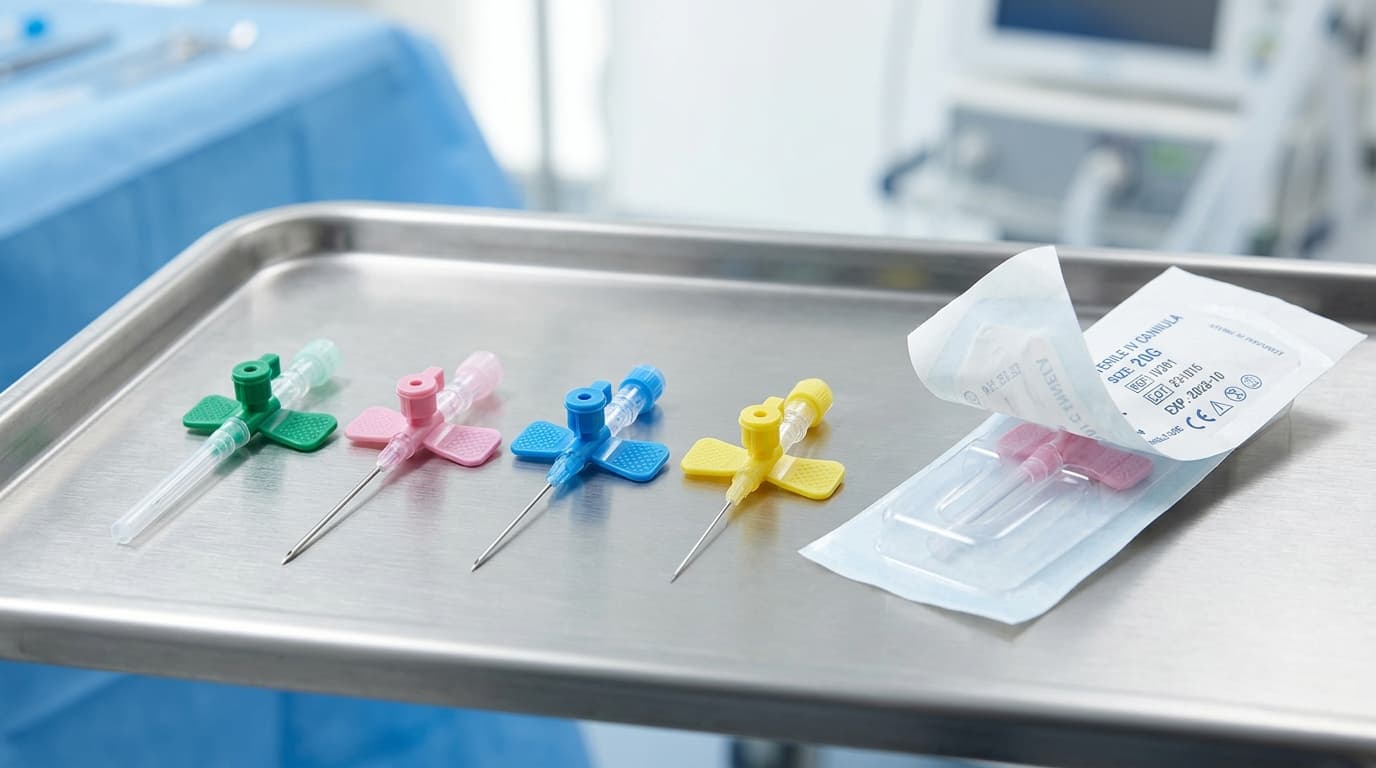
Our IV cannula with injection port and wings comes in 14G to 26G, ISO colour coded, with PTFE, FEP or PUR catheters and a back-check injection valve.
IV cannula importers in Iraq: packing, MOQ and shipping
Most IV cannula importers in Iraq work in two channels at once: state tenders through KIMADIA, and supply to private hospitals in Baghdad, Erbil and Basra through local IV cannula distributors who hold the product registration. The tender channel is slower but larger, and its lot sizes are usually quoted per gauge, so plan the packing early.
Our cannulas are packed one piece per colour-coded blister, 50 pieces per dispenser box and 20 boxes per carton, which is 1,000 pieces per carton. The minimum order is 50,000 pieces, and the current lead time is 12 to 18 days from order confirmation, before transit. If a tender asks for a quantity per gauge that is smaller than one gauge's full production lot, ask in the quotation how the minimum order can be split across gauges. For customs, IV cannulas are generally declared under HS 9018.39 (other needles, catheters and cannulae); confirm the national tariff line and any duty with your customs broker before costing the bid.
Prices move with resin, needle steel and freight, so for each tender we give a current quotation per gauge rather than a list price. When you compare offers from several suppliers, line them up on the same catheter material, the same packing, the same Incoterm to Umm Qasr or to a Baghdad warehouse, the same remaining shelf life on arrival, and the same document file. A lower price that comes without test reports for the gauges you are bidding is not a lower price once the offer is disqualified.
How to choose an IV cannula supplier for Iraq: a short checklist
Ask for the full gauge list, colour codes and tested flow rates on one sheet, and check them against ISO 10555-5.
Request free samples of every gauge you plan to offer, from a current lot, and check them against that sheet.
Check that the ISO 13485 and CE certificates name the same manufacturer and the same product as the samples.
Confirm the packing, minimum order and lead time in writing, and ask how the minimum can be split by gauge.
Agree in advance who prepares and pays for attestation and legalisation of each document, and how long it takes.
Ask for a reference shipment or a previous tender file for a Middle East buyer, if the supplier can share one.
For a wider comparison of sourcing origins, see our guide to IV cannula exporters in India and China. If you also bid for infusion sets in the same tender, our team can quote both products together so the document files match.
Send us the tender number, gauge list and quantities, and we will return a per-gauge quotation with the document list for your bid.
Sterile peripheral IV catheter with injection port, flexible stabilization wings, and radio-opaque FEP/PTFE catheter tubing, engineered for smooth atraumatic vein entry and reliable venous access. Container consignments dispatched from Port Mundra & Port Nhava Sheva, with certificates and test reports shared with every quotation.
Made to CE MDRMade to ISO 13485Made to ISO 10555-5MOQ: 50,000 pcs
KIMADIA is the Iraqi Ministry of Health's state company for marketing drugs and medical appliances. It runs central procurement of medicines and medical supplies for public hospitals, usually through tenders that foreign manufacturers enter via a local agent.
What is the colour code for IV cannula sizes?
Under ISO 10555-5: 14G orange, 16G grey, 17G white, 18G green, 20G pink, 22G blue, 24G yellow and 26G violet. Check that the hub colour on every sample matches the gauge printed on its blister.
What is the flow rate of an 18G and a 20G IV cannula?
On our spec sheet, 18G is 90 ml/min and 20G is 61 ml/min. Flow rates vary with catheter length and design, so use each supplier's tested figure for the exact product offered.
What is the HS code for IV cannula?
IV cannulas are generally classified under HS 9018.39, other needles, catheters and cannulae. Confirm the full national tariff line and any duty with your customs broker before costing an order.
What is the minimum order for IV cannulas from Manshav Impex?
The minimum order for our IV cannula is 50,000 pieces, packed 1,000 pieces per carton. For tenders, ask in the quotation how the minimum can be split across gauges.
Sharmil Mangukiya (Founder & MD)
Sharmil Mangukiya is the founder and managing director of Manshav Impex, an Indian manufacturer & exporter of medical disposables serving importers, distributors, hospitals and governments in 48+ countries since 2019.