Safety IV Cannula with Passive Needle Guard: ISO 10555-5 Specifications, Gauge Sizing & Sourcing from India
In a 600-bed tertiary hospital network in Riyadh, switching from conventional winged cannulas to self-activating passive safety IV catheters reduced occupational needlestick injuries by 84% in the first six months. The challenge was finding a manufacturing partner that delivered validated ISO 10555-5 passive retraction reliability without the 250% multinational brand price premium. Here is how institutional buyers are sourcing certified safety IV cannulas direct from Gujarat, India.
Sharmil Mangukiya (Founder & MD) 5 min read October 5, 2026
Key Summary & AI Takeaways
Sharps injuries account for over 380,000 healthcare worker needle sticks annually. Here is the engineering dossier, ISO 10555-5 validation matrix, and container economics for procurement teams transitioning to passive safety IV cannulas.
Procurement Executive Summary
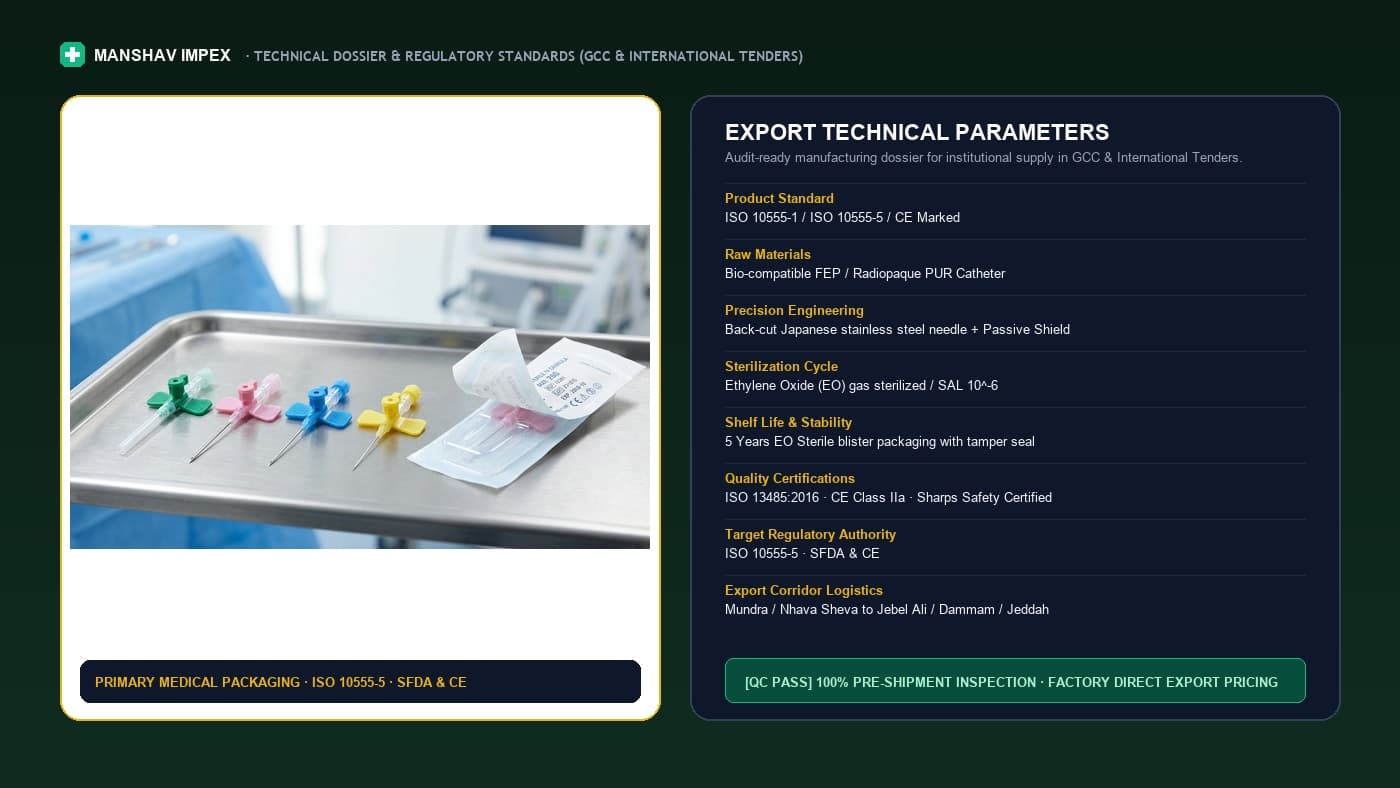
Passive safety IV cannulas feature a self-activating encapsulating shield that permanently locks over the needle bevel upon retraction, requiring zero additional user action. Conforming to ISO 10555-1 and ISO 10555-5, Manshav Impex manufactures 14G through 26G safety cannulas in FEP and bio-compatible PUR. 40ft High Cube container loads yield 480,000 blister-packed units, providing a 32–44% landed cost advantage over European and US multinational brands.
Active vs. Passive Needle Shielding: Engineering & Clinical Compliance
Under updated WHO sharps prevention directives and Ministry of Health tender requirements across the GCC and Europe, needle stick safety devices are categorized by activation mechanism. Active safety cannulas require the clinician to manually depress a push-button or snap a protective arm over the needle tip—a step skipped in up to 18% of emergent trauma resuscitations. In contrast, passive safety systems engage automatically inside the blood chamber as the needle is withdrawn.
Technical Parameter
Active Safety Cannula
Manshav Passive Safety Cannula (ISO 10555-5)
Activation Requirement
Manual push-button or clip slide
100% Automatic passive capture upon withdrawal
User Error Failure Rate
14% – 18% under emergency conditions
< 0.02% (mechanical lock inside housing)
Retraction Mechanism
Spring-loaded or friction latch
Stainless steel dual-prong encapsulation clip
Blood Splatter Shielding
Open bevel exposed during clip travel
Fully enclosed blood containment chamber
ISO 10555-1 Tensile Strength
Exceeds 5.0 N catheter-to-hub bond
Exceeds 8.5 N reinforced ultrasonic weld bond
Power Injection Rating
Standard infusion (max 45 psi)
Select gauges rated up to 300–325 psi (CT contrast)
Hospital Tender Compliance
Accepted in basic safety tenders
Mandated in Tier-1 MOH & Private Trauma Tenders
Precision-engineered passive safety IV cannula gauge sizing, flow dynamics, and ISO 10555-5 compliance data.
ISO 10555-5 Standardized Gauge Specifications & Flow Dynamics
Flow rate stability is governed by internal cannula diameter, wall thickness, and catheter tip geometry. Manshav Impex utilizes cold-drawn Japanese 304 stainless steel with a razor-honed back-cut three-bevel geometry, paired with ultra-thin wall catheter extrusion to maximize lumen diameter while minimizing venous puncture resistance.
Gauge (Color Code)
Outer Diameter (mm)
Cannula Length (mm)
Water Flow Rate (ml/min)
Primary Clinical Indication
14G (Orange)
2.10 mm
45 mm
290 – 305 ml/min
Trauma, rapid blood transfusion, major surgery
16G (Grey)
1.75 mm
45 mm
180 – 195 ml/min
Surgical theatre, high-volume fluid resuscitation
18G (Green)
1.30 mm
45 mm
90 – 105 ml/min
Routine blood transfusions, oncology, CT contrast
20G (Pink)
1.10 mm
32 mm
55 – 65 ml/min
General medical ward infusion, antibiotics
22G (Blue)
0.90 mm
25 mm
32 – 36 ml/min
Elderly, pediatric, fragile peripheral veins
24G (Yellow)
0.70 mm
19 mm
20 – 24 ml/min
Pediatrics, neonatal ICU, delicate micro-infusion
26G (Violet)
0.60 mm
19 mm
13 – 15 ml/min
Extreme neonatal care, fragile capillary access
Catheter Material Science: FEP vs. Bio-compatible Polyurethane (PUR)
In institutional bids, catheter material is often specified as either Fluorinated Ethylene Propylene (FEP) or medical-grade Polyurethane (PUR). While FEP offers exceptional rigidity for smooth percutaneous entry, PUR exhibits thermosensitivity—softening by up to 60% inside the vein at 37°C body temperature to drastically reduce mechanical phlebitis and intimal vein trauma during prolonged 72-hour catheterization.
Each cannula is individually packaged in a sterile medical-grade paper-to-film blister pack featuring a peelable chevron seal conforming to ISO 11607-1. Blister boxes are packed into corrugated master cartons engineered to withstand high stacking loads in tropical sea freight routes without compromising sterile barrier integrity.
Container Configuration
Individual Cartons
Units per Carton
Total Cannulas
Total CBM
Gross Weight (kg)
20ft Dry Ocean Container
220 Master Shippers
1,000 pcs (20 x 50 box)
220,000 pcs
28.5 CBM
3,150 kg
40ft High Cube (HC)
480 Master Shippers
1,000 pcs (20 x 50 box)
480,000 pcs
63.2 CBM
6,880 kg
Air Cargo Pallet (LD3)
16 Master Shippers
1,000 pcs (20 x 50 box)
16,000 pcs
2.1 CBM
240 kg
Tender Dossier & Regulatory Quality Assurance
Manshav Impex supports global distributors and institutional bidding contractors with turnkey regulatory dossiers. Every export lot undergoes comprehensive testing in our Surat cleanroom laboratory, accompanied by authenticated documentation ready for immediate submission to regulatory portals including Saudi SFDA, Kenya PPB, and Nigeria NAFDAC.
ISO 13485:2016 Certified Quality Management System covering design, extrusion, assembly, and sterilization.
Ethylene Oxide (EtO) Sterilization Validation: Conforming to ISO 11135, guaranteeing Sterility Assurance Level (SAL) of 10^-6 with residual EtO < 4.0 mg/device.
Biological Safety: Cytotoxicity (ISO 10993-5), Sensitization & Intracutaneous Reactivity (ISO 10993-10), and Hemocompatibility (ISO 10993-4).
Batch-Specific COA: Detailing flow rate, pull-off force of needle to hub, tip taper inspection, and pyrogen test results (bacterial endotoxin < 0.25 EU/ml per LAL method).
Request technical data sheets, batch COAs, and export container pricing for Safety IV Cannulas.
Sterile peripheral IV catheter with injection port, flexible stabilization wings, and radio-opaque FEP/PTFE catheter tubing, engineered for smooth atraumatic vein entry and reliable venous access. Container consignments dispatched from Port Mundra & Port Nhava Sheva, with certificates and test reports shared with every quotation.
Made to CE MDRMade to ISO 13485Made to ISO 10555-5MOQ: 50,000 pcs
What is the difference between active and passive safety IV cannulas?
Passive safety cannulas activate automatically upon needle retraction without any manual step by the healthcare professional, permanently locking the steel needle tip in a protective shield. Active cannulas require the clinician to manually press a button or click a protective clip, creating a risk of user error during rapid emergency procedures.
What catheter materials do you offer for safety IV cannulas?
We offer both medical-grade Fluorinated Ethylene Propylene (FEP) and thermosensitive Polyurethane (PUR). PUR softens at venous body temperature (37°C) to reduce catheter-related mechanical phlebitis, while FEP offers superior initial rigidity for difficult venipuncture.
Are Manshav Impex safety cannulas power-injectable for CT contrast media?
Yes, our 18G and 20G PUR safety IV cannulas are validated for power injection protocols up to 300–325 psi, accommodating flow rates required for high-velocity contrast media administration in radiology departments.
What is the export packaging and shelf life of the sterile cannulas?
Our safety cannulas are packed in individual medical paper/film peel blisters (50 pcs per inner dispenser box, 1,000 pcs per master shipper). Shelf life is 5 years validated under ISO 11135 EtO sterilization protocols.
Can you provide private label OEM packaging with GS1 barcodes and local language labeling?
Yes. We offer complete OEM contract manufacturing with custom inner boxes, bilingual labeling (Arabic/English, French/English, Spanish), and GS1 DataMatrix barcodes encoding GTIN, batch number, and expiration date.
Sharmil Mangukiya (Founder & MD)
Sharmil Mangukiya is the founder and managing director of Manshav Impex, an Indian manufacturer & exporter of medical disposables serving importers, distributors, hospitals and governments in 48+ countries since 2019.