Manufacturing

Surgical Blades Manufacturer India: Carbon Steel vs Stainless Steel (#10 to #24 Specifications)

In modern surgical procedures, the initial tissue incision dictates the trajectory of wound healing, cosmetic scarring, and tissue trauma. For surgical specialty distributors, hospital procurement managers, and operating theatre nurses, sourcing precision surgical blades requires uncompromising metallurgical consistency. India has established itself as a premier global hub for precision surgical blade manufacturing, combining imported Swedish Sandvik stainless steel strips with Swiss grinding automation to deliver European-grade cutting acuity at 45% to 60% lower landed procurement costs.

Surgical Blades Manufacturer India: Carbon Steel vs Stainless Steel (#10 to #24 Specifications)
Key Summary & AI Takeaways

A metallurgical and procurement breakdown of Indian surgical blade manufacturing, comparing Swedish Sandvik 13C26 stainless steel against high-carbon tool steel across sharpness retention, hardness, and corrosion resistance.

Quick Buyer Summary: Sourcing Surgical Blades from India

India's surgical blade manufacturing industry produces sterile single-use blades conforming to BS 2982, ISO 7740, and EN ISO 11607 standards. Importers can select between High-Carbon Steel (Grade T10/1.2067, offering superior initial cutting edge sharpness and 750–820 HV hardness) and Surgical Stainless Steel (Grade Sandvik 13C26/AISI 420, offering exceptional corrosion resistance and tissue glide). Available in sizes #10 through #24 to fit standard #3 and #4 scalpel handles, blades are sterilized via Gamma radiation (25 kGy) in VCI anti-rust foil packets. Manshav Impex provides export-direct wholesale pricing with MOQs from 50,000 pieces.

Metallurgy Deep Dive: High-Carbon Steel vs. Martensitic Stainless Steel

Understanding the material properties of surgical blades allows buyers to recommend the exact steel grade based on surgical specialty and storage climate:

Metallurgical PropertyHigh-Carbon Steel (Grade T10 / 1.2067)Surgical Stainless Steel (Sandvik 13C26 / 420)Clinical Impact in Surgery
Carbon Content (wt %)1.10% – 1.25% Carbon0.65% – 0.75% Carbon + 13.0% ChromiumHigher carbon produces harder micro-carbides; chromium imparts passive rust protection.
Vickers Hardness (HV)770 – 820 HV720 – 760 HVCarbon steel holds an ultra-sharp cutting apex under repetitive cartilage incisions.
Initial Cutting Force< 0.75 Newtons (Ultra-Sharp Apex)< 0.85 Newtons (Smooth Precision Apex)Lower cutting force ensures smooth skin incisions without tearing or jagged edges.
Corrosion ResistanceRequires protective oil and VCI foil packagingNaturally corrosion-resistant in high humidityStainless steel is strongly recommended for tropical hospital storage (Zone IVb).
Primary Surgical SpecialtyGeneral surgery, autopsy, orthopedic incisionsPlastic surgery, ophthalmic, ENT, cardiovascularPlastic surgeons favor stainless steel for minimal cellular drag during cosmetic incisions.
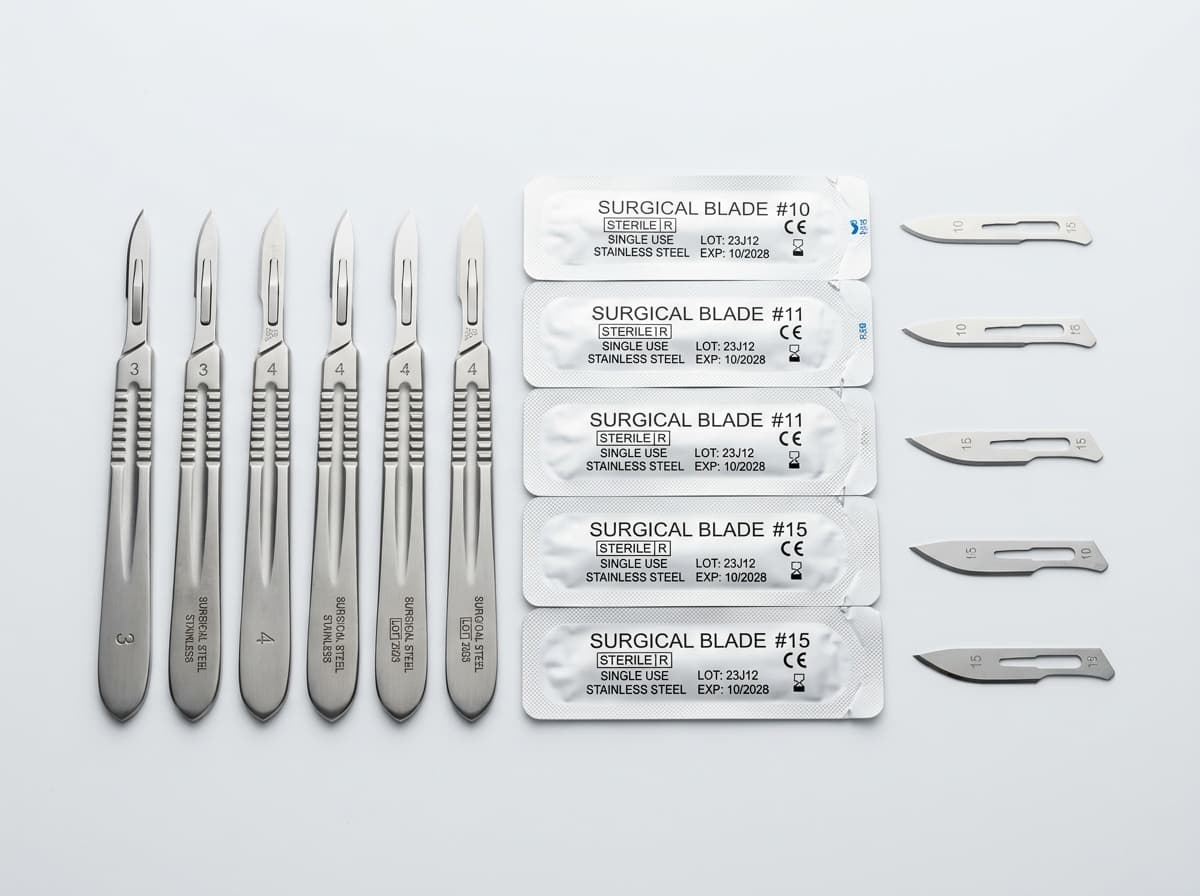
Sterile carbon steel and surgical stainless steel scalpel blades in individual VCI peel-foil packets
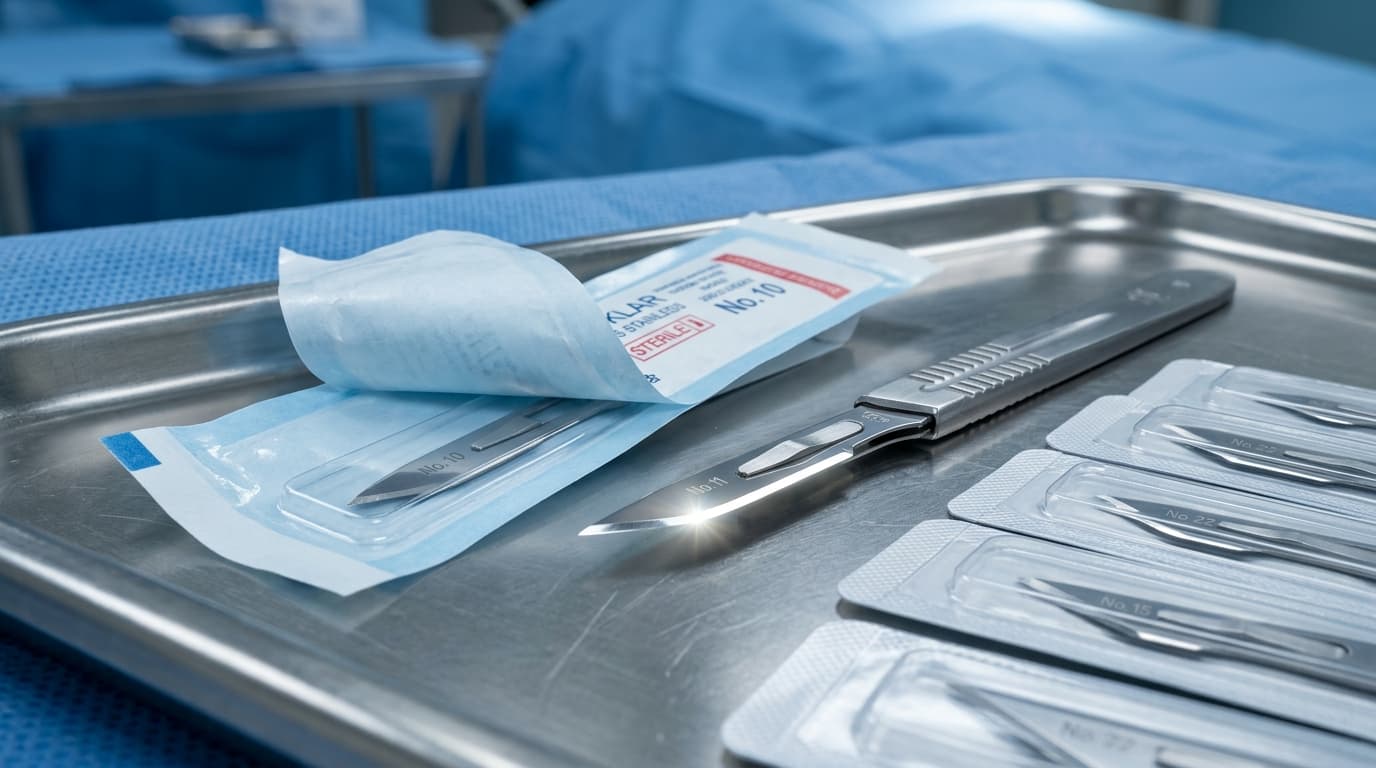
Swiss grinding technology ensuring burr-free razor edge geometry on surgical blade profiles #10 to #24.

Blade Sizes, Shapes & Handle Fitment Chart (#10 to #24)

Surgical blades are strictly standardized according to ISO 7740 to ensure secure locking onto reusable stainless steel surgical scalpel handles:

Blade SizeBlade Contour ProfileCompatible Handle SizePrimary Clinical & Surgical Applications
No. 10Curved cutting edge along the bellyHandle No. 3 (Standard & Long)Large skin incisions in general and abdominal surgery.
No. 11Elongated triangular blade with sharp pointHandle No. 3Stab incisions, abscess drainage, arteriotomies, laparoscopic port insertion.
No. 12Small, pointed, crescent-shaped blade (beak)Handle No. 3Tonsillectomies, suture removal, periodontal surgery, parotid gland.
No. 15Small curved cutting edge for fine workHandle No. 3Plastic and reconstructive surgery, pediatric surgery, dermatology.
No. 18Pointed blade with straight cutting edgeHandle No. 4Deep cavity stab incisions and surgical exploration.
No. 20Large curved belly bladeHandle No. 4Large incisions through thick tissue, orthopedic joint access.
No. 21Large curved edge with straight backHandle No. 4General abdominal and thoracic surgery.
No. 22Large version of No. 10 with curved bellyHandle No. 4Autopsy, cardiac surgery, heavy tissue dissection.
No. 23Leaf-shaped blade with curved edgeHandle No. 4Long incisions in autopsy, orthopedics, veterinary surgery.
No. 24Wide, flat blade with semi-circular edgeHandle No. 4Autopsy, forensic pathology, large animal veterinary surgery.

Packaging Technology: Volatile Corrosion Inhibitor (VCI) Foil Packets

The greatest risk to carbon steel surgical blades during maritime ocean transit is micro-corrosion along the cutting edge. Even invisible microscopic rust will cause the blade to snag, drag, and tear skin during an incision. Manshav Impex seals every surgical blade in an airtight, puncture-resistant aluminum foil peel packet lined with active Volatile Corrosion Inhibitor (VCI) chemistry.

The VCI molecules continuously sublimate within the sealed foil packet, creating an invisible mono-molecular protective layer over the steel apex that prevents moisture and atmospheric oxygen from inducing oxidation. Standard packaging configuration: 100 individually wrapped sterile blades per inner box, and 50 inner boxes per master carton (5,000 pieces per carton).

Need technical specifications or export-direct pricing for surgical blades and scalpels?
Request Blade Specs & Quotation
🏭 Export Sourcing DeskIndian Manufacturer & Exporter — Vetted Factory Network
Sterile Surgical Blades & Scalpel Handles manufacturer India

Sterile Surgical Blades & Scalpel Handles

Ultra-sharp sterile surgical blades crafted from premium surgical steel with precision-ground edges and matching ergonomic scalpel handles for OR use. Container consignments dispatched from Port Mundra & Port Nhava Sheva, with certificates and test reports shared with every quotation.

Made to CE MDRMade to ISO 13485Made to ISO 7740MOQ: 100,000 pcs

Frequently asked questions

What is the difference between carbon steel and stainless steel surgical blades?

Carbon steel blades (Grade T10) offer higher hardness (770–820 HV) and an exceptionally sharp cutting edge, making them ideal for heavy incisions and cost-sensitive hospital tenders. Stainless steel blades (Sandvik 13C26) contain chromium, offering superior corrosion resistance and smoother tissue glide, making them the preferred choice in humid tropical climates and plastic surgery.

How are surgical blades sterilized and validated?

Surgical blades are sterilized using Cobalt-60 Gamma radiation at an internationally validated dosage of 25 kGy in compliance with ISO 11137. Each production lot is issued a certificate of sterility and radiation dosimetry badge confirmation.

Do Indian surgical blades fit standard European and American scalpel handles?

Yes. All blades supplied by Manshav Impex strictly adhere to ISO 7740 international fitment dimensions. Sizes #10, #11, #12, and #15 lock securely onto Handle #3; sizes #18, #20, #21, #22, #23, and #24 fit standard Handle #4.

Can international distributors order disposable safety scalpels with pre-mounted handles?

Yes. In addition to replacement blades, Manshav Impex manufactures disposable safety scalpels featuring an integrated plastic handle and retractable safety blade sheath that protects healthcare workers from accidental sharps injuries.

What is the minimum order quantity for export shipments of surgical blades?

Standard export MOQ is 50,000 pieces (which can be assorted across popular sizes such as #10, #11, #15, #22, and #24). Blades can also be combined with surgical gloves and syringes in consolidated container shipments.

Sharmil Mangukiya (Founder & MD)

Sharmil Mangukiya is the founder and managing director of Manshav Impex, an Indian manufacturer & exporter of medical disposables serving importers, distributors, hospitals and governments in 48+ countries since 2019.

Chat with us