How to Import Medical Devices from India: A Complete Buyer's Guide (2026)
From certification to customs — the essentials every importer should verify before placing an order with an Indian medical supplier.

Freight choice can swing your landed cost and your delivery date dramatically. Here is a simple framework for choosing between sea, air and courier for medical shipments.

Balancing cost, speed and product type when choosing how to ship your order.
There is no single 'best' freight mode — only the right one for a given order. The decision comes down to three factors: volume, value and urgency.
| Factor | Sea freight | Air freight |
|---|---|---|
| Cost per unit | Lowest | High |
| Transit time | 3–6 weeks | 2–7 days |
| Best for | Bulk consumables, furniture | Urgent, high-value, low-volume |
| Volume | Full or shared containers | Smaller, dense loads |
Sea is the default for bulk disposables, hospital furniture and any large, non-urgent order. You can ship a Full Container Load (FCL) or share space with Less than Container Load (LCL). It is the most economical way to move volume, and for planned restocking the longer transit time is easy to absorb.
Air makes sense for urgent orders, high-value low-volume equipment, or when a customer deadline can't wait for ocean transit. The per-unit cost is higher, but for time-critical or compact shipments the speed often justifies it.
For samples, spare parts and small parcels, international express courier is usually faster and simpler than either freight mode — ideal for getting approval samples in front of a customer quickly.
Sea freight is far cheaper per unit and is the default for bulk consumables and furniture. Air freight costs more but delivers in days rather than weeks, making it worthwhile for urgent or high-value low-volume orders.
Typically 3–6 weeks in transit depending on the origin and destination ports, plus manufacturing lead time before dispatch.
International express courier is usually the fastest and simplest option for samples, spare parts and small parcels — often reaching the customer in a few days.
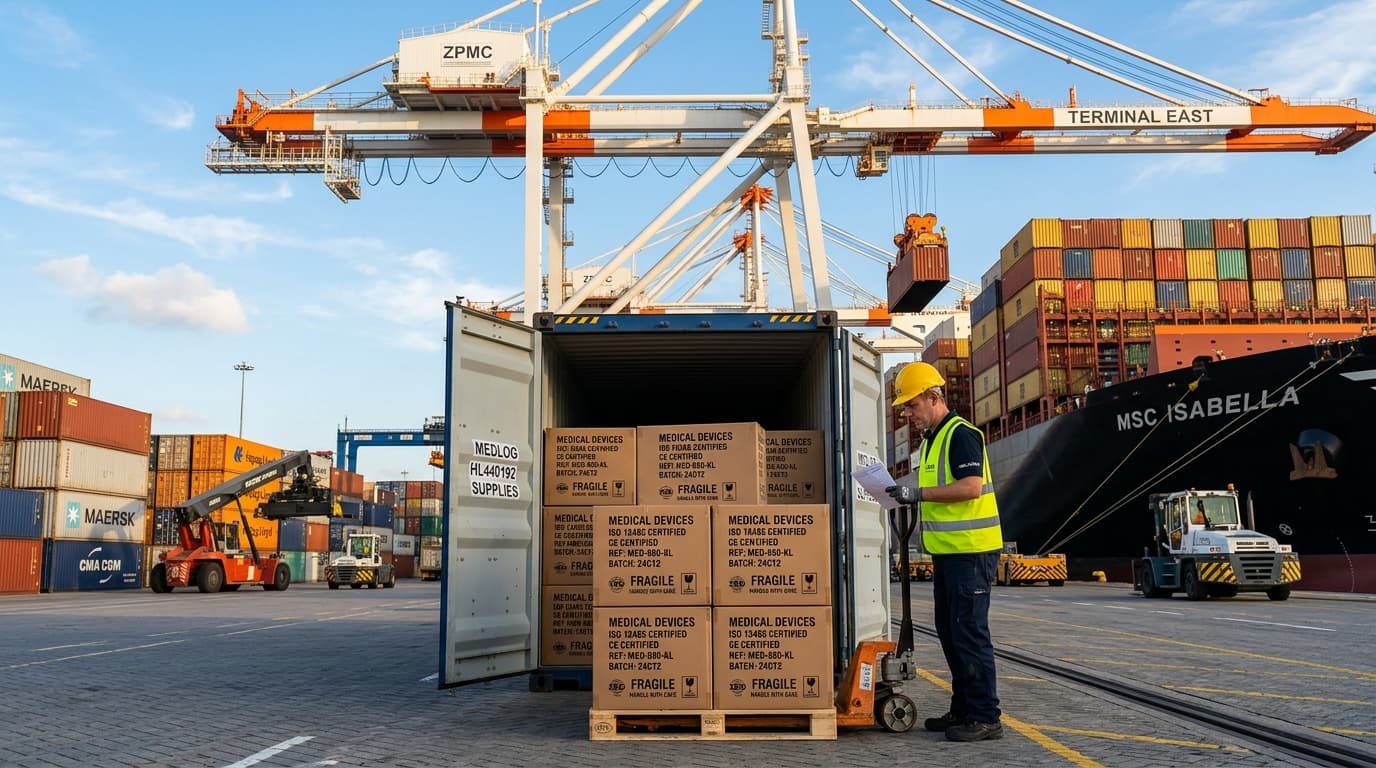
From certification to customs — the essentials every importer should verify before placing an order with an Indian medical supplier.
Invoice, packing list, COO and certificates — what each document does and why it matters.
How order volume shapes pricing — and how to plan a first import that is easy to scale.